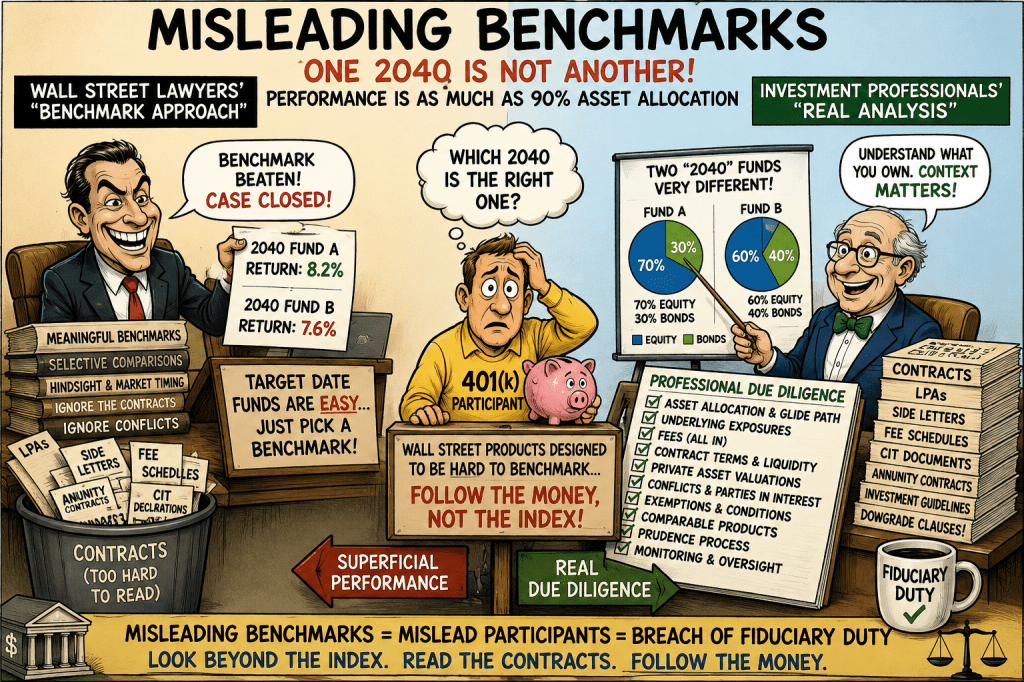
For years, ERISA litigation has increasingly revolved around two magic words:
“Meaningful benchmark.” The phrase sounds like investment science.
Too often, it isn’t. It has become a litigation construct that can distract courts from the investment question that actually matters:
Did the fiduciary prudently evaluate the investment, its risks, its costs, its contracts, its asset allocation and the reasonable alternatives available at the time?
Investment professionals don’t start with a lawyer’s search for a single magical benchmark.
They start by understanding what they actually own.
And that distinction becomes enormously important with target-date funds, annuities, private equity, private credit and increasingly complicated collective investment trusts.
The BlackRock Target-Date Cases Show What Went Wrong
Beginning in 2022, essentially parallel lawsuits challenged employers’ use of BlackRock LifePath Index target-date funds. These were low cost funds. The theory was straightforward: BlackRock’s funds underperformed several competing target-date families.
The problem was that target-date funds aren’t interchangeable. One 2040 fund might have roughly 70% in equities while another has 60%.
One may use active management. Another passive management. One may have substantially greater international exposure. Another may hold more bonds. Their glide paths can be materially different.
Those differences matter enormously because asset allocation can dominate investment results.
Comparing the raw return of Fund A against Fund B therefore doesn’t necessarily tell you whether either investment manager did a good job.
It may primarily tell you that one fund owned more stocks during a bull market. I believe that BlackRock on a fair basis outperformed in general because of lower fees.
Yet that superficial comparison became the centerpiece of numerous BlackRock lawsuits.
And courts repeatedly threw them out. Three early BlackRock cases were dismissed with prejudice, with courts rejecting comparisons based on other TDF suites, the S&P Target Date Index and even Sharpe ratios.
By 2024, a litigation survey counted eight of the original eleven BlackRock cases dismissed, with only one motion to dismiss denied and two then pending. Cisco became an especially revealing example.
Plaintiffs amended their complaint repeatedly attempting to solve the comparator problem. In March 2025, the court dismissed the third amended complaint, ending the case at the district-court level.
That’s an expensive lesson.
A bad benchmark can destroy an otherwise interesting fiduciary investigation.
A Target-Date Fund Isn’t Really One Investment
A target-date fund is better understood as an asset-allocation portfolio wrapped inside a single investment vehicle.
Suppose:
2040 Fund A
70% stocks 30% bonds
and
2040 Fund B
60% stocks 40% bonds
If stocks dramatically outperform bonds, Fund A should outperform Fund B even if Fund B’s underlying managers actually produced superior risk-adjusted investment results.
Calling Fund A’s higher return proof of superior fiduciary prudence is therefore potentially nonsense.
The correct analysis starts by decomposing the portfolio.
What percentage was allocated to equities?
What percentage to fixed income?
What percentage internationally?
What were the underlying exposures?
How did those allocations change?
What risks were being taken?
What did the underlying managers contribute after controlling for those exposures?
Only then can you intelligently discuss performance.
The DOL Has Now Effectively Acknowledged the Problem
This isn’t merely theoretical anymore.
The Department of Labor’s March 2026 proposed investment-fiduciary regulation defines a meaningful benchmark as an investment, strategy, index or comparator having similar:
mandates, strategies, objectives and risks.
Even more importantly, DOL specifically addresses target-date funds.
Its proposal explains that a fiduciary may use a custom composite benchmark blending broad market indexes according to the TDF’s actual asset allocation.
That is much closer to how an investment professional should approach the problem.
In other words:
The benchmark should follow the investment. The investment shouldn’t be squeezed into whatever benchmark makes a lawyer’s complaint work.
Market Timing Disguised as Benchmarking
There is another danger.
Select a comparator after observing which TDF performed best and you may simply be engaging in hindsight market timing.
Imagine stocks outperform bonds for five years.
A lawyer searches the TDF universe and identifies another fund with superior returns.
But suppose that “superior” fund simply maintained a substantially larger equity allocation.
The complaint effectively argues:
The fiduciary should have known five years earlier that stocks were going to outperform bonds and selected the TDF positioned to benefit from that outcome.
That’s not necessarily evidence of imprudence.
It’s hindsight.
The CMFG court identified essentially this problem, rejecting comparisons between BlackRock LifePath and TDF families having materially different investment strategies and management approaches.
Now Add Private Equity
This problem becomes far worse when Wall Street puts private assets inside target-date funds.
A hypothetical 2040 fund might contain:
55% public equities
25% bonds
10% private equity
5% private credit
5% real estate
Now find me the magical index.
There isn’t one.
Private equity doesn’t even produce a continuously observable market price comparable to publicly traded stocks.
Its reported volatility and correlations can be affected by appraisal-based valuations and infrequent marks.
So simply comparing this fund against Vanguard’s or BlackRock’s conventional 2040 fund can become economically misleading.
The DOL’s own 2026 proposal implicitly recognizes this difficulty. For an asset-allocation investment containing private equity, DOL discusses combining public-market indexes with methodologies commonly used for the private-equity component, including IRR and public-market-equivalent analysis.
That is a vastly more sophisticated exercise than:
Fund A returned 8.2%.
Fund B returned 7.6%.
Therefore Fund B was imprudent.
Annuities Expose the Absurdity Even More Clearly
The benchmark obsession becomes especially problematic with fixed annuities.
A general-account fixed annuity isn’t a bond fund. It isn’t a synthetic stable-value fund.
It isn’t a Treasury bill. It is fundamentally an insurance-company contractual promise.
The participant exchanges assets for an obligation of an insurer subject to contractual provisions governing such things as: crediting rates, withdrawals, surrender provisions, market-value adjustments, liquidity, transfer restrictions, investment guidelines, termination rights, and ultimately the insurer’s creditworthiness.
Trying to find a Bloomberg index that magically captures those contractual characteristics misses the investment. As I have argued previously:
Fixed annuities have comparables. They don’t necessarily have benchmarks.
The obvious question isn’t: What index perfectly tracks this contract?
It is: What were comparable insurers willing to pay for reasonably comparable contracts at the same time?
If Insurer A offered 2.25% and equally or more creditworthy Insurer B offered 4.25% on reasonably comparable terms, that’s economically important evidence.
You don’t need to invent an index to recognize it.
Prohibited Transactions Make the Benchmark Distraction Particularly Dangerous
This becomes even more important after Cunningham v. Cornell.
Suppose an affiliated insurer, asset manager, recordkeeper or other party in interest is involved in an investment arrangement.
The first question shouldn’t necessarily be:
Did this product underperform its benchmark?
The questions may instead include:
Who received compensation?
Was the provider a party in interest?
What transaction occurred?
What exemption supposedly permitted it?
Were the exemption’s conditions satisfied?
What did the contract actually say?
What alternatives were available?
What fees were embedded inside the structure?
Those are transaction and fiduciary-process questions.
Performance can matter enormously for damages and prudence.
But a prohibited transaction doesn’t magically become permissible because somebody finds an index that the product happened to outperform.
And Guess Which Products Are Hardest to Benchmark?
There is an uncomfortable pattern.
The products increasingly being pushed into retirement plans are precisely the products that are hardest to evaluate using conventional public-market benchmarks:
Private equity.
Private credit.
Insurance-company general accounts.
Separate-account annuities.
Lifetime-income products.
Private real estate.
Multi-asset CITs containing combinations of them.
That’s not a reason fiduciaries should receive less scrutiny.
It’s a reason they require more sophisticated scrutiny.
The Contract May Be More Important Than Morningstar
An attorney can download performance data in minutes.
Reading a 70-page insurance contract is harder.
Obtaining an LPA is harder.
Understanding a CIT declaration is harder.
Reconstructing embedded fees is harder.
Analyzing surrender provisions is harder.
Evaluating insurer credit risk is harder.
Determining whether investment guidelines actually constrain an insurer is harder.
Calculating asset-allocation-adjusted performance is harder.
And hiring somebody who understands these things costs money.
But ERISA isn’t supposed to become:
Whatever can be downloaded cheaply from Morningstar is actionable; everything requiring investment expertise gets ignored.
That turns litigation economics into fiduciary law.
The Better Plaintiff Playbook
Instead of beginning an ERISA investment case by asking “What benchmark underperformed?”, begin with the investment itself.
| Question | Superficial approach | Investment-professional approach |
| TDF performance | Compare 2040 vs. 2040 | Normalize asset allocation and glide path |
| Active management | Compare total return | Separate allocation from manager contribution |
| Private equity | Compare reported return | PME + cash flows + valuation + fees |
| Private credit | Compare yield | Credit quality + leverage + liquidity + defaults + fees |
| Fixed annuity | Find an index | Compare contemporaneous competing contracts |
| Insurance risk | Use stated return | Examine insurer credit + contract protections |
| CIT | Compare NAV | Examine underlying holdings and governing documents |
| Affiliated product | Compare performance | Start with transaction, compensation and exemption |
| Lifetime income | Compare payout | Examine guarantee, portability, liquidity and downgrade provisions |
| Fiduciary process | Look at outcome | Examine what fiduciaries actually knew and considered |
That is due diligence.
The Irony
Wall Street spent years arguing that retirement investments were too complicated to judge using simplistic comparisons.
On that point, Wall Street was often correct. But that shouldn’t produce the conclusion:
Therefore complicated products cannot be challenged. It should produce exactly the opposite conclusion:
Complicated products require complicated due diligence.
And DOL’s proposed rule makes another important point: when an investment is sufficiently complex, the fiduciary must determine whether it actually possesses the knowledge and experience necessary to evaluate it—or whether qualified investment assistance is required.
That principle should apply to litigation too.
Stop Litigating Investments Like Lawyers. Analyze Them Like Investors.
The lesson of the BlackRock target-date litigation shouldn’t be that ERISA investment cases are dead. The lesson should be that superficial performance lawsuits are bad investment analysis.
A target-date fund isn’t merely its return. An annuity isn’t merely its crediting rate.
Private equity isn’t merely its reported IRR. A CIT isn’t merely its NAV.
And an affiliated financial product isn’t cleansed of a potential prohibited transaction because somebody can produce a favorable performance chart.
The next generation of ERISA cases should move beyond the Wall Street-lawyer obsession with finding one magical “meaningful benchmark.” “the wave of BlackRock LifePath cases overwhelmingly failed, largely demonstrating the danger of comparator-driven pleading.”
Start with: the assets, the allocation, the contract, the fees, the liquidity, the credit risk, the conflicts, the parties in interest, the available alternatives, and the fiduciary’s actual decision-making process.
Then analyze performance. Because sometimes the most misleading benchmark of all is the one that makes a complicated investment look simple.
Appendix: Intel, the Eleventh Circuit and Wall Street’s “Meaningful Benchmark” Catch-22
The misleading-benchmark problem is now squarely before the Supreme Court—and a brand-new Eleventh Circuit decision shows why the Court should be very careful about turning the phrase “meaningful benchmark” into a universal pleading requirement.
In Anderson v. Intel Corporation Investment Policy Committee, the Supreme Court will decide whether an ERISA plaintiff alleging imprudent investment based on underperformance must plead a “meaningful benchmark.”
Intel participants challenged portfolios containing substantial allocations to hedge funds and private equity, alleging high fees, unusual risks and poor performance. The Ninth Circuit nevertheless affirmed dismissal because plaintiffs had not supplied sufficiently comparable benchmarks. The Supreme Court granted review in January 2026.
The Problem: Sometimes the Differences ARE the Case
On August 18, the Eleventh Circuit provided an important counterweight.
In Johnson v. Russell Investments Trust Co., involving Royal Caribbean’s replacement of Vanguard target-date funds with Russell target-date funds, the district court had demanded essentially an apples-to-apples comparator—another TDF with sufficiently similar strategy and risk characteristics.
The Eleventh Circuit rejected making that requirement dispositive.
Its key observation:
“An ERISA plaintiff need not identify an apples-to-apples comparison to establish objective imprudence in every case.”
Why?
Because the plaintiff argued that the very characteristics distinguishing the Russell funds from other TDFs were themselves what made Russell imprudent.
Requiring another investment possessing those same allegedly imprudent characteristics creates a logical trap.
That Is Exactly the Problem With Intel
Consider the Intel allegations. Suppose Intel’s portfolios really were unusual because they contained substantially more:
private equity, hedge funds, illiquid investments, high fees, and other alternative strategies.
Then requiring plaintiffs to locate another retirement portfolio with essentially the same unusual combination of risks and strategies before they can challenge Intel produces an absurd result:
The more unusual the fiduciary’s investment strategy becomes, the harder it becomes to sue the fiduciary because fewer comparable investments exist.
That turns ERISA prudence upside down.
Wall Street’s Benchmark Catch-22
The argument can become:
Step 1: Create an unusual investment.
Step 2: Add private equity, private credit, hedge funds, annuities or other difficult-to-value assets.
Step 3: Give it a bespoke asset allocation.
Step 4: Make conventional comparisons increasingly difficult.
Step 5: When participants sue, demand an investment with essentially identical characteristics.
Step 6: Argue that no “meaningful benchmark” exists.
Step 7: Dismiss the case.
That is not investment analysis.
It is potentially a complexity safe harbor.
But This Doesn’t Mean Any Benchmark Will Do
There is an important distinction.
The Eleventh Circuit isn’t saying that lawyers should be free to compare any target-date fund against any other target-date fund.
That would create the opposite problem.
As the Eleventh Circuit itself previously observed in Pizarro, “target date funds are not all created equal.” A more equity-heavy TDF will tend to outperform a conservative TDF during a strong equity market, while the relative results can reverse during a downturn.
That supports the investment-professional criticism of many TDF lawsuits.
If:
Fund A = 70% equities / 30% bonds
and
Fund B = 60% equities / 40% bonds,
and equities boom, Fund A’s higher return doesn’t prove Fund B was imprudent.
The plaintiff may simply be using hindsight to say:
The fiduciary should have known stocks were going to outperform bonds.
That’s market timing disguised as benchmarking.
Two Very Different Cases
This distinction is crucial:
| Case theory | Proper benchmark treatment |
| “Fund A was imprudent because Fund B returned more.” | Demand a genuinely meaningful comparison |
| Different TDF asset allocations | Normalize for asset allocation/glide path |
| Active vs. passive management | Separate allocation effect from manager effect |
| Private equity underperformed | PME and appropriate economic analysis |
| Fixed annuity paid too little | Contemporaneous comparable contracts may matter more than an index |
| Excessive fees | Compare services, economics and market alternatives |
| Excessive illiquidity | Analyze liquidity itself |
| Excessive private-assets allocation | Analyze the allocation and risks |
| Contract contains dangerous restrictions | Read the contract |
| Conflicted/affiliated transaction | Analyze parties, compensation and applicable exemptions |
| Strategy is itself allegedly imprudent | An identical comparator may defeat the point |
The mistake is turning “meaningful benchmark” from an analytical tool into a legal password.
Sometimes “There Is No Comparable Fund” Is Evidence Worth Investigating
Suppose a fiduciary created a 2040 TDF containing:
50% public equities
20% bonds
10% private equity
10% private credit
5% real estate
5% annuity contracts.
A court could ask:
Where is the identical 2040 fund that proves this was imprudent?
But perhaps there isn’t one.
And that might be precisely why the investment deserves greater scrutiny.
The real questions become:
Why did the fiduciary depart from conventional allocations?
What additional return was expected for the additional risk?
What liquidity was sacrificed?
What fees were added?
How were private assets valued?
What leverage existed underneath the investments?
What did the contracts say?
Were affiliates involved?
What alternatives were considered?
What happened to diversification after looking through the underlying holdings?
Those are investment questions, not simply benchmark questions.
Intel Could Determine Whether Complexity Becomes Its Own Defense
The stakes in Intel therefore extend well beyond one company’s retirement plans.
The Supreme Court essentially has three choices.
It could allow superficial comparisons, encouraging more lawsuits claiming that one TDF was imprudent merely because another TDF with a completely different asset allocation performed better.
That would be bad investment analysis.
At the other extreme, it could impose a rigid apples-to-apples benchmark requirement that makes unusual private-market and alternative-investment strategies increasingly difficult to challenge precisely because nothing sufficiently identical exists.
That could be even worse.
Or the Court could recognize the economically sensible middle ground now highlighted by the Eleventh Circuit:
A meaningful comparator may be necessary when the inference of imprudence depends upon comparative performance. But an identical comparator should not be required when the allegedly imprudent characteristics of the investment themselves are the reason no identical prudent comparator exists.
That distinction matters enormously as Wall Street pushes private equity, private credit, annuities, real estate and other opaque products deeper into 401(k) target-date funds.
Show Me What the Plan Actually Owned
The debate ultimately comes down to two approaches.
Wall Street litigation approach:
Show me your benchmark.
Investment-professional approach:
Show me what the plan actually owned.
Then examine:
asset allocation, fees, contracts, leverage, liquidity, valuation methodology, conflicts, parties in interest, alternatives and fiduciary process.
After understanding those things, determine the appropriate method for evaluating performance.
The Eleventh Circuit’s new decision gets an important part of this right:
Sometimes the characteristics making two investments different are precisely the characteristics the lawsuit should be examining.
That is the issue the Supreme Court should keep front and center in Intel.
Otherwise “meaningful benchmark” risks becoming the ultimate Wall Street Catch-22:
The stranger, more complicated and less transparent the investment, the harder it becomes to find an identical comparator—and therefore the harder it becomes to challenge.
A benchmark should help courts understand an investment.
It should not protect an investment from being understood.
Appendix: The Eleventh Circuit Just Poked a Hole in the “Meaningful Benchmark” Wall
August 20, 2026
Two days after this article was published, the Eleventh Circuit provided an important real-world example of why the judicially created “meaningful benchmark” doctrine has become too rigid.
In Johnson v. Royal Caribbean Cruises Ltd., the Eleventh Circuit reversed summary judgment for Royal Caribbean in litigation challenging its replacement of Vanguard target-date funds with Russell target-date funds. The district court had effectively demanded an “apples-to-apples” comparator sharing the Russell funds’ strategy and risk profile.
The Eleventh Circuit rejected making that an absolute requirement:
“The important point is that the law imposes no mandate that a plaintiff prove objective imprudence through apples-to-apples comparator evidence.”
That is an important sentence. The court held that comparisons can be useful evidence—but they are not the exclusive method of proving imprudence. Depending upon the circumstances, qualitative evidence, quantitative evidence, or a combination of both may establish that an investment fell outside the range of reasonable choices available to a prudent fiduciary.
Royal Caribbean Shows Why Investment Analysis Cannot Be Reduced to One Comparator
The facts illustrate the problem.
According to the Eleventh Circuit’s analysis, the Russell target-date funds had a very small client base, had lost their two largest clients to Vanguard, carried relatively high pricing, and were associated with an arrangement requiring that at least 75% of the plan’s investment offerings be Russell funds. Evidence also indicated inferior risk, return and risk-adjusted-return characteristics. The Russell funds ultimately underperformed the Vanguard funds they replaced, the American Funds that later replaced Russell, and their own composite benchmark.
An investment professional would look at all of that evidence.
Yet the increasingly lawyer-driven “meaningful benchmark” doctrine threatens to turn ERISA prudence into a search for a nearly identical investment product. That is particularly problematic with customized target-date funds, hedge funds, private equity, private credit and other alternative investments—where differences in asset allocation and strategy can always be invoked to argue that the plaintiff’s comparator isn’t sufficiently “meaningful.”
Royal Caribbean pushes back against that trap.
The Timing Could Matter for Anderson v. Intel
The decision arrives just before the Supreme Court considers Anderson v. Intel Corp. Investment Policy Committee, where the Court will address whether an ERISA plaintiff alleging imprudence based on investment performance must plead a “meaningful benchmark.” The Ninth Circuit required such a comparator even though ERISA itself contains no express “meaningful benchmark” pleading requirement.
Royal Caribbean does not decide Anderson. There is also an important procedural distinction: Royal Caribbean reached the Eleventh Circuit after summary judgment, whereas Anderson concerns what a participant must plead before obtaining discovery.
But that distinction may actually highlight the transparency problem.
If courts require participants to identify a nearly identical comparator before discovery, defendants controlling customized funds and opaque alternative investments can potentially use the uniqueness and complexity of those investments as a litigation shield:
The harder an investment is to understand and benchmark, the harder it becomes for participants to obtain the discovery necessary to determine whether it was prudent in the first place.
That would turn opacity into legal protection.
The Eleventh Circuit instead returned to a much more sensible principle: ERISA prudence is a facts-and-circumstances inquiry, not a mechanical benchmark contest.
A Possible Preview of the Supreme Court?
Royal Caribbean therefore strengthens the argument for the Supreme Court to reject a categorical meaningful-benchmark pleading rule in Anderson.
The better rule is not that benchmarks are irrelevant. They are extremely important investment tools. The problem arises when courts transform one comparator into a judicial gatekeeper to discovery.
Participants should be able to point to fees, risk, performance, asset allocation, liquidity, valuation practices, conflicts, industry analysis, fiduciary process and other relevant evidence—and then obtain discovery into what the fiduciaries actually knew and did.
That is especially important as Wall Street pushes increasingly opaque private-market investments into 401(k) plans.
A benchmark should be evidence. It should not be a secrecy shield.
And the Eleventh Circuit has now given the Supreme Court one more reason to say so.
Sources: Eleventh Circuit, Johnson v. Russell Investment Management, LLC/Royal Caribbean Cruises Ltd., No. 25-10692 (Aug. 17, 2026); PLANSPONSOR, “11th Circuit Revives ERISA Suit Over Royal Caribbean Retirement Plan Investments”; NAPA, “Eleventh Circuit: ERISA Plaintiffs Don’t Always Need a Meaningful Benchmark”.
https://commonsense401kproject.com/2026/08/14/sec-mutual-fund-standards-are-slipping-but-not-fast-enough-for-private-equity-which-is-turni https://commonsense401kproject.com/2026/08/11/who-regulates-your-401k-cit-blackrock-goldman-prudential-and-lincoln-lead-back-to-las-vegas/

