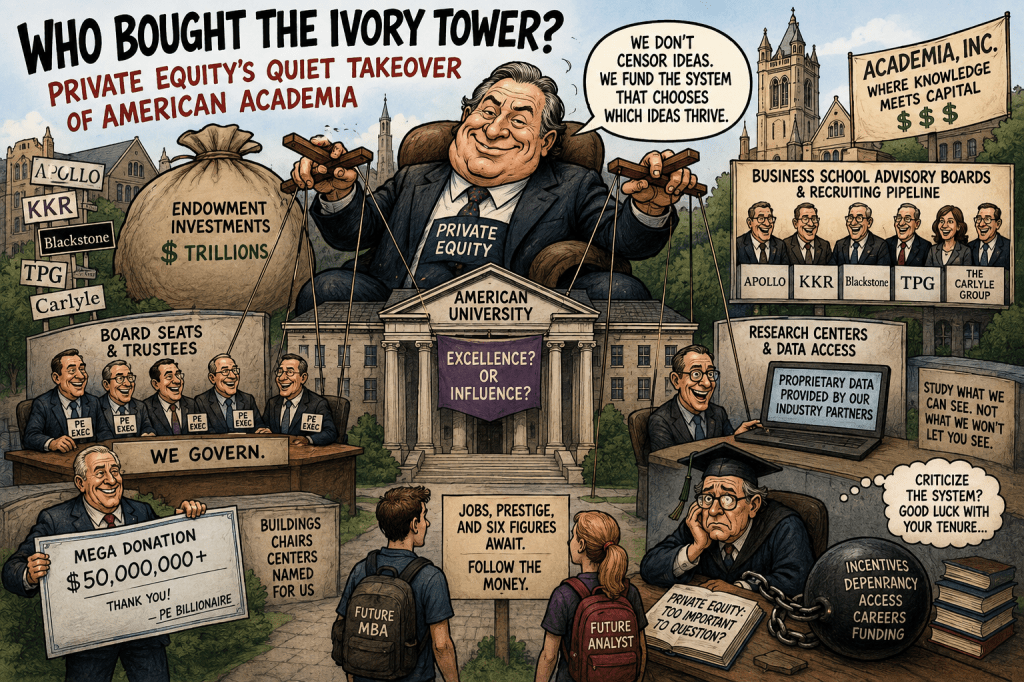
Private equity doesn’t need to censor professors. It has something better: billions in endowment money, billionaire donors, university trustees, business-school influence, proprietary research data—and jobs everyone wants.
Private equity has figured out American academia. I dig deep into the Sports end at https://commonsense401kproject.com/2026/08/18/want-a-national-championship-rent-a-billionaire/
You don’t have to control what professors say if you can help control the economic ecosystem in which they say it.
America’s universities have spent decades pouring endowment and pension money into private equity. Then the relationship metastasized.
Private-equity billionaires became: Trustees. Mega-donors. Investment-committee members. Business-school advisers. Sponsors of research centers. Gatekeepers to proprietary data. Employers of the students universities desperately want placed in lucrative jobs.
Nobody has to tell the professor:
Don’t criticize private equity.
The university’s financial structure delivers the message.
Marc Rowan: When the Donor Starts Acting Like the Boss
Apollo CEO Marc Rowan provides an extraordinary case study.
Rowan isn’t merely a Penn alumnus. He gave $50 million to Wharton and chairs Wharton’s Board of Advisors.
Then came the Gaza controversy.
Rowan urged Penn alumni to “close their checkbooks” and became a major force pushing for changes at Penn. Faculty and the AAUP warned that donor pressure was crossing the line into academic freedom and shared governance.
Whatever one’s views about Gaza, Israel, antisemitism or the campus protests, consider the power relationship.
A billionaire threatens the money.
The university listens. That’s not how academic freedom is supposed to work.
And Rowan isn’t simply any billionaire. He runs Apollo, one of the world’s most powerful alternative-investment companies.
Then Professors Took On Apollo
The story became even more extraordinary in 2026.
The AFT and AAUP demanded an SEC investigation of Apollo concerning disclosures about contacts between Jeffrey Epstein and Apollo executives including Rowan and Leon Black.
Rowan wasn’t merely demanding that Penn fight antisemitism. After helping lead the donor revolt that toppled Penn’s president, the Apollo CEO circulated questions asking whether trustees should close academic departments, change faculty qualifications, alter instruction and discipline faculty over viewpoints. Penn’s AAUP chapter called it what private-equity professionals themselves would recognize immediately: a “hostile takeover” of the university’s core operations.
And the takeover attempt came amid an escalating battle over Israel and Gaza. Penn faculty said colleagues criticizing Israeli government policy were subjected to systematic harassment, while administrators restricted Palestine-related teach-ins, protests and educational events. National AAUP specifically warned that criticism of Israel was being conflated with antisemitism.
That’s where Rowan’s private-equity background becomes relevant. Apollo’s CEO wasn’t behaving like an ordinary alumnus writing an angry letter. He was behaving like an activist owner: change management, change governance, examine the workforce, reconsider underperforming departments and impose new operating rules. The problem is that a university isn’t an Apollo portfolio company—and professors aren’t employees of Marc Rowan.
There’s an even stronger national example that would broaden this beyond Rowan. Just this month, the Guardian reported that the University of Minnesota paid historian Raz Segal $250,000 after withdrawing its offer for him to lead its Center for Holocaust and Genocide Studies. Segal had called Israel’s Gaza campaign a “textbook case of genocide.” Public-record emails showed donor pressure, including warnings that pledges and fundraising could disappear if his appointment went ahead. The university settlement did not admit wrongdoing.
Director of the Center for Holocaust and Genocide Studies Center for Jewish Studies, warned a university official that the Jewish Community Relations Council (JCRC) of Minnesota and the Dakotas, a group that claims to represent “the public affairs voice of the Jewish community”, was planning to coordinate a “volley” of donor objections, Marion Rarick, a Republican
The irony is difficult to miss. American academics increasingly find their freedom dependent upon institutions whose donors, trustees and pension systems are deeply intertwined with private capital. At Minnesota, organized donor pressure helped derail the appointment of a Jewish Israeli genocide scholar who criticized Israel’s conduct in Gaza. At the same time, Minnesota teachers themselves supply billions of dollars to the private-market industry through a pension portfolio allocating more than one-fifth of its assets to private markets. The professors supply the capital. Wall Street collects the fees. Donors gain influence. And the professor who says the wrong thing can discover just how fragile academic independence really is.
https://nypost.com/2024/08/10/us-news/teachers-minn-pension-fund-under-tim-walz-cooking-the-books-by-vastly-underreporting-madoff-miracle/ https://commonsense401kproject.com/2026/04/17/apollo-divestment-case-for-jeffrey-epstein-ties-stronger-after-wyden-letter/
AAUP says its members’ retirement systems have at least $27.5 billion committed to Apollo.
Read that twice. Professors’ retirement money helps capitalize Apollo.
Apollo collects fees and profits. Those profits help create enormous personal fortunes.
Those fortunes create mega-donors.
Those mega-donors gain extraordinary access to universities.
And then the professors’ own union finds itself asking federal regulators to investigate the company.
Academia isn’t merely under private equity’s thumb.
In many cases, academia is helping finance the thumb.
Look Who Is Sitting in the Boardroom
Rowan isn’t some bizarre exception.
Private-equity and private-capital executives are scattered throughout the governance structure of America’s elite universities.
| University | PE/private-capital figure | University role | Financial connection |
| Penn/Wharton | Marc Rowan | Chair, Wharton Board of Advisors | Apollo |
| Stanford | José Feliciano | Trustee | Clearlake Capital |
| Stanford | James Coulter | Trustee | TPG |
| Columbia | Alisa Amarosa Wood | Trustee | KKR |
| Columbia | Jonathan Lavine | Former trustee/chair | Bain Capital |
| NYU | Joseph Landy | Trustee | Warburg Pincus |
| NYU | Gregorio Napoleone | Trustee | Stirling Square |
| NYU | Luiz Fraga | Trustee | Gávea |
| Northwestern | Du Chai | Trustee | Horsley Bridge |
| Northwestern | J. Landis Martin | Former board chair | Platte River Equity |
| Harvard | David Rubenstein | Former Corporation member | Carlyle |
| MIT | Joseph Broshy | Corporation member | Healthcare PE |
These aren’t struggling community colleges looking for somebody to write a $50,000 check.
These are institutions that help determine who becomes America’s economists, financiers, regulators, journalists and political leaders.
And this is only a preliminary list.
Private equity didn’t just get a seat at the table.
It increasingly helps populate the table.
The Business Schools Can Look Like PE Farm Teams
University boards are only the beginning.
Northwestern Kellogg has maintained a Private Equity Advisory Council populated by executives associated with Blackstone, Warburg Pincus, Thoma Bravo, Ares, Partners Group, HIG, Riverside and other private-market firms.
Other elite business schools have built similarly intimate relationships with private capital.
There’s an obvious justification.
Students want private-equity jobs.
Schools want their students to get those jobs.
PE firms want access to elite graduates.
Successful graduates become wealthy alumni.
Wealthy alumni become donors.
Donors become trustees.
Trustees help govern universities.
It’s a beautiful circle.
For private equity.
The obvious question is where the counterweight is.
Where is the Private Equity Skeptics Advisory Council?
Where are the institutional seats for people examining whether PE’s fees, leverage, valuations and claimed diversification benefits actually hold up?
Apparently those aren’t quite as useful for MBA placement statistics.
Even the Academic Data Can Come Through the Industry
This problem gets deeper.
Researchers studying Microsoft don’t need Bill Gates to give them Microsoft’s stock price.
Private equity is different.
Its funds are private.
Its underlying companies are private.
Its contracts are private.
Its valuations are largely private.
Its fees can be extraordinarily difficult for outsiders to reconstruct.
Academic researchers therefore often depend upon proprietary databases and cooperation from institutional investors and industry participants.
UNC’s Private Equity Research Consortium, for example, has described itself as a collaboration between academics and industry professionals and historically facilitated researcher access to Burgiss private-equity data.
Important academic PE research has been produced from institutional datasets like these.
That doesn’t make the research wrong.
But academia ought to recognize the obvious problem:
If the industry controls much of the information, the industry possesses enormous power over the research agenda.
Researchers can investigate the data they can obtain.
The secrets stay secret.
Where Were America’s PE Critics?
For years, Jeffrey Hooke at Johns Hopkins seemed remarkably lonely.
Hooke repeatedly challenged private-equity performance claims, enormous fees and institutional investors’ fascination with alternatives.
Oxford’s Ludovic Phalippou became another major critic.
Notice something?
Oxford.
Not Harvard.
Not Wharton.
Not Stanford.
Not Columbia.
Not Chicago.
That doesn’t prove American professors were silenced.
It raises a better question:
Why did an industry controlling trillions of dollars generate so little sustained criticism from the American academic institutions sitting closest to Wall Street?
Only recently has the academic opposition begun getting louder.
Scholars including Jill Fisch Clayton and Elisabeth de Fontenay have challenged the rush to put private equity into ordinary workers’ 401(k)s.
Others are questioning private credit, valuations, fees and the supposed diversification miracle of private assets.
Good.
But where was this skepticism when institutional investors were shoveling trillions into the industry?
Nobody Needs to Bribe the Professor
This is where defenders of the system will deliberately misunderstand the argument.
They’ll say:
“Show me the professor Marc Rowan paid to change a research paper.”
That’s not how sophisticated institutional capture works.
Imagine you’re a 35-year-old finance professor.
Your university endowment has billions in alternatives.
PE billionaires sit on the university board.
PE executives donate enormous sums.
Your business school wants relationships with Apollo, KKR, Blackstone and Carlyle.
Your students desperately want jobs at those firms.
Your research may depend on private-market data.
Your dean wants successful alumni.
And those successful PE alumni may someday write eight-figure checks to the university.
Now choose your research agenda:
“Private Equity Improves Portfolio Diversification.”
or
“Private Equity Returns Are Inflated by Leverage, Valuation Smoothing, Bad Benchmarks and Hidden Fees.”
Nobody needs to threaten you.
Nobody needs to buy you.
Nobody needs to censor you.
You can read the room.
Universities Police $25,000 Conflicts While Ignoring $50 Million Ones
This may be academia’s greatest hypocrisy.
Universities obsess over professors’ conflicts.
Take a modest corporate research grant and disclosure rules appear.
Consult for an outside company and forms must be completed.
Own shares in a company you’re researching and everybody properly worries about independence.
But what happens when the conflict moves upstairs?
A billionaire gives $50 million.
His industry manages university assets.
Executives from the industry sit on boards and advisory councils.
The business school cultivates their companies.
The industry’s databases support academic research.
Apparently that isn’t a conflict.
That’s philanthropy.
Private Equity Doesn’t Need to Own the University
It has developed something more efficient.
Private equity can simultaneously be:
The university’s investment manager.
The university’s investment.
The university’s donor.
The university’s trustee.
The business school’s adviser.
The student’s dream employer.
The researcher’s data source.
And increasingly:
A political force demanding changes in university governance.
Every individual relationship can be defended.
Put them together and you get something that starts looking remarkably like institutional capture.
The AAUP-Apollo Fight Exposes the Whole System
That is what makes the AAUP confrontation with Apollo so important.
The organization devoted to defending professors’ academic freedom is challenging a company whose CEO is simultaneously one of America’s most powerful university donors.
Meanwhile, the professors’ own retirement savings help provide billions of dollars of capital to Apollo.
You could hardly design a better illustration of the problem.
Academia didn’t wake up one morning and discover private equity had taken over.
Academia sold it the keys.
First came the endowment investments.
Then the private-equity managers.
Then the billionaire donations.
Then the trustees.
Then the advisory councils.
Then the research relationships.
Then the political influence.
Now universities are discovering something they should have learned long ago:
When somebody supplies enough of the money, eventually they expect a say.
Private equity loves to preach accountability when it buys a company.
Perhaps America’s universities should try some on their own campuses.
Disclose the PE trustees.
Disclose the PE donations.
Disclose the PE managers.
Disclose the research relationships.
Disclose the proprietary-data arrangements.
And most importantly:
Stop pretending a $50 million donor presents less of an academic conflict than a professor with a $25,000 consulting contract.
Private equity didn’t have to buy the Ivory Tower.
Academia put itself up for sale.

