Private Equity, NIL and Public Pensions Are Turning College Sports Into the Billionaires’ Fantasy League
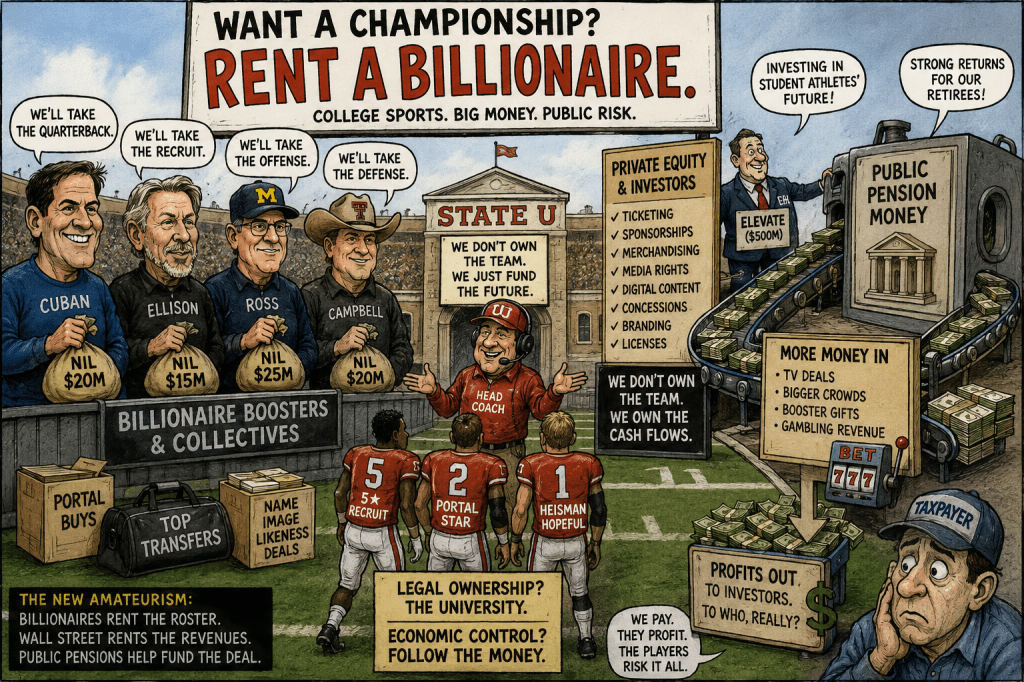
For more than a century, college sports had a fairly simple hierarchy.
Alabama was Alabama. Ohio State was Ohio State. Michigan was Michigan.
And Indiana football was Indiana football.
Then college sports discovered something more powerful than tradition:
Money that can buy a roster.
Indiana may be the perfect case study.
Mark Cuban had never been a major Indiana athletics donor. Then Curt Cignetti arrived, started winning, and convinced Cuban that additional money could make a difference.
When Indiana needed more money to land quarterback Fernando Mendoza from Cal, Cuban says athletic director Scott Dolson told him what was needed.
Cuban essentially said:
I’ll put up the money.
Mendoza reportedly went from about $1.6 million at Cal to $2.6 million at Indiana. He won the Heisman Trophy. Indiana went undefeated and won the national championship. Mendoza then became the first pick in the NFL draft.
Cuban subsequently put in more money.
That’s not old-fashioned alumni philanthropy.
That’s something much closer to renting a football team.
You Don’t Have to Own the University
Suppose you’re worth $10 billion.
You can’t buy Indiana University.
You can’t buy Michigan.
You can’t buy Oregon.
But you don’t need to.
If the university and television contracts already pay for the stadium, athletic department, coaches and infrastructure, you only need to provide the marginal dollars that separate an average roster from a championship roster.
That number suddenly looks surprisingly affordable.
A recent survey found the average Power-conference football roster now costs more than $20 million. Miami was reportedly above $40 million, while many schools supplement their revenue-sharing money with another $3 million to $5 million from booster-funded NIL collectives.
For a billionaire, that’s pocket change.
Spend $20 million a year for three years and you’ve spent $60 million.
For someone worth $10 billion, that’s 0.6% of his fortune.
An NFL franchise might cost $8 billion.
A college football fantasy team might cost $20 million a year.
Which sounds like more fun?
Indiana Is Not an Outlier
Look around college sports.
Phil Knight and Oregon.
Larry Ellison and Stephen Ross at Michigan.
Cody Campbell at Texas Tech.
Ryan Smith and the BYU basketball ecosystem.
Tilman Fertitta at Houston.
The Tyson and Jones families at Arkansas.
David Booth at Kansas.
Mat and Justin Ishbia at Michigan State.
Paul Tudor Jones at Virginia.
Anthony Pritzker at UCLA.
David Rubenstein and the private-money ecosystem surrounding Duke.
These aren’t boosters buying everyone a steak dinner after the game.
Some are billionaires whose financial resources rival the annual budgets of the universities themselves.
And the new rules allow that wealth to get much closer to the playing field.
Mark Cuban Accidentally Explained the Whole Thing
Cuban has compared the new college-football environment to an NBA salary cap.
He’s right.
But there’s one enormous difference.
The Dallas Mavericks have an owner.
Indiana University doesn’t.
Theoretically.
Yet if one billionaire supplies enough incremental capital to determine which quarterback Indiana can afford, how many transfer-portal players the coach can recruit and how competitive the roster becomes, we should at least ask:
What does ownership really mean?
Cuban doesn’t hire the coach.
He doesn’t own Indiana Athletics.
He doesn’t tell the quarterback which play to run.
That’s important.
But economic control doesn’t always require legal ownership.
If your money makes possible a roster that otherwise couldn’t be purchased, you’ve acquired something extremely valuable:
influence over competitive outcomes.
College Basketball Is Even Easier to Rent
Football requires dozens of expensive players.
Basketball requires five starters.
Kentucky reportedly spent around $22 million constructing its 2025-26 roster, and reports suggested another $20-million-plus roster could follow.
Think about that.
A billionaire doesn’t need to donate $500 million to build a medical school.
He can spend $20 million on basketball players.
For two years.
Maybe win a championship.
Sit courtside.
Become the most popular alumnus on campus.
And move on.
That looks remarkably like renting a professional franchise—without paying the franchise acquisition price.
Now Private Equity Has Discovered the Other Half of the Business
The billionaires can finance the players.
Private capital can monetize everything surrounding them.
The University of Utah has already crossed the line.
Utah created a for-profit company with Otro Capital that manages revenue-producing activities including events, branding, licensing, sponsorships, ticketing and digital media.
Otro gets a percentage of the resulting revenue.
Utah still owns the facilities and controls coaches, recruiting and athletes.
That’s precisely why the structure is so fascinating.
Otro doesn’t have to own the Utah Utes.
It gets access to the economics surrounding the Utes.
The original transaction contemplated potentially hundreds of millions of dollars of outside capital, with reports putting the broader potential commitment as high as $500 million.
This is the private-equity version of renting the team.
Then the Big 12 Called Wall Street
The Big 12 subsequently approved a five-year partnership with RedBird Capital Partners and Weatherford Capital.
The conference gets a $12.5 million capital infusion and commercial-development assistance.
Individual schools can obtain up to $30 million apiece through an optional credit facility.
Importantly, RedBird doesn’t own the conference, its revenues or its governance.
Again:
Why own the team when contracts can give you access to its economics?
As of May, no Big 12 school had publicly confirmed taking the $30 million credit offer.
That restraint may not last forever.
And Guess Who Else Has Discovered College Sports?
Public money.
Elevate launched a $500 million Collegiate Investment Initiative backed initially by Velocity Capital Management and the Texas Permanent School Fund Corporation.
Its purpose is to provide capital for revenue-generating college athletic projects.
Read that again.
A public institutional investment fund is helping capitalize a platform designed to monetize college athletics.
Meanwhile, the Big Ten considered something even larger.
UC Investments—connected to the University of California retirement and investment system—proposed putting $2.4 billion into a new Big Ten commercial entity in exchange for a 10% interest in Big Ten Enterprises, which would house media-rights and sponsorship economics.
Michigan and USC opposed the transaction and the proposal was paused.
But the significance isn’t whether that particular deal ultimately closes.
The wall has already been breached.
Follow the Circular Money Trail
Here’s where college sports starts looking a lot like the rest of modern finance.
Public/institutional money
↓
Private-equity and investment managers
↓
Billionaire fortunes
↓
College boosters and private-capital vehicles
↓
Players, coaches and athletic departments
↓
Winning
↓
Tickets, television, sponsorships and gambling
↓
More valuable college-sports cash flows
↓
Private investment returns
↓
Back to institutional investors
This isn’t the college-sports business most alumni think they’re watching on Saturday afternoon.
Then Add Gambling
This is where regulators should start paying attention.
College games are no longer merely contests between students representing universities.
They are events surrounded by enormous amounts of legal gambling.
And roster information moves betting markets.
A quarterback transfer matters.
An injury matters.
A player’s compensation dispute matters.
A billionaire deciding whether to finance another transfer matters.
If private investors, billionaire boosters, commercial partners, data companies and sportsbooks increasingly surround the same teams, the question isn’t whether any particular participant is doing something improper.
The question is:
Who is watching the conflicts?
The Public-University Problem
The issue gets stranger when the team belongs to a public university.
The taxpayers effectively own the institution.
Students pay tuition.
Fans buy tickets.
Donors finance facilities.
Television networks finance conferences.
Billionaires finance players.
Private capital can finance commercial operations.
And public investment pools can potentially provide capital to the investors.
Who exactly is the principal?
And who is the agent?
That is a governance structure begging for conflicts.
The Billionaire Fantasy League
Maybe we need to stop pretending this is still traditional amateur college athletics.
College football and basketball are evolving toward something genuinely new:
The Billionaire Fantasy League.
Pick your alma mater.
Hire a great coach.
Put $20 million into the roster.
Buy a quarterback.
Bring in transfers.
See if you can win the championship.
If it works, put in another $20 million next year.
Cuban’s experience is almost a perfect demonstration.
Indiana needed a quarterback.
The athletic director had one in mind.
There was a funding gap.
A billionaire wrote the check.
The quarterback won the Heisman.
Indiana won the national championship.
Cuban put in more money.
That may be the greatest booster return on investment in college-football history.
The Next Great College Rivalry May Be Billionaire vs. Billionaire
Michigan–Ohio State used to be about recruiting, coaching and tradition.
Increasingly it is also about:
Whose alumni have more money? Larry Ellison or Les Wexner?
Whose collective can raise more?
Whose billionaire wants to play?
Whose private-capital partners can generate more revenue?
And whose university is willing to mortgage more of tomorrow’s sports economics to win today?
That last question should concern university trustees.
Because billionaires can walk away.
Players graduate.
Coaches leave.
Private-equity contracts don’t necessarily disappear.
Debt doesn’t disappear.
And revenue-sharing obligations don’t disappear.
The Most Dangerous Sentence in College Sports
It may eventually be:
“We have to do it because everyone else is doing it.”
That’s how arms races work.
Indiana proves that money can rapidly change the competitive hierarchy.
Utah proves private capital can get directly inside the commercial structure of a public university’s athletics operation.
The Big 12 proves conferences will turn to private capital when they can’t keep up with richer competitors.
And the Texas Permanent School Fund and proposed UC/Big Ten transaction show institutional public money can wind up on the investor side of the equation.
College sports isn’t simply being professionalized.
It is being financialized.
The universities may still own the jerseys.
The fans may still sing the fight songs.
But increasingly, somebody else may be financing the players, somebody else financing the athletic department, and somebody else owning a contractual claim on the money those players and fans generate.
Private equity doesn’t have to buy your college football team.
A billionaire can rent the roster.
Wall Street can rent the revenues.
And public money may help finance both sides of the game.

