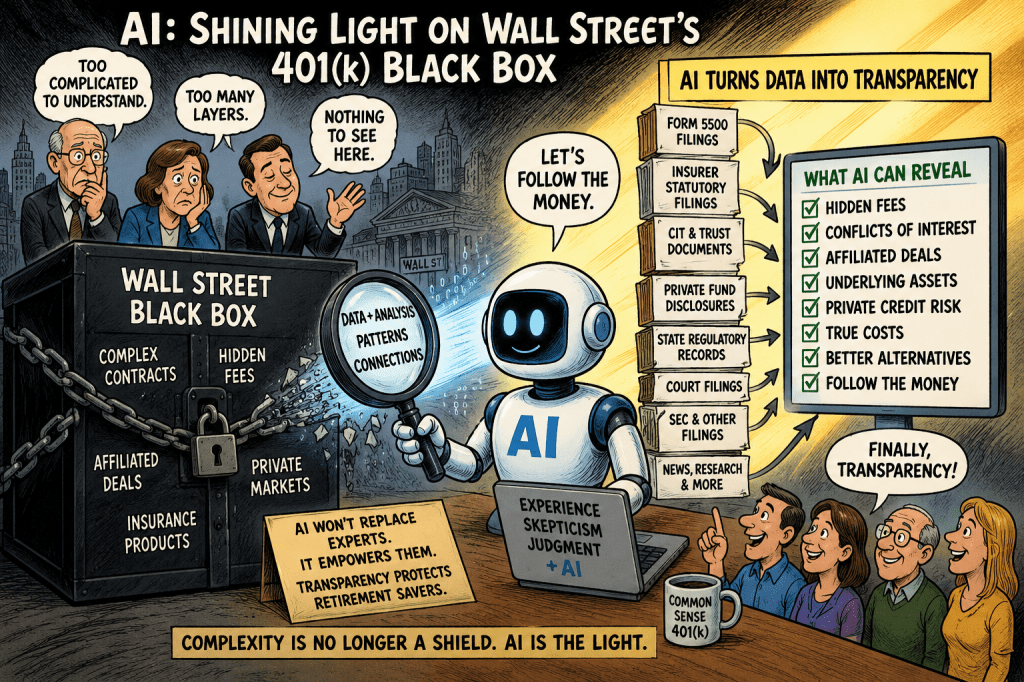
My Latest Broadcast Retirement Network Interview—and Why Artificial Intelligence May Be the Biggest Transparency Tool Retirement Investors Have Ever Had
By Christopher B. Tobe, CFA, CAIA
In my latest interview with Jeffrey Snyder on the Broadcast Retirement Network, we talked about 401(k) litigation, target-date funds, annuities, collective investment trusts and private markets. https://www.youtube.com/@BroadcastRetirementNetwork
But underneath all those subjects is a much bigger story.
Artificial intelligence is radically changing who has the ability to investigate Wall Street.
I know because I am using it.
For decades, much of the retirement industry’s business model benefited from an enormous information advantage.
A large insurance company might have hundreds of contracts.
A private-equity manager might have hundreds of partnerships.
A target-date fund might contain funds inside funds.
A public pension might have hundreds of alternative-investment relationships.
A collective investment trust might be regulated by an obscure state banking regulator with documents scattered across multiple databases.
The information wasn’t necessarily nonexistent.
It was frequently just too expensive, fragmented and time-consuming for anyone to assemble.
AI is beginning to destroy that advantage.
Bloomberg Showed What Happens When AI Meets the 401(k) Black Box
Bloomberg’s investigation of collective investment trusts was an important demonstration. https://commonsense401kproject.com/2026/08/13/dead-people-for-private-equity-bloomberg-exposes-astroturfing-behind-trump-dols-401k-push/
Bloomberg used artificial intelligence and extensive data analysis to examine a market that historically has been extraordinarily difficult to map.
That matters because CITs have grown into a roughly $6–$7 trillion market rivaling mutual funds, while disclosure remains fragmented among federal and state regulators and no regulator appears to possess a complete picture of the marketplace.
That is remarkable.
We have trillions of dollars of American retirement savings sitting in investment vehicles for which the public lacks anything resembling the SEC’s centralized mutual-fund disclosure system.
Bloomberg used technology to begin putting that puzzle together.
I have been trying to do something similar on a much smaller scale.
AI Gives every Participant the power
A smart participant say someone who is an engineer or almost any business background, by putting their statement and 5500 in AI and could know more than historically plan sponsors and even their advisors. On issues like fees which many plans and most advisors have tried to ignore now become transparent.
In the hands of an expert AI can tear apart almost any 401k plan and sort out the ones that should be litigated.
A smart plan sponsor would put their plan in AI and ask what is wrong? But their advisors will discourage doing this to protect their jobs.
AI makes expertise scalable.
I can ask questions today that would have been economically unrealistic for an independent researcher to ask five years ago.
Follow the Money—At Machine Speed
This is where things become uncomfortable for Wall Street.
AI is increasingly good at connecting information that institutions have historically disclosed separately.
Each document by itself may tell you relatively little.
Connect 50 of them and you may have a story.
That is exactly the kind of work AI makes dramatically easier.
The Most Important AI Skill Is Still Knowing What Doesn’t Smell Right
AI is not magic. It makes mistakes.
Every important finding still needs to be verified against original documents.
But that misses the real significance of the technology.
An experienced investigator often knows that something doesn’t make sense long before he can prove why.
Those questions come from experience.
AI allows the investigator to pursue dozens of them simultaneously.
Human skepticism + investment experience + AI research capacity is an extraordinarily powerful combination.
The 401(k) Industry Was Built for an Information-Scarce World
A surprising amount of retirement regulation assumes that information is expensive.
Participants cannot investigate everything, so give them standardized disclosures.
Plan committees cannot analyze everything, so hire consultants.
Regulators cannot inspect everything, so require periodic filings.
Courts cannot reconstruct every investment decision, so rely upon benchmarks and fiduciary process.
Wall Street learned to operate inside those limitations and lack of transparency.
Complexity became protection.
Fragmentation became protection.
Scale became protection.
Put something inside another fund and it becomes harder to see.
Put it inside a CIT and disclosure may decline further.
Put a private fund inside the CIT and another layer appears.
Put an insurance contract underneath it and another appears.
Twenty years ago, following that chain might have required a team of lawyers, accountants and investment professionals.
Today an experienced investigator with AI can start pulling those layers apart from a laptop.
AI Could Be Particularly Dangerous to Hidden Fees
Wall Street can defend a disclosed 40-basis-point fee.
It is much harder to defend economics nobody disclosed.
This is why I think insurance products deserve particular attention.
If participants receive 2% while an insurer earns substantially more on the underlying portfolio, the economic difference can dwarf the tiny mutual-fund expense-ratio disputes that have dominated ERISA litigation.
Historically, determining those economics was difficult.
AI makes it increasingly possible to combine crediting rates, insurer portfolio yields, statutory filings, product documents, competitor rates and plan disclosures.
The same principle applies to private equity.
Private credit.
Real estate.
CITs.
Target-date funds.
Consulting relationships.
Revenue sharing.
And conflicts of interest.
Opacity becomes less valuable when computers can connect the disclosures you scattered across 20 different places.
Bloomberg Has Resources. Now Individuals Have Leverage Too.
Bloomberg’s investigation demonstrates what sophisticated technology and financial data can accomplish at institutional scale.
But the more revolutionary development may be happening below Bloomberg’s level.
Independent Reporters. Academics. Plaintiff attorneys. Pension trustees. Participant advocates.
Independent investment professionals. Even individual retirement-plan participants.
They increasingly have access to analytical capabilities that once belonged almost exclusively to large financial institutions.
The information advantage is narrowing.
That could ultimately matter more to retirement investors than another thousand pages of regulation.
This Is Why Wall Street’s Move Toward Complexity May Backfire
Private markets are arriving in 401(k)s at exactly the wrong historical moment for secrecy.
Wall Street is moving toward investments with: More complicated contracts. More subjective valuations. More layers. More affiliated entities. More private credit. More insurance structures. More state-regulated CITs.
Less standardized disclosure. That strategy assumes complexity will continue protecting the industry from scrutiny.
AI is making the opposite bet.
The more complicated the structure becomes, the more relationships there are for machines to discover.
The more documents scattered among regulators, the more documents there are to connect.
The more affiliated entities involved, the more potential conflicts can be mapped.
The more complicated the money trail, the more valuable automated analysis becomes.
Wall Street is building increasingly complicated haystacks at precisely the moment AI is getting extraordinarily good at finding needles.
I don’t believe AI replaces investment professionals, lawyers, journalists or regulators.
It does something potentially more important.
It dramatically increases their reach.
An experienced investment professional can investigate thousands of plans instead of dozens.
A journalist can connect records scattered among regulators.
A plaintiff attorney can identify potential fiduciary problems before discovery.
A pension trustee can independently test what consultants are telling the board.
And participants may eventually be able to ask questions about their retirement investments that previously required institutional research departments to answer.
For decades, complexity gave Wall Street an enormous advantage.
The contracts were too long.
The filings were too numerous.
The databases didn’t talk to each other.
The relationships were too complicated.
The money trail was too difficult to follow.
That era may be ending.
AI doesn’t make Wall Street transparent.
It makes hiding in complexity much harder.

