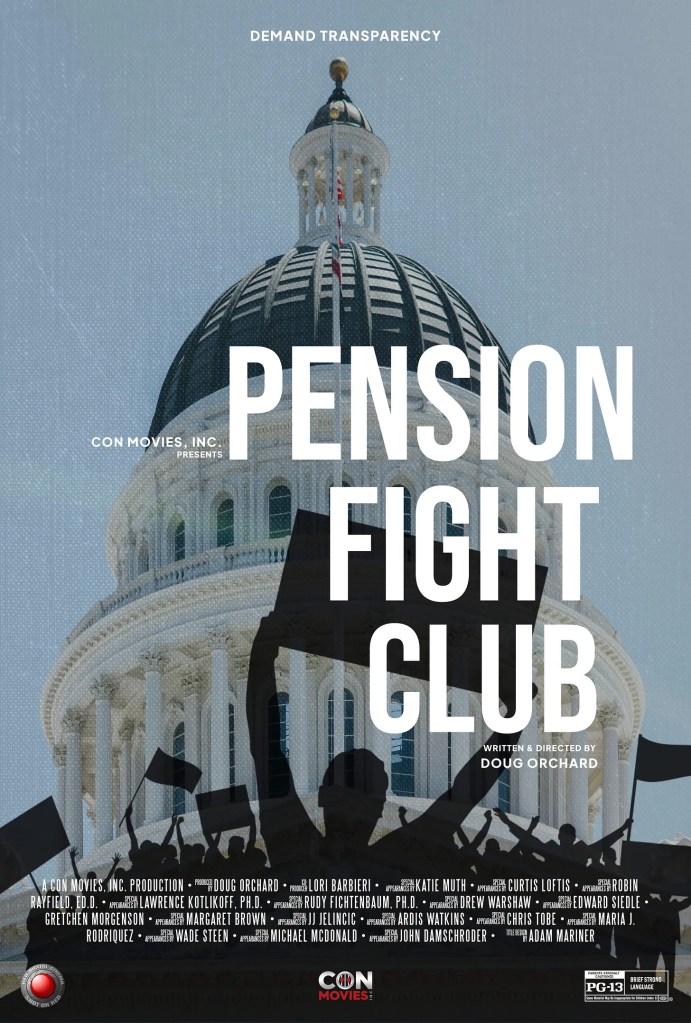
When Pension Fight Club premiered in Sacramento in May, just steps from CalPERS, it looked like the culmination of years of battles over public pension secrecy.
It may turn out to have been the beginning.
Award-winning filmmaker Doug Orchard’s 87-minute documentary Pension Fight Club is now available to stream online, bringing together one of the most unusual collections of pension critics ever assembled in one film: Republican and Democratic elected officials, union leaders, current and former pension trustees, professors, journalists, whistleblowers, retiree advocates—and ordinary teachers who simply started asking what was happening to their retirement money.
The film’s premise is provocative but remarkably simple: Public pension money is public money. Why has so much information about how that money is invested—particularly in private equity, private credit, hedge funds and other alternative investments—become secret?
The documentary argues that pension fiduciaries themselves can face obstacles obtaining the contracts governing some of their largest and riskiest investments. It examines hidden or difficult-to-measure fees, opaque valuations and benchmarks, consultant and manager conflicts, and the political and institutional resistance encountered by trustees and beneficiaries who demand answers.
What makes Pension Fight Club particularly powerful is that there is no convenient political stereotype for its cast. These people come from California, Pennsylvania, South Carolina, Ohio, Kentucky, Illinois, New York, Rhode Island, Minnesota and North Carolina. They include Republicans, Democrats, union officials and people with no obvious partisan agenda at all.
Wall Street secrecy turns out to be bipartisan. So does opposition to it.
Meet the Pension Fight Club
Margaret Brown — Former CalPERS Board Member
Brown has moved from being a dissident voice inside CalPERS to one of its most persistent outside critics. Now president of the Retired Public Employees’ Association of California, Brown argues that trustees, retirees and taxpayers cannot meaningfully evaluate private equity without credible information about fees, risks, valuations, benchmarks and performance. She has criticized CalPERS communications that portray private equity positively without giving members an equally clear picture of its risks. Her message is fundamentally about governance: you cannot have accountability without information.
J.J. Jelincic — Former CalPERS Board Member
Few people know CalPERS from the inside as well as J.J. Jelincic, who spent decades at the system as an investment officer before serving on its board. Long before pension transparency became fashionable, Jelincic was asking uncomfortable questions about private-equity fees, fee offsets, carried interest and what exactly CalPERS was paying its managers. His criticism goes to the heart of fiduciary oversight: if a trustee doesn’t know all the fees being charged, how can the trustee determine whether the pension is receiving value for them?
Katie Muth — Pennsylvania State Senator
Muth turned the transparency issue into an actual legislative program. She has proposed making public-pension investment contracts subject to Pennsylvania’s Right-to-Know Law, disclosing managers and contracts to beneficiaries, and limiting pension exposure to non-public markets. She has also fought PSERS over access to records as a board member herself. Her experience illustrates one of the documentary’s most disturbing questions: What does it say about pension governance when an elected pension trustee has to fight her own pension system for information?
Curtis Loftis — South Carolina State Treasurer
Loftis may be one of the original pension fight-club members. For more than a decade he has attacked excessive investment costs, opaque alternative investments and contracts that restrict meaningful oversight. He has repeatedly argued that private equity can have a legitimate place in a portfolio—but only if fiduciaries actually know what they are paying and can compare those costs with performance. Years ago, he complained that South Carolina was paying hundreds of millions to Wall Street while struggling even to identify all the underlying expenses. His issue isn’t simply high fees. It is fees nobody can reliably measure.
Wade Steen — Former STRS Ohio Board Member
Steen became one of the central figures in the extraordinary political war over Ohio STRS. As a reform-oriented board member, he questioned investment practices and management and aligned himself with members seeking significant changes at the pension. His disputes eventually escalated far beyond ordinary boardroom disagreements, including litigation and controversy surrounding the QED proposal. Whatever one’s view of that separate controversy, Steen’s story illustrates the intensity of the institutional resistance that can develop when pension trustees challenge entrenched investment practices.
Rudy Fichtenbaum, Ph.D. — STRS Ohio Board Member
Economist Rudy Fichtenbaum has made perhaps the clearest quantitative case among the Ohio reformers. He advocates greater use of low-cost passive investing, lower investment expenses, better benchmarks and greater transparency around alternative investments. He has argued that STRS increased risk and reduced transparency through heavy exposure to alternatives and has repeatedly challenged the benchmarks used to judge their performance. Fichtenbaum’s question is devastatingly straightforward: if expensive active and alternative management is worth the money, demonstrate it against a credible benchmark after all costs.
Chris Tobe — Former Kentucky Retirement Systems Trustee
Tobe brings the perspective of a former Kentucky pension trustee, investment consultant, author and longtime critic of public-pension alternative investments. His work has focused on hidden investment fees, misleading benchmarks, conflicts involving consultants and money managers, and the difficulty trustees face when investment contracts and underlying economics are obscured. His broader argument fits squarely into Pension Fight Club: a fiduciary cannot prudently oversee an investment he cannot independently value, benchmark, cost and fully understand.
Maria J. Rodriguez — Chicago Teacher Pension Trustee
Rodriguez represents another important constituency in the movie: pension trustees willing to dissent rather than simply ratify staff and consultant recommendations. Her presence broadens the story beyond the better-known CalPERS and STRS fights. Chicago’s pension systems operate in an environment of chronic funding pressure, making independent trustee scrutiny of investment costs, governance and risk particularly important. Pension Fight Club makes the larger point that board dissent should be treated as part of fiduciary governance—not as an institutional nuisance.
Drew Warshaw — New York Comptroller Candidate
Warshaw has taken the fight directly into electoral politics. His campaign against New York’s longtime comptroller attacked the state’s reliance on hundreds of outside Wall Street managers and argued that much of the portfolio could be managed more cheaply through diversified passive strategies. Warshaw says New York has paid billions to outside managers without receiving adequate value for those fees. His challenge is essentially the index-fund question writ large: why should taxpayers pay Wall Street billions to try to beat markets if the expensive strategy fails to beat appropriate benchmarks after costs?
Lawrence Kotlikoff, Ph.D. — Boston University Professor
Economist Lawrence Kotlikoff supplies an academic perspective on the much larger problem: pension promises, funding assumptions and the intergenerational transfer of costs when governments fail to account honestly for retirement obligations. His presence helps move the film beyond individual managers or individual pension systems. Ultimately pension opacity is not merely an investment-management problem. If risks and liabilities are misstated today, workers and taxpayers bear the consequences tomorrow.
Robin Rayfield, Ed.D. — Ohio Retirement for Teachers Association
Rayfield and ORTA helped transform Ohio teachers from pension beneficiaries into pension investigators. ORTA helped finance Edward Siedle’s forensic investigation of STRS and has repeatedly demanded disclosure of investment fees, expenses and alternative-investment information. Rayfield has asked why STRS refused to provide records needed for that investigation and has argued that accountability cannot exist when information remains hidden from the people whose retirement money is being managed.
Dean Dennis — Ohio Retirement for Teachers Association
Dennis has focused relentlessly on the connection between investment policy and lost teacher benefits. His criticism is that teachers have worked longer, contributed more and lost inflation protection while STRS continued expensive active management and opaque private-market investing. Dennis contrasts that approach with simpler index investing and argues that hidden fees and nondisclosure agreements make meaningful accountability more difficult.
Edward Siedle — The Pension Warrior
Ted Siedle is effectively the connective tissue of the movie. A former SEC lawyer turned forensic pension investigator, Siedle has spent years investigating public pensions and arguing that the combination of secrecy, complex alternatives, hidden fees, conflicted advisers and weak trustee oversight creates an enormous opportunity for Wall Street to extract wealth from retirement systems. His investigations in Rhode Island, Ohio, Kentucky, Minnesota and most recently CalPERS have also demonstrated something important: retirees themselves can finance independent forensic scrutiny when pension institutions won’t provide it. The CalPERS investigation that helped inspire the documentary was itself crowdfunded by pensioners.
Gretchen Morgenson — NBC News Senior Financial Reporter
Pulitzer Prize-winning financial journalist Gretchen Morgenson brings something different to the film: decades of experience following money that powerful institutions would prefer not be followed. Her reporting has examined pension investment costs, private markets and the CalPERS forensic investigation. Morgenson helps connect what might otherwise look like isolated fights in individual states into a national financial story: hundreds of billions of dollars of workers’ retirement savings have migrated into increasingly complicated and opaque investments.
Michael McDonald — President, Rhode Island Council 94, AFSCME
Rhode Island is an important chapter in the modern pension story. Public workers experienced benefit reductions while the state moved substantial assets toward expensive alternative investments. McDonald represents the union and beneficiary perspective: workers are routinely told sacrifices are necessary to protect pension solvency, yet far less attention may be paid to the fees, costs and investment decisions on the asset side of the pension equation. Pension Fight Club asks why workers’ benefits are so easy to scrutinize while Wall Street contracts can remain so difficult to see.
John Damschroder — The Blade
Damschroder brings the Ohio fight into the realm of public accountability and journalism. While much of the Ohio media was controlled by Private Equity interests, Damschroder and the Toledo Blade brought real independent journalism to Ohio. The STRS controversy demonstrates why local and regional financial reporting matters: pension disputes that sound technical—benchmarks, alternative-investment expenses, staff incentives and governance—ultimately determine the retirement security of hundreds of thousands of people. The movie turns those seemingly obscure financial questions into something understandable: Whose money is it, who controls it, and who is watching the people controlling it?
Minnesota Teachers Maggie Temple, Katie Dickerson,Allison Goodman, Vickie Penick, Paul Peterson, Todd Richter
This group represents the people at the bottom of the pension organizational chart but at the center of its purpose: teachers. They have testified publicly about disparities affecting Minnesota teachers’ retirement benefits. Their presence reminds viewers that pension policy isn’t an academic argument over basis points. Changes in retirement ages, contribution requirements and benefits determine how long a teacher must remain in the classroom and what kind of retirement that teacher can afford.
After decades in education, they have argued that retirement rules can leave veteran teachers feeling that they have little financial choice but to continue working. Her story puts a human face on the numbers: when a pension system underperforms expectations, teachers don’t experience a spreadsheet variance—they experience additional years of work and a less secure retirement.
Minnesota educators helped raise money for an independent forensic examination of their pension investments rather than relying solely on assurances from the institutions managing them. Their involvement is one of the documentary’s strongest themes: beneficiaries increasingly want independent verification, not simply another consultant telling them everything is fine.
Trina Prufer — Ohio Teacher
Prufer gives the Ohio battle its most important perspective—the teacher living with the consequences. Ohio educators have watched contribution rates rise, retirement requirements change and COLAs disappear or become uncertain while investment professionals and outside managers continued to be paid. Her presence keeps the STRS debate focused where it belongs: the pension exists to provide retirement benefits to teachers, not to provide an asset pool for the investment industry.
Ardis Watkins — Executive Director, State Employees Association of North Carolina
Watkins brings organized labor into the transparency coalition. SEANC has fought for pension transparency and accountability in North Carolina for more than 15 years. Her presence also destroys the convenient argument that questioning Wall Street pension management is somehow anti-worker or anti-pension. Watkins’ position is essentially the opposite: protecting public employees’ pensions requires demanding accountability from the people investing their money. SEANC itself has urged members to watch the documentary.
This Isn’t a Movie About Red States or Blue States
That may be Pension Fight Club’s most important accomplishment.
Look at the map.
California. South Carolina. Pennsylvania. Ohio. Kentucky. Illinois. Rhode Island. Minnesota. North Carolina. New York.
Look at the participants.
Republicans. Democrats. Union officials. Retirees. Professors. Teachers. Journalists. Pension trustees.
Yet they repeatedly arrive at versions of the same questions:
What are we paying?
What are we getting?
What risks are we taking?
Who picked these managers?
Who is checking the consultants?
Why can’t trustees see everything?
Why are public investment contracts secret?
Why are private-market valuations accepted without the same market discipline applied to publicly traded securities?
And perhaps most importantly:
Why does asking these questions so often produce hostility rather than answers?
That is why Pension Fight Club matters beyond pensions.
America’s public retirement systems control trillions of dollars. Those trillions have helped make public pensions some of the most important customers of private equity, private credit, hedge funds, real estate funds and Wall Street investment managers.
The people whose money supplies that enormous financial machine are teachers, firefighters, police officers, nurses and other public workers—and ultimately taxpayers.
They should not need a forensic investigator to find out what they own.
A trustee should not have to fight staff to see an investment contract.
A retiree should not need a finance degree to determine whether a manager beat a legitimate benchmark.
And taxpayers should not be told to write bigger checks without being able to determine how much money disappeared into fees, expenses and underperformance first.
The First Rule of Pension Fight Club Should Be: Talk About Pension Fight Club
The movie had its world premiere May 19 at Sacramento’s historic Crest Theatre, near both the California Capitol and CalPERS, as California debated legislation intended to increase private-equity transparency.
Now the fight has moved online.
This is a documentary that should be watched by every public pension trustee, every state legislator who oversees a retirement system, every union representing public workers, every financial reporter covering state government—and especially every teacher and public employee who has ever been told:
“Don’t worry. The experts have this under control.”
Maybe they do.
But after watching Pension Fight Club, you may decide you’d still like to see the contracts.
Watch Pension Fight Club online


Pingback: My SEC Comment Opposing Repeal of the Pay-to-Play Rule for Public Pensions | The CommonSense 401k Project