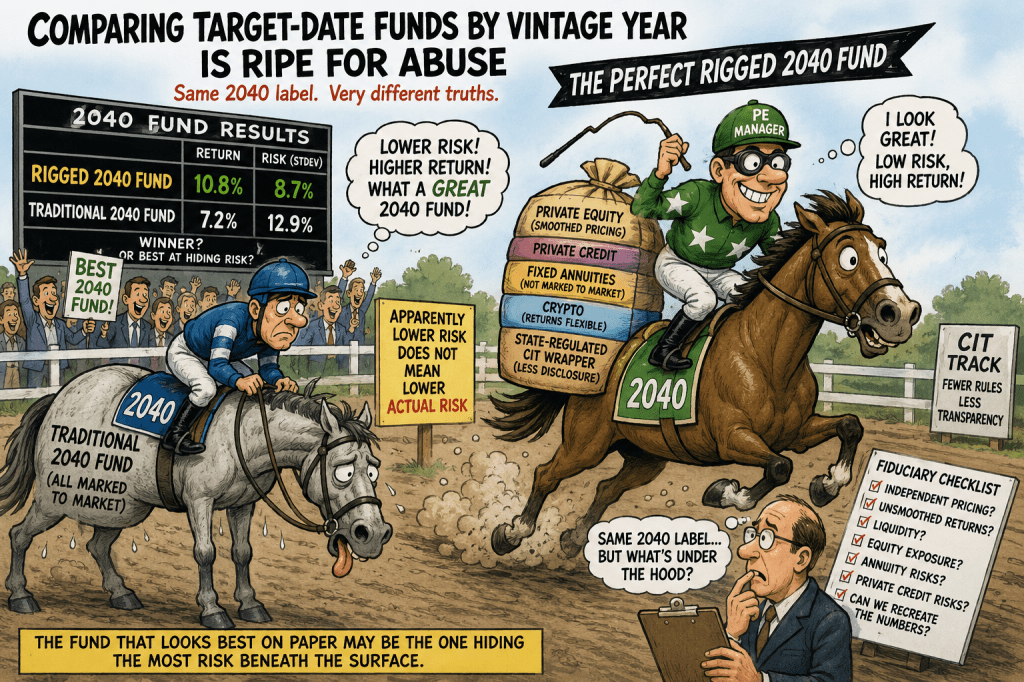
Private equity, state-regulated CITs and annuities could make the “best-performing 2040 fund” the fund with the most aggressively manufactured numbers.
For years, one of the simplest ways to evaluate a target-date fund has been to compare it with other funds having the same vintage.
Compare a 2040 fund with other 2040 funds. Compare a 2050 fund with other 2050 funds.
That sounds reasonable.
It is also becoming dangerously easy to game.
I could design a 2040 target-date fund that appears to outperform most conventional 2040 funds without appearing to take substantially more risk.
The trick is not necessarily superior investment management.
The trick is changing the ruler used to measure risk.
How I Would Build the “Best” 2040 Fund
Start with an ordinary 2040 target-date fund holding publicly traded stocks and bonds.
Then replace part of it with private equity and private credit.
Public stocks are marked to market every trading day. If stocks fall 20%, everybody sees the loss.
Private equity is different. Managers periodically estimate what their investments are worth. Those valuations can move slowly even when public markets are crashing.
That creates an enormous statistical advantage.
Smoothed valuations → lower reported volatility → lower measured correlation → apparently better diversification → apparently better risk-adjusted performance.
I have previously called this the private-equity diversification illusion.
It doesn’t necessarily mean the investment became less risky.
It means the reported price moved less frequently.
My recent discussion of continuation funds shows how the valuation problem can go even further. A private-equity manager can potentially participate on both sides of a transaction in which an asset moves from an existing fund into a continuation vehicle. The resulting transaction can then appear to validate a valuation even though the same manager remains involved with the asset.
That is a very different price-discovery mechanism from selling 100,000 shares of Microsoft on Nasdaq.
Now Use the Fake Low Volatility to Buy More Stocks
Here is where the target-date comparison really breaks down.
Suppose a conventional 2040 fund holds:
70% stocks + 30% bonds.
Now suppose my competing 2040 fund contains private equity whose reported volatility and correlation are artificially suppressed by stale or smoothed valuations.
My portfolio model may conclude that private equity provides wonderful “diversification.”
Suddenly I can build something economically closer to:
80%–90% equity and equity-like risk + much less conventional fixed income.
During a rising market, my 2040 fund should outperform the boring 70/30 competitor.
But when Morningstar, consultants or fiduciaries compare the two funds, my reported standard deviation may not look dramatically higher.
I have seemingly created something wonderful:
Higher return without higher risk.
Except I haven’t.
I have combined real market volatility with accounting volatility and treated them as if they were the same thing.
Garbage risk statistics in.
Beautiful efficient frontier out.
Private Equity Can Juice Both Sides of the Equation
This isn’t merely about understated risk.
Private-market valuation practices can potentially improve both sides of the conventional risk/return comparison.
On the return side, private assets are not continuously marked by independent markets. Managers exercise substantial valuation judgment.
On the risk side, those same infrequent valuations suppress measured volatility and correlation.
Jay Rogers makes the larger transparency problem forcefully in his recent column, “Private Equity’s Trojan Horse Is Headed for Your 401(k).” Rogers notes that private equity and private credit increasingly can reach workers through target-date funds and CITs, while asking the fundamental question: who verifies the price? He also points to the enormous migration of target-date assets toward CIT structures. https://www.bedfordgazette.com/editorial/private-equitys-trojan-horse-is-headed-for-your-401-k/article_002fc029-f229-4d70-9b55-a2d13689475d.html
That question becomes even more important when fiduciaries start comparing one target-date vintage against another.
The manager controlling the least transparent assets may be given a statistical advantage over the manager holding transparent securities.
Then I Would Game the “Safe” Side of the Portfolio
Why stop with private equity?
I can potentially make the fixed-income portion look artificially safe too.
Instead of holding publicly traded bonds that are continuously marked to market, put some of the supposedly conservative allocation into fixed annuities backed by an insurance company’s general or separate account.
The insurer may itself hold large amounts of private credit and other illiquid assets.
Now we have another layer where market volatility can disappear from the target-date fund’s reported statistics.
A conventional bond fund immediately reflects changing interest rates, credit spreads and market prices.
An insurance contract may continue reporting a stable contract value or crediting rate.
That does not mean its underlying economic risk disappeared.
The volatility disappeared from the reported number.
That distinction is critical.
A fixed annuity backed by increasingly illiquid private credit should not magically receive a lower risk score merely because nobody marks the contract to market every afternoon.
And Then There Are State-Regulated CITs
This becomes especially concerning as the target-date market migrates from SEC-registered mutual funds toward collective investment trusts.
As I discussed previously, private equity has potentially found two roads into the 401(k): loosening restrictions involving registered products and the much less uniform world of state-regulated CITs.
CITs are not subject to the same registration, disclosure and reporting regime as mutual funds. Rogers reports that CITs have now overtaken mutual funds in target-date assets, citing Sway Research data showing CITs at 55% of TDF assets as of June 30, 2026.
CIT regulation varies by state. Pennsylvania is fairly solid. In Nevada anything goes.
But it makes the fiduciary’s job harder, particularly if a CIT contains layers of private equity, private credit, insurance products or other assets whose valuations cannot easily be independently reconstructed.
A label saying “2040 Target Retirement CIT” tells you almost nothing about what is underneath it.
Crypto Could Make the Problem Almost Absurd
Once we accept the proposition that assets with unusual pricing characteristics can be mixed with conventional securities and evaluated using conventional risk statistics, where does it stop?
Crypto demonstrates the problem from the opposite direction.
Its volatility is obvious, but establishing a sensible expected return, correlation regime and long-term retirement-risk assumption is extraordinarily difficult.
Yet an optimizer needs numbers.
Give it assumptions and it will produce an allocation.
That doesn’t make those assumptions reliable.
Private equity can make risk appear artificially low because prices don’t move enough.
Crypto can produce optimization results that are extremely sensitive to whatever return, volatility and correlation assumptions somebody decides to feed into the model.
Different problem.
Same warning:
The sophistication of the output does not improve the quality of the inputs.
The “2040” Label Is Not a Benchmark
This is why fiduciaries need to stop treating vintage-year comparisons as if they were apples-to-apples comparisons.
Two funds can both say 2040 while having radically different:
- public-equity exposure;
- private-equity exposure;
- private-credit exposure;
- liquidity;
- valuation frequency;
- insurance-company credit exposure;
- leverage;
- true equity beta; and
- dependence on manager-estimated prices.
Comparing their returns and standard deviations without adjusting for those differences could reward the fund with the least transparent valuation system.
That turns prudent benchmarking upside down.
The manager marking everything to market gets punished with volatility.
The manager estimating private assets quarterly gets rewarded with “stability.”
Fiduciaries Need a New Target-Date Guardrail
My earlier Target Date Fund Fiduciary Due Diligence Guardrail Checklist argued that fiduciaries need to look through the target-date wrapper and understand what they actually own. https://commonsense401kproject.com/2026/05/30/target-date-fund-fiduciary-due-diligence-guardrail-checklist/
That principle becomes even more important as private markets enter TDFs.
A fiduciary comparing target-date funds should not simply ask:
“How did this 2040 fund perform versus other 2040 funds?”
The better questions are:
How much actual economic risk did each manager take?
Which assets were independently marked to market?
Which returns came from manager-estimated NAVs?
Have private-market returns been unsmoothed before calculating volatility and correlation?
How much equity-equivalent exposure does the portfolio really contain?
Are annuity values masking changes in insurer credit or liquidity risk?
Could private-credit valuations be suppressing apparent fixed-income volatility?
Can the fiduciary independently reproduce the valuation, risk and benchmark calculations?
If the answer to the last question is no, the fiduciary should be extremely reluctant to call one 2040 fund “better” than another.
The Perfect Rigged Target-Date Fund
If my objective were simply to win the target-date-fund horse race, I know what I would be tempted to build.
Load the growth allocation with private equity whose valuations move slowly.
Use those artificially attractive volatility and correlation statistics to justify more equity exposure.
Put private credit and fixed annuities into the supposedly conservative side of the portfolio.
Package everything inside a lightly disclosed state-regulated CIT.
Perhaps sprinkle in crypto using whatever long-term assumptions make the optimizer happy.
Then compare my fund’s reported return and reported standard deviation against boring SEC-regulated 2040 mutual funds holding publicly traded stocks and bonds.
My fund could look brilliant.
More return.
Less apparent volatility.
Wonderful diversification.
Same 2040 label.
But the comparison could be largely meaningless.
Private equity doesn’t become safer because somebody hasn’t marked it down yet.
An insurance contract doesn’t become riskless because its value doesn’t flash on a Bloomberg screen.
And two target-date funds don’t become comparable simply because somebody stamped “2040” on both of them.
As Wall Street moves private equity, private credit and insurance products deeper into America’s default retirement investments, the easiest target-date fund to make look good may increasingly be the one whose risks are hardest to see.
Appendix: New Research Confirms the Problem — “Same Target Date” Does Not Mean “Same Risk”
A new target-date-fund study provides unusually direct empirical support for the central argument of this article: a 2040 fund is not necessarily comparable to another 2040 fund simply because both have “2040” in their names.
Mitchell Bollinger’s forthcoming research, Same Target Date, Different Risk: A Survivor-Bias-Free Reassessment of Target-Date Funds with Investable Style Analysis, examines the CRSP survivor-bias-free universe of target-date funds using a methodology designed to recover their changing investment exposures. Its central conclusion is remarkably straightforward: “The label on a target-date fund fixes the year, not the risk.” Among major TDF providers, two funds with the same retirement year can differ by roughly 20 percentage points of equity exposure and several percentage points of expected volatility.
That distinction matters enormously when funds are ranked by historical performance. Bollinger finds that, following rising equity markets, selecting the best-performing fund within a target-date vintage tends to select the higher-risk fund rather than the more skilled manager. The three-year rank correlation between trailing returns and recovered equity exposure is approximately +0.30 overall and rises to +0.36 following equity-market gains. After equity losses, the relationship reverses. In other words, performance chasing among same-vintage TDFs can become risk chasing.
The economic consequences can be enormous. Bollinger stress-tests today’s TDF allocations against the Global Financial Crisis. Among 2025 funds, the highest-equity fund would have suffered an estimated drawdown of roughly 34%, compared with about 10% for the lowest-equity fund bearing the same 2025 label. For 2030 funds, the corresponding figures were approximately 35% versus 19%.
Earlier NBER Research Was Already Warning Us
This builds on John Shoven and Daniel Walton’s 2020 NBER study, An Analysis of the Performance of Target Date Funds. Their returns-based style analysis found that TDFs generally followed their advertised glide paths, but also demonstrated substantial risk even as participants approached retirement. During the February 19–March 23, 2020 market collapse, long-dated TDFs generally lost 30–35%, while 2025 funds—then designed for workers only about five years from retirement—lost approximately 20–25%.
Shoven and Walton also found that past TDF performance had remarkably little predictive power. A fund that outperformed by one percentage point annually in the earlier period was associated with only about 9 basis points of additional annual performance in the subsequent period. Their conclusion was essentially that past winners largely reverted toward the mean.
Their study also showed why looking underneath the vintage label matters. Style analysis found long-dated TDFs with effective equity exposure exceeding 80%, while equity exposure declined as retirement approached and bonds increased. Importantly, their results were distributions—not a single mandatory asset allocation dictated by the year printed on the fund.
Even the Measurement Tools Can Be Gamed or Mislead
Bollinger’s companion methodological research adds another warning that is particularly relevant to fiduciaries comparing TDF performance. Conventional returns-based style analysis can itself mismeasure exposures and alpha.
The standard methodology often constrains style weights to sum to one without providing a free intercept. Bollinger finds that this can cause a flat investment-management fee to leak into the estimated exposures rather than appearing fully as reduced alpha. In his example, of a 50-basis-point fee, only about 22 basis points appeared as lower measured alpha; roughly 28 basis points were absorbed into the fitted benchmark. The higher the fee, the greater the potential distortion.
Performance fees can create an even stranger result: because they alter the shape of net returns, they can reduce fitted upside beta and thereby create the appearance of market-timing skill.
Bollinger proposes “Investable Style Analysis,” which attempts to solve these problems by tracking changing exposures and comparing the fund against actual investable factor portfolios. In simulated funds, the method approximately halved the error of conventional rolling-window analysis and eliminated an approximately 20-basis-point upward bias over five years. On Vanguard’s TDFs, it reconstructed the published equity glide path from returns alone to within roughly 0.9 percentage point across eleven vintages.
There is an additional benchmark warning. If the benchmark fails to contain an exposure actually held by the fund, the omitted exposure can show up as supposed managerial skill. Bollinger demonstrates the problem with a passive Canadian index fund: when Canada was absent from the benchmark opportunity set, the completely passive fund generated approximately two percentage points per year of spurious “alpha.”
Why This Could Become Much Worse With Private Markets
This last point is where the research intersects with the concern raised in this article.
Bollinger’s empirical work is principally about publicly traded assets. It does not establish that private equity, private credit, annuities or crypto are currently being used to manipulate TDF comparisons. But the methodology illustrates why introducing difficult-to-measure assets could make vintage comparisons even more problematic.
If two public-market 2040 funds can already differ by 20 percentage points of equity exposure, calling them both “2040” plainly does not establish equivalent risk.
Now imagine that one 2040 fund also contains private equity carried at manager-reported valuations, private credit without continuous market prices, or an insurance general-account product whose reported value does not fluctuate like a publicly traded bond portfolio.
The comparison problem becomes substantially harder.
A fund can potentially appear to have lower volatility without actually bearing less economic risk. That apparent reduction in measured volatility can then provide room for additional return-seeking exposure elsewhere in the portfolio. A conventional comparison may conclude that Fund A produced a higher return at similar measured risk when the real difference is that some of Fund A’s risk was simply harder to observe.
That is the critical lesson from these papers for fiduciaries:
Do not compare the performance of two target-date funds until you have first established that you are actually comparing comparable risks.
The target year is a label. It is not a risk classification.
And once private assets, insurance products and other non-marked or difficult-to-benchmark investments enter target-date funds, the opportunity for a misleading same-vintage comparison becomes greater, not smaller.
Suggested citations
Bollinger, Mitchell. Same Target Date, Different Risk: A Survivor-Bias-Free Reassessment of Target-Date Funds with Investable Style Analysis. Manuscript prepared for peer review. The study uses the CRSP Survivor-Bias-Free U.S. Mutual Fund Database and reports that roughly 54% of TDFs ever launched had closed, with defunct funds having worse nominal returns and higher fees than survivors—another reason historical comparisons based only on today’s available TDFs can flatter the industry.
Bollinger, Mitchell. When Fees and Alphas Distort Style Recovery: Introducing Fee and Alpha Robust Investable Style Analysis. Research manuscript. The paper argues that conventional no-intercept returns-based style analysis can push fees and alpha into estimated factor loadings and proposes a fee-robust investable alternative.
Shoven, John B., and Daniel B. Walton. “An Analysis of the Performance of Target Date Funds.” NBER Working Paper No. 27971, October 2020.
I think the 34% versus 10% drawdown for two 2025 funds is the killer statistic for your article. It makes the point immediately: same vintage, radically different risk. Then your private-equity/private-credit argument becomes the next logical question—if vintage comparisons are already this unreliable with observable public-market exposures, what happens when some of the risk is buried in assets whose prices themselves are smoothed?

