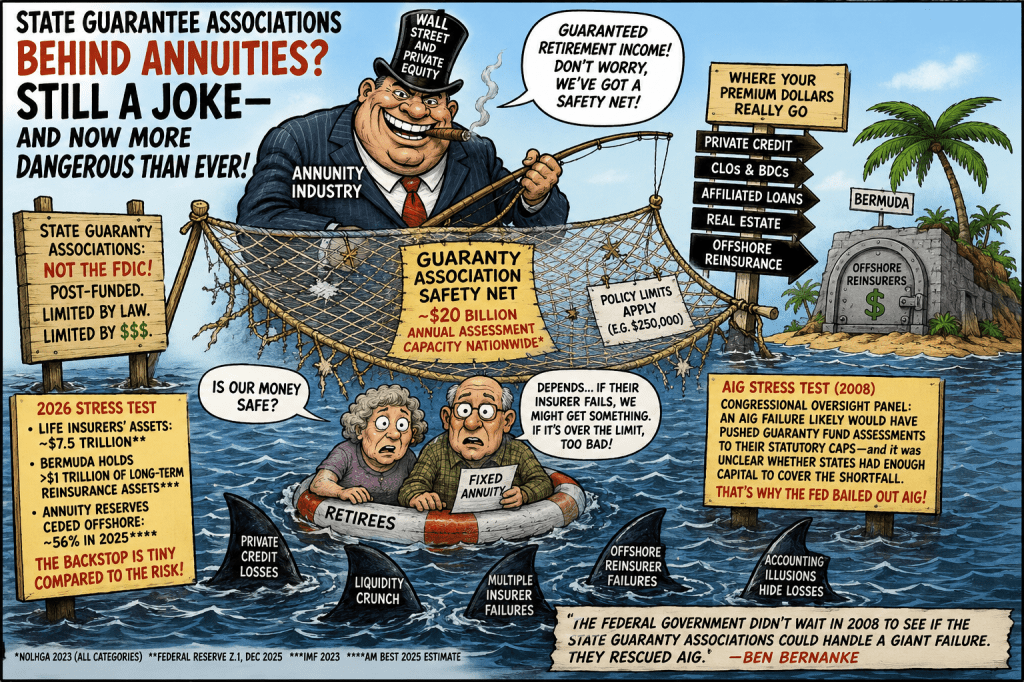
When I wrote in 2025 that state guaranty associations were a flimsy substitute for real insurance of annuity promises, the industry could dismiss the concern as theoretical. https://commonsense401kproject.com/2025/06/24/state-guarantee-associations-behind-annuities-are-a-joke/
It isn’t theoretical anymore.
The Federal Reserve, Treasury, IMF, Bank for International Settlements and even state insurance regulators are now wrestling with a life-insurance industry that has fundamentally changed. Insurers are holding more private credit and other illiquid assets. Private-equity firms and affiliated asset managers increasingly control insurance assets. Enormous blocks of U.S. annuity liabilities have been moved through offshore reinsurance structures, particularly Bermuda. And the state guaranty-association system standing behind these promises remains essentially the same post-failure assessment mechanism designed decades ago.
It isn’t the FDIC. It isn’t even close.
The Chicago Fed Has Now Said the Quiet Part Out Loud
A remarkably useful 2024 Federal Reserve Bank of Chicago study explains exactly how different the insurance guaranty system is from federal deposit insurance.
The FDIC is designed around a national, prefunded system capable of resolving banks quickly. State insurance guaranty associations instead operate state by state and are funded after an insolvency occurs, primarily by assessing surviving insurers. Those assessments are subject to annual statutory limits.
The Chicago Fed concludes that it is simply “unclear how the insolvency of a relatively large U.S. insurer would impact the state guaranty fund system.”
It goes further. A sufficiently large failure could require states to assess surviving insurers for many years, while benefit payments could exceed the money coming in from those assessments. Associations might then have to borrow to bridge the difference.
That is a long way from:
Your annuity is guaranteed.
A more accurate description is:
If your insurer fails, a state-created association may eventually provide statutorily limited benefits, financed largely by assessments imposed on the other insurers that have not yet failed.
The Numbers Show How Thin the Backstop Is
NOLHGA’s own nationwide data make the scale problem obvious.
Its November 2024 report showed nationwide annual assessment capacity in 2023 of approximately:
| Account | Reported annual capacity |
| Life | $4.08 billion |
| Allocated annuity | $7.53 billion |
| Unallocated annuity | $73 million |
| Health | $8.47 billion |
| All categories combined | $20.16 billion |
Those numbers are not a giant pool of cash sitting in a vault waiting for claims. They are principally the statutory capacity to assess insurers after failures occur.
For perspective, Federal Reserve data show that U.S. life insurers’ general accounts alone held about $7.53 trillion of financial assets at year-end 2025.
I would not claim that the $20 billion capacity should equal $7.5 trillion of insurer assets—the two numbers measure different things. But the comparison demonstrates the magnitude problem. The supposed backstop is tiny relative to the insurance balance sheets it ultimately stands behind.
And annuity protection is capped at the individual-policy level as well. NOLHGA itself gives the example of a $300,000 annuity in a state with a $250,000 guaranty benefit: the association guarantees $250,000, while the remaining $50,000 generally becomes a claim against the failed insurer’s estate.
That matters enormously for wealthy retirees, pension-risk-transfer retirees and institutional retirement arrangements involving benefits far above ordinary individual coverage limits.
We Already Ran the Experiment: It Was Called AIG
The best historical evidence remains AIG.
Ben Bernanke testified in March 2009 that without the federal rescue, some of AIG’s enormous insurance subsidiaries likely would have entered state rehabilitation proceedings, “leaving policyholders facing considerable uncertainty about the status of their claims.”
He also warned that doubts about insurance products could have produced a run on the broader insurance industry.
Bernanke later gave an even more revealing answer when Senator Jim Bunning suggested that New York’s insurance regulator should have handled AIG. Bernanke responded that the state regulator:
“did not have the capacity to deal with a global insurance company”
whose failure threatened the financial system.
But the Congressional Oversight Panel made the guaranty-association point even more explicitly.
Its investigation concluded that an AIG failure likely would have imposed a significant burden on state guaranty funds and the surviving insurers assessed to finance them. More importantly, because state laws limit annual assessments, the Panel found that AIG’s size likely would have caused guaranty-fund assessments to hit those statutory caps.
The Panel further concluded that it was unclear whether individual state guaranty funds had sufficient capital—or access to capital—to deal with the resulting shortfall.
That is the citation I would put immediately after the Bernanke discussion.
The federal government didn’t wait around in 2008 to see whether fifty state mechanisms could handle a giant insurer collapse.
It rescued AIG.
And Today’s Insurers May Be Harder to Resolve Than the Insurers the Guaranty System Was Built For
The disturbing part is what has happened since AIG.
The Federal Reserve reported in 2025 that life insurers’ exposure to below-investment-grade corporate debt had roughly doubled since the financial crisis. Insurers increasingly obtain this exposure not only through direct loans but through CLOs, BDCs, joint-venture loan funds and other structures involving affiliated asset managers.
The Fed describes some of these arrangements as “complex and arguably opaque” and says they can exploit loopholes in rating methodologies and accounting standards. It even describes an insurer-affiliated structure in which underlying consolidated leverage could reach approximately 12-to-1, while substantial exposures were not transparently consolidated at the insurer level.
That should terrify anyone whose answer to annuity credit risk is:
Don’t worry. There is a state guaranty association.
Private Equity Has Turned Insurance Into a Private-Credit Funding Machine
The NAIC says it had identified 137 private-equity-owned U.S. insurers at year-end 2024, rising to 139 by June 2025. The NAIC specifically identifies related-party investments, structured securities and cross-border reinsurance as areas demanding additional monitoring.
The IMF estimates that U.S. private-equity-influenced life insurers control well over $1 trillion of assets, more than 15% of U.S. life-insurance assets in its analysis. It also finds that PE-influenced insurers tend to hold more illiquid assets.
The Bank for International Settlements reached an even broader conclusion in 2025. It said the life-insurance industry had undergone a “profound structural transformation” involving:
private equity ownership, riskier and more opaque assets, increased derivatives usage and greater reliance on asset-intensive offshore reinsurance.
The BIS concluded that insurers’ systemic importance has increased and specifically identified greater liquidity risk, interconnectedness, valuation opacity and supervisory complexity.
In other words, the insurance industry has moved toward structures that are harder to value, harder to understand, more interconnected and potentially harder to liquidate.
The guaranty system hasn’t remotely evolved at the same speed.
Then Wall Street Moved the Annuity Liabilities Offshore
The offshore numbers may be the biggest addition to the original article.
The IMF found that Bermuda long-term reinsurance assets exceeded $1 trillion, with PE-influenced reinsurers accounting for roughly half of Bermuda’s long-term reinsurance assets in the data it examined. It also found that PE-influenced Bermuda reinsurers allocated substantially more assets to illiquid investments than typical global insurers.
And it has accelerated.
AM Best reported that Bermuda accounted for more than 40% of all reserves ceded by U.S. life-annuity writers in 2024 and more than 60% of reserves associated with transactions effective during 2023 and 2024.
Recent 2026 reporting based on AM Best data indicates that offshore reinsurers accounted for almost 56% of ceded annuity reserves in 2025, with Bermuda still dominant and Cayman gaining ground.
Even Treasury is now paying attention. In May 2026, Treasury Secretary Scott Bessent met with state insurance commissioners specifically to discuss private credit, “the movement of U.S. life and annuity reserves to offshore jurisdictions,” private-letter ratings and offshore reinsurance supervision.
That is an extraordinary sentence.
America is selling retirees a product marketed as guaranteed, while an increasingly large share of the economic machinery supporting those guarantees has migrated through complex offshore reinsurance structures.
PHL Variable Shows What “Guaranteed” Means Before the Guaranty Association Even Arrives
We don’t need to wait for the next AIG to see how messy this can become.
PHL Variable Insurance Company entered rehabilitation in Connecticut in May 2024. By December 2025, its rehabilitator concluded that rehabilitation was not feasible and that liquidation would ultimately be required.
During rehabilitation, some annuity payments and transactions have been restricted by court order.
Its own SEC disclosures now warn customers:
“There is a significant risk that the financial guarantees and obligations under your contract will not be fulfilled.”
The disclosures say liquidation benefits will be subject to state guaranty-association limits—typically $250,000 for annuities—and explicitly warn that general-account guarantees may not be paid in full.
That is what an insurance “guarantee” looks like when the guarantor actually gets into trouble.
The guarantee does not magically transform into Treasury securities.
First comes rehabilitation.
Then restrictions.
Then litigation.
Then valuation.
Then potentially liquidation.
Only then does the statutory guaranty system become fully relevant.
And anything over applicable coverage limits may become a creditor claim against an insolvent estate.
Private Credit Makes the Timing Problem Worse
This is where the private-credit problem connects directly to guaranty associations.
A guaranty association doesn’t create economic value. Ultimately someone has to recover value from the insolvent insurer’s assets, transfer policies to another insurer, or raise money by assessing surviving insurers.
That process is much easier when an insurer owns transparent, liquid securities.
It becomes harder when the balance sheet contains private loans, affiliated investments, CLOs, private asset-backed securities and offshore reinsurance recoverables whose real cash value may be uncertain during a crisis.
The Fed recently noted that leverage among the largest life insurers remained in the upper quartile of its historical range and that insurers have steadily increased holdings of risky and illiquid assets.
And we are now seeing real-world evidence of the gap between private-credit NAVs and cash prices. Recent private-credit tender offers have produced bids at substantial discounts to reported values. As I recently wrote, refusing to sell at 74 cents allows an investor to continue reporting something much closer to $1.00.
That accounting option becomes much less useful when an insurer needs actual cash to meet policyholder obligations.
The Fundamental Flaw: The Healthy Insurers Have to Rescue the Failed Insurers
This is the part most retirement savers are never told.
The guaranty association generally doesn’t sit on a gigantic prefunded reserve comparable to the FDIC Deposit Insurance Fund.
The system largely works by sending an assessment to the surviving insurers.
That was manageable when failures were isolated.
But imagine several heavily interconnected annuity insurers simultaneously suffering losses on:
private credit, CLOs, affiliated loans, real estate, asset-backed finance or offshore reinsurance recoverables.
The companies being assessed to rescue the failed insurers could themselves own similar assets.
That creates a procyclical mechanism:
Insurer A fails → Insurers B, C and D are assessed → B, C and D are already suffering the same market losses → their liquidity and capital decline just when the guaranty system asks them for more cash.
The Congressional Oversight Panel recognized exactly this danger in examining AIG: guaranty-fund assessments could have pulled additional liquidity out of surviving insurers during an already severe liquidity crunch.
Private equity and private credit have made that common-exposure problem substantially more important.
State Guaranty Associations Were Designed for a House Fire. Wall Street Is Building a Wildfire.
That is the updated argument.
State guaranty associations have a legitimate purpose. They can work reasonably well when an individual insurer fails and the rest of the industry remains healthy.
That does not mean they are adequate protection against systemic annuity risk.
They are:
post-funded rather than meaningfully prefunded;
state-by-state rather than national;
subject to policyholder benefit limits;
subject to annual assessment limits;
dependent on surviving insurers remaining solvent and liquid;
potentially slow because they operate through rehabilitation and liquidation proceedings;
and essentially untested against simultaneous failures of today’s giant, private-credit-heavy, offshore-reinsured annuity complexes.
The Chicago Fed admits the system has never really been tested against the failure of a relatively large U.S. insurer.
The Congressional Oversight Panel concluded that AIG likely would have pushed guaranty assessments to their statutory caps.
Bernanke warned that AIG’s insurers could have ended up in rehabilitation with policyholders uncertain about their claims.
And Washington responded by bailing AIG out rather than conducting the experiment.
What ERISA Fiduciaries Should Ask
This is particularly important for pension-risk transfers, fixed annuities in 401(k)s and new lifetime-income products.
A fiduciary shouldn’t be allowed to say simply:
The insurer is highly rated and the state guaranty association provides additional protection.
The questions ought to be:
What is the participant’s actual guaranty-association coverage limit?
How much of the insurer’s portfolio is private or otherwise illiquid?
How much is affiliated?
How much has been reinsured?
Where is the reinsurer domiciled?
What collateral actually secures that reinsurance?
What happens if the reinsurer fails?
What happens if the domestic insurer is downgraded?
Can the participant exit before insolvency?
What are the insurer’s CDS and bond spreads telling us?
And what happens to the guaranty association if several insurers owning the same private-credit risks fail together?
That is why I continue to believe a meaningful downgrade clause is vastly more valuable than telling retirees that somebody may protect them after the insurer is already insolvent.
The sensible time to protect a retiree is before the fire reaches the guaranty association.
Appendix: Academics Warned About This in 2014
My criticism of state guaranty associations is not simply a reaction to today’s private-equity insurance boom. More than a decade ago, Professors Daniel Schwarcz and Steven L. Schwarcz identified essentially the same structural danger in Regulating Systemic Risk in Insurance, published in the University of Chicago Law Review.
Their warning is even more important today because it preceded the enormous expansion of private credit, affiliated asset management, offshore reinsurance, and private-equity influence over annuity companies.
State Guaranty Associations Can Handle an Isolated Fire—not an Industry-Wide Wildfire
The authors distinguished between the failure of one insurer and correlated failures across multiple insurers. An isolated insolvency may be manageable when the rest of the industry remains financially strong. The system becomes much more doubtful when insurers share the same assets, guarantees, investment strategies, valuation methods, and vulnerabilities.
They explained that state guaranty associations are:
- not generally prefunded;
- subject to benefit limits;
- subject to per-policyholder limits;
- not explicitly backed by the federal government; and
- dependent upon assessments collected from the surviving insurance companies.
That last feature creates the central weakness. As Schwarcz and Schwarcz wrote, the guaranty associations’ ability to handle “several major insolvencies concurrently is highly doubtful.” They warned that assessments imposed on surviving insurers after several large failures could weaken otherwise-solvent insurers and generate a downward spiral.
That is precisely the risk created by today’s insurance system. If several annuity companies suffer losses simultaneously on private credit, CLOs, commercial real estate, affiliated investments, or offshore reinsurance recoverables, the surviving companies asked to finance the cleanup may own many of the same troubled assets.
The guaranty system therefore does not necessarily diversify systemic insurance risk. Under sufficiently severe conditions, it can transmit and magnify it.
The Executive Life Run Demonstrated the Liquidity Problem
The article also provides useful historical support for the proposition that life insurers and annuity companies can experience runs.
Policyholders withdrew more than $3 billion from Executive Life during the year before its 1991 failure. The authors acknowledged that the run reflected Executive Life’s deteriorating condition, but they emphasized that the withdrawals forced the company to liquidate a substantial part of its investment portfolio.
This history matters enormously today. An insurer holding publicly traded bonds may be able to sell them quickly, even at a loss. An insurer holding private loans, affiliated investments, private asset-backed securities, real estate, or offshore reinsurance recoverables may not be able to turn reported book values into cash when policyholders want their money.
A supposedly long-term liability can become short-term when contractholders lose confidence and exercise withdrawal, surrender, transfer, or loan rights. The authors cited the Financial Stability Oversight Council’s finding that a substantial portion of Prudential’s general-account liabilities could be withdrawn with little or no penalty and therefore could behave like short-term liabilities.
A surrender restriction does not necessarily solve the problem. Invoking a contractual right to delay payments may itself signal weakness and accelerate concern among policyholders, counterparties, and investors.
Common Annuity Guarantees Can Produce Common Failures
Schwarcz and Schwarcz also rejected the comforting assumption that insurance failures will necessarily remain isolated. They explained that investment-oriented insurance products— including fixed annuities and guaranteed investment contracts—can expose many insurers to the same financial-market shock.
Prolonged low interest rates, falling bond values, real-estate losses, or other sustained market declines can pressure multiple insurers simultaneously. The article notes that six major life insurers, each having more than $4 billion in assets, failed in 1991 following common exposures to commercial real estate and junk bonds.
The authors’ broader point was that an insurer need not be individually “too big to fail” for the insurance sector to create systemic risk. A group of insurers can collectively become dangerous when they hold similar assets, promise similar guarantees, rely upon similar reserving assumptions, or transfer risk through the same concentrated reinsurance system.
Private equity and private credit have made that 2014 warning much more relevant.
State Regulation Has the Wrong Geographic Incentives
The article makes another point that is largely missing from the current guaranty-association debate: systemic insurance risk is national and international, but the regulatory structure remains state based.
A state receives local benefits from accommodating an insurer, including jobs, incorporation activity, premium-tax revenue, and industry influence. But many of the costs of a large or correlated failure are imposed on policyholders, taxpayers, financial markets, and surviving insurers throughout the country.
The authors therefore concluded that states may have inadequate incentives to regulate risks whose costs extend far beyond their borders. The immediate political and economic costs of tougher regulation are local, while much of the benefit from preventing a systemic collapse is national.
That criticism is even stronger when a domestic insurer transfers liabilities to an affiliated reinsurer in Bermuda or another offshore jurisdiction. No single state regulator necessarily sees—or bears responsibility for—the full chain of risk.
Entity-by-Entity Regulation Misses the Conglomerate
Schwarcz and Schwarcz also criticized state regulators for concentrating on individual insurance legal entities instead of the entire holding company.
Investment policy, risk management, reserving, affiliated transactions, and reinsurance strategy are often determined at the holding-company level. Yet a regulator examining one domestic insurance subsidiary may not have a complete picture of risks accumulating across affiliated insurers, asset managers, reinsurers, special-purpose vehicles, and offshore entities.
AIG demonstrated the danger. State regulators focused on individual insurance subsidiaries while failing to appreciate how risks elsewhere in the conglomerate could threaten the insurance companies and the broader financial system.
Today’s private-equity insurance structures make this legal-entity problem still more serious. The economically relevant enterprise may include:
- a domestic annuity issuer;
- a private-equity parent;
- an affiliated investment manager;
- affiliated loan-origination platforms;
- special-purpose investment vehicles;
- offshore reinsurers; and
- complex collateral, derivative, and retrocession arrangements.
The annuity promise may be issued by one legal entity, while important investment decisions, fees, risks, and profits reside elsewhere.
The 2014 Warning Has Become the 2026 Reality
This article did not anticipate every feature of the current private-equity insurance model. It did something more important: it identified the mechanism.
Correlated investments and guarantees can weaken many insurers at once. Policyholder withdrawals can force asset liquidations. Reinsurance can transmit rather than eliminate risk. State regulators may see only fragments of a national and international conglomerate. And guaranty associations depend on assessments against the same surviving insurers that may already be suffering from the same market shock.
The state guaranty system may work when one house burns down.
Schwarcz and Schwarcz warned in 2014 that it was not designed for a neighborhood fire. Private equity, private credit, affiliated investments, and offshore reinsurance have now connected the houses and filled them with harder-to-value assets.
That is why “the state guaranty association will protect participants” is not an adequate ERISA fiduciary analysis. The relevant question is whether the annuity can be exited, transferred, or protected before insolvency forces retirees to test a post-failure assessment system whose ability to withstand multiple major failures remains highly doubtful.


Pingback: Could Teachers’ Annuities Be the Next Casualty of the LA Dodgers Insurance Unwind? | The CommonSense 401k Project
Pingback: Liquidity Is a Retirement Risk ERISA Fiduciaries Need to Start Taking Seriously | The CommonSense 401k Project
Pingback: Security Benefit May Be the Biggest Annuity Risk Since AIG—and the State Guaranty System Is Not Ready | The CommonSense 401k Project
Pingback: The CLEAR Forms Act Could Hide the Next Mark Walter | The CommonSense 401k Project
Pingback: New England Law Paper Exposes the Private-Credit Time Bomb Behind “Guaranteed” Annuities | The CommonSense 401k Project
Pingback: Judge Says Lumina Retirees Have No Injury—Because the Athene Time Bomb Hasn’t Exploded Yet | The CommonSense 401k Project
Pingback: Elizabeth Warren May Be the Insurance Industry’s Only Real Watchdog—and a CFPB-Style Federal Regulator Is Its Worst Nightmare | The CommonSense 401k Project
Pingback: Congress Finally Asks Whether America Needs a Federal Insurance Regulator. The Answer Is Yes. | The CommonSense 401k Project