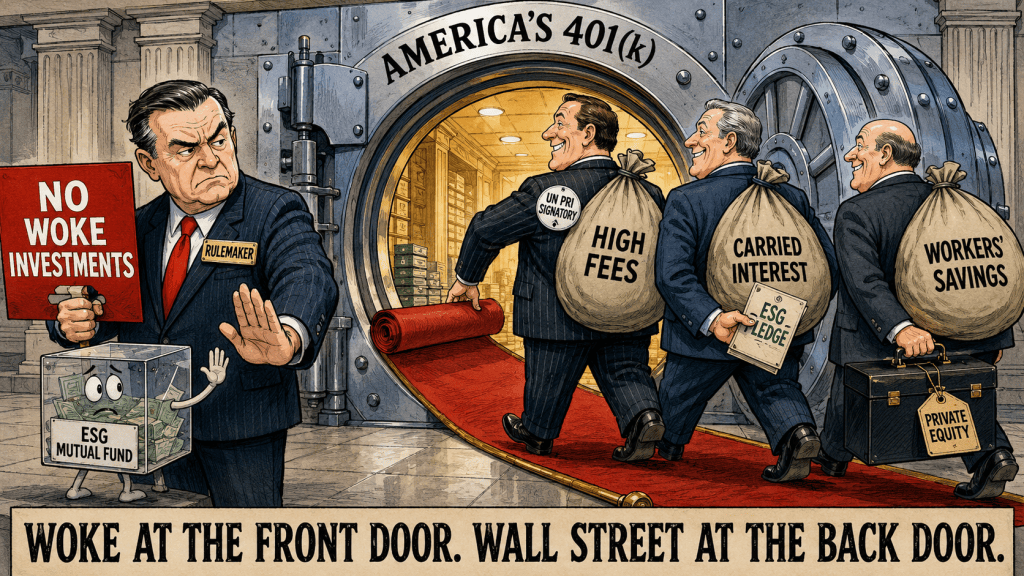
The Trump administration is preparing to tell 401(k) fiduciaries that they must not use workers’ retirement savings to advance environmental, social or political objectives.
At the same time, the administration is trying to make it easier—and legally safer—for those same fiduciaries to funnel workers’ savings into private-equity firms that have spent years publicly pledging allegiance to the United Nations’ Principles for Responsible Investment.
Apparently, an investment becomes “woke” only when it is transparent, low fee, publicly traded and easy to remove from a 401(k). Put the same ESG commitments behind a private-equity curtain, add layers of fees and carried interest, and Republican regulators suddenly call it “democratizing access.”
Two 401(k) Rules Going in Opposite Directions
Luis Garcia at the Wall Street Journal identified the contradiction.
The Department of Labor is reportedly preparing a proposal that would reverse the Biden-era ESG rule and require 401(k) fiduciaries to concentrate exclusively on “pecuniary” considerations. Daniel Aronowitz, head of DOL’s Employee Benefits Security Administration, has characterized ESG and diversity-oriented investment strategies as potentially “disloyal” to retirement savers.
But DOL has already proposed another rule intended to encourage target-date funds and other 401(k) options to invest in private equity, private credit, real estate, infrastructure, cryptocurrency and other alternative assets.
The March 2026 proposal would give fiduciaries a presumption of prudence when they follow specified procedures. It repeatedly emphasizes “maximum discretion” for fiduciaries and openly says that one purpose is to reduce the litigation risk that has discouraged private-market investments.
One rule effectively says:
Do not let nonfinancial environmental or social considerations influence a 401(k) investment decision.
The other says:
We want to protect fiduciaries who place workers into opaque private-market funds—many managed by firms that have formally promised the United Nations that they will incorporate ESG considerations into investment decisions.
That is not a coherent fiduciary policy. It is a political exemption for Wall Street.
Wall Street Journal: Trump Administration Rulemakers Diverge on 401(k) Investment Offerings
DOL’s proposed private-assets safe harbor
What Private-Equity Firms Promised the United Nations
The Principles for Responsible Investment, commonly called PRI or UN-PRI, were launched with United Nations support. Investment managers that become signatories commit to six principles, including commitments to:
- Incorporate ESG issues into investment analysis and decision-making.
- Be active owners and incorporate ESG issues into ownership policies and practices.
- Seek ESG disclosures from the entities in which they invest.
- Promote acceptance of the principles throughout the investment industry.
- Cooperate with other signatories to implement the principles.
- Report on their activities and progress toward implementing them.
PRI does not merely ask managers to acknowledge that climate, labor practices or governance failures can affect investment values. Its principles call for ESG incorporation, active ownership, industry promotion and public reporting.
Signing PRI also does not prove that every fund managed by a signatory is an ESG fund—or that the manager faithfully follows its promises. That distinction matters. But it does prove that the firm made a public, institutional commitment to incorporate and promote the very considerations Republican officials now condemn as “woke” when used elsewhere in retirement plans.
Private Equity Has Played Both Sides
Many of America’s largest alternative-asset managers have participated in PRI or related ESG and climate initiatives while simultaneously cultivating Republican politicians who attack ESG.
KKR, for example, has been identified in PRI materials as a signatory since 2009. Apollo appeared among PRI’s new signatories in 2021. Major private-market managers have built ESG departments, issued sustainability reports, marketed impact strategies and sought capital from pension systems with responsible-investment mandates.
Private equity was happy to speak the language of ESG when that helped raise trillions from California, New York, university endowments and European institutions.
Now that political power has shifted, the same industry speaks the language of energy dominance, national security, data centers and “democratizing” investment access. The label changes. The fundraising machine does not.
The key question is not whether private-equity executives are genuinely woke. It is whether Republican officials are willing to enforce their anti-ESG principles when enforcement might interfere with the fees collected by their major Wall Street allies.
So far, the answer appears to be no.
Florida Already Demonstrated the Hypocrisy
Florida officials led one of the nation’s loudest attacks on ESG investing. But the Florida Retirement System continued employing hundreds of outside investment managers, including many firms that had signed PRI or made comparable ESG commitments.
My earlier review of Florida’s investment holdings identified approximately 575 separate manager mandates, partnerships or investment vehicles. I could confirm that managers associated with approximately 201 of those relationships had signed PRI.
Florida’s holdings included multiple funds connected with some of the world’s largest alternative managers, including approximately:
- 3 Apollo funds
- 12 Blackstone funds
- 9 Carlyle funds
- 2 KKR funds
- 4 JPMorgan funds
- 4 Oaktree funds
- 11 Thoma Bravo funds
These counts should not be misrepresented as 201 separate ESG funds. They demonstrate something more politically revealing: Florida attacked ESG in public while continuing to send pension money to managers that had made institutional ESG commitments.
The state did not purge private equity. It did not eliminate the managers’ high fees, illiquid structures, self-valued assets or conflicts of interest. It largely purged the word “ESG.”
Florida Retirement System 2020–21 ACFR, investment listings at pages 123–133
Ohio and Kentucky Are Running the Same Play
Ohio’s retirement systems employ many of the same high-fee private-equity and private-credit managers. Yet Ohio’s anti-ESG political network attacks selected public investment managers while leaving the alternative-investment establishment remarkably undisturbed.
The State Financial Officers Foundation, or SFOF, has helped convert “anti-woke investing” into a national political fundraising vehicle. But politicians associated with that movement have not demonstrated the same enthusiasm for confronting private-equity firms, data-center financiers or alternative managers that support them.
In Ohio, the connections among STRS investments, Republican political figures, SFOF, QED, Vivek Ramaswamy and Wall Street money deserve far more scrutiny.
Ohio STRS: Follow the Money—and Follow QED’s Seth Metcalf, SFOF and Ramaswamy Connection
Ohio’s Data-Center Money Machine: Husted, Ramaswamy, Faber, SFOF and Wall Street
Kentucky presents a similar shell game. Politicians attack ESG while maintaining relationships with private-market firms that have long used ESG commitments to attract institutional money.
Allison Ball’s ESG Shell Game: Follow the Money From Kentucky to KKR to SFOF
Investigations by Katya Schwenk and Julia Rock at The Lever and Lauren Windsor at Zeteo have documented how the anti-ESG campaign intersects with political money, state financial officers and private financial interests.
The Lever: Alleged Fraudsters Are Fueling Trump’s “Fraud” Crusade
The Lever: How Dark Money Enabled Vivek Ramaswamy’s Cash Grab
Zeteo: Kreifels’ “War on Woke” Cash Grab in Alaska
Private Equity Presents the Bigger Fiduciary Problem
A publicly traded ESG mutual fund generally provides daily pricing, published holdings, standardized expense disclosures and daily liquidity. A fiduciary can compare it against public benchmarks and remove it without waiting years for the manager’s permission.
Private equity may provide none of those protections.
Workers can face:
- Management fees, carried interest and portfolio-company charges that are difficult to calculate.
- Illiquid holdings that cannot be sold when participants need their money.
- Manager-generated valuations rather than observable market prices.
- Return smoothing that disguises volatility and correlation.
- Stale valuations that can make a target-date fund appear less risky than it really is.
- Subscription lines and other financial engineering that can inflate reported internal rates of return.
- Conflicts involving affiliated advisers, insurers, lenders, continuation funds and portfolio companies.
- ESG and impact claims that are even harder to verify than those made by public mutual funds.
If DOL is genuinely worried about fiduciaries sacrificing participants’ financial interests to political or social objectives, private-market impact funds should be examined at least as closely as publicly traded ESG funds.
Instead, DOL proposes to give alternative investments a special presumption of prudence.
That is not removing politics from 401(k)s. It is selecting which politically connected industry receives regulatory protection.
Require Private-Equity Firms to Choose
Before any PRI-signatory manager receives access to 401(k) target-date funds or protection under DOL’s proposed safe harbor, plan fiduciaries should obtain clear written answers:
- Is the manager currently a PRI signatory?
- Which PRI commitments apply to the manager and the proposed fund?
- Does the manager incorporate environmental or social considerations into investment decisions?
- Are those considerations treated only as financially material risks, or does the fund pursue separate impact objectives?
- Has the manager marketed substantially similar strategies as ESG, sustainable or impact investments to other investors?
- Does the fund’s compensation depend on valuations supplied by the manager?
- Can participants independently determine all management fees, carried interest and portfolio-company charges?
- What liquidity, valuation and conflict protections exist specifically for 401(k) participants?
- Has the manager’s political positioning changed while its underlying investment practices remained substantially the same?
- If ESG considerations are supposedly “disloyal,” why should a firm that promised to incorporate and promote them receive a federal 401(k) safe harbor?
DOL should also publish a cross-reference of alternative managers seeking 401(k) access against PRI and other climate, sustainability and impact-investing commitments.
The Bottom Line
The administration’s message appears to be:
ESG is dangerous when used to select a transparent mutual fund—but acceptable when embedded inside an opaque, illiquid and extremely expensive private-equity fund.
Republican officials are not necessarily eliminating ESG from retirement investing. They may simply be clearing away lower-fee competition while granting politically connected private-equity firms privileged access to trillions of dollars in 401(k) savings.
Private equity signed the “woke pledge” when doing so helped raise public-pension money. Now it supports politicians attacking that pledge while asking them to open the 401(k) vault.
Workers should not be forced to finance both sides of Wall Street’s political shell game.

