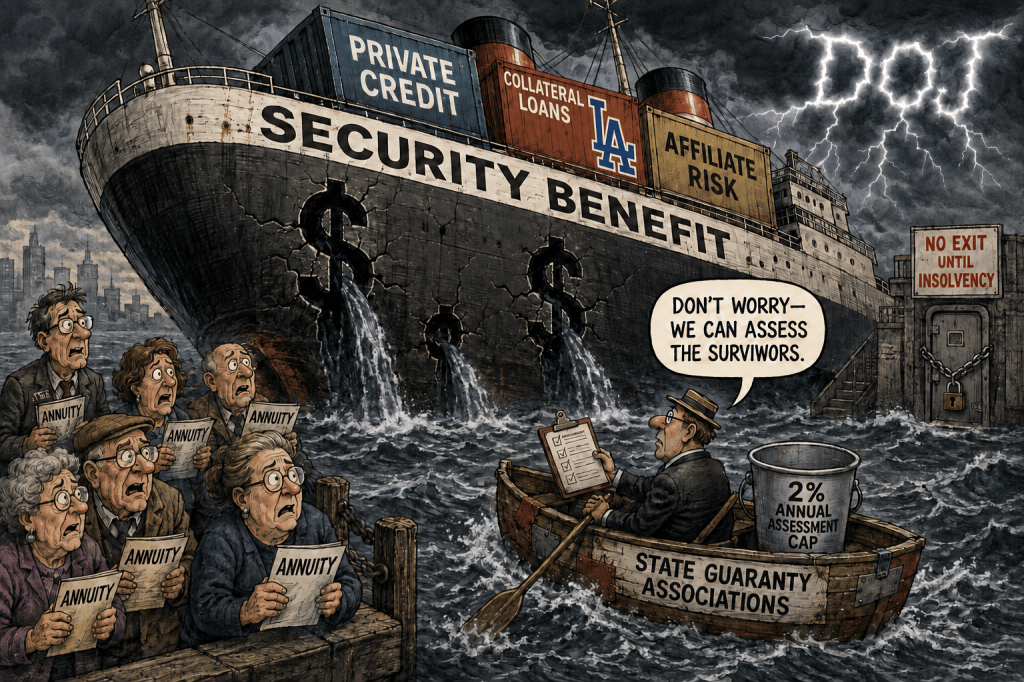
Waiting until Security Benefit is officially declared insolvent to discuss the danger would be absurd. By then, annuity owners would already be trapped, regulators would already have imposed restrictions, questionable assets would already be difficult to sell, and the state guaranty associations would be scrambling to construct a rescue with money they do not presently possess.
Security Benefit may be the largest major-carrier annuity risk since AIG.
The company reported approximately $66.83 billion in admitted assets and $59.53 billion in liabilities as of June 30, 2026. Behind those reassuring statutory numbers lies an extraordinary concentration in collateral loans, private assets and transactions connected to the sprawling sports-finance-insurance empire built around Guggenheim, Todd Boehly, Mark Walter and their former associates.
Security Benefit reportedly held 47% of all collateral loans held by the entire U.S. life-insurance industry in 2024. One of those loans—approximately $185 million—was linked to Boehly’s interest in the Los Angeles Dodgers. Regulators have warned that collateral loans are being used to obtain lower capital charges than would apply if insurers held the underlying risky assets directly. Security Benefit and the Kansas Insurance Department successfully pushed the NAIC to delay stronger capital rules until 2027. Financial Times
That is not a minor accounting disagreement. It goes directly to whether Security Benefit’s reported capital adequately reflects the economic risks supporting tens of billions of dollars of annuity promises.
The federal investigation is a warning that cannot be ignored
The Justice Department and SEC investigations into Mark Walter’s insurance empire concern allegations that billions of dollars of apparently “unaffiliated” private-credit investments may actually have supported Walter-connected businesses.
Delaware Life subsequently restated its affiliated investments from less than 5% to approximately 42% of assets. Federal prosecutors reportedly are examining whether intermediary companies obscured the financial connections between insurer-funded loans and Walter’s broader business empire. Reuters
Security Benefit has not been publicly identified as the recipient of those subpoenas. But treating it as safely removed from the problem ignores the history and structure of the enterprise.
Walter and Guggenheim helped build the modern private-equity insurance machine that included Security Benefit. Boehly came out of the same Guggenheim organization. The Dodgers transaction connected Walter, Boehly, Guggenheim and insurance money. Security Benefit subsequently held a collateral loan backed by Boehly’s Dodgers interest. Meanwhile, Security Benefit became the overwhelmingly dominant insurance-industry user of the very collateral-loan structure regulators say may permit capital arbitrage.
The federal investigation next door is not proof that Security Benefit is safe. It is a warning flare illuminating the same financial architecture:
- insurer money;
- private-credit intermediaries;
- assets classified as unaffiliated;
- sports and other holdings connected to insurance-company owners;
- statutory accounting that may understate the underlying risk;
- weak state regulation; and
- affiliated managers extracting fees while annuity owners bear the ultimate credit risk.
The correct question is not whether Security Benefit has already been charged with a crime. The correct question is why retirement savers should wait for a subpoena, downgrade or receivership order before being allowed to escape.
A small valuation change could consume Security Benefit’s apparent cushion
Security Benefit’s reported admitted assets exceed its reported liabilities by approximately $7.3 billion. But when a company has nearly $67 billion of assets, that apparent cushion can disappear with a relatively modest valuation adjustment:
| Reduction in reported asset value | Approximate amount |
| 5% | $3.34 billion |
| 10% | $6.68 billion |
| 15% | $10.02 billion |
| 20% | $13.37 billion |
A 10% adjustment would consume almost the entire reported difference between admitted assets and liabilities.
Private credit makes this calculation particularly dangerous. Publicly traded bonds reveal losses continuously. Private loans, collateral loans and affiliated investments can remain near par because no market transaction forces the owner to recognize the cash price.
An insurer can report an asset at 100 cents while the amount that could actually be realized during a crisis is 70 or 80 cents. That accounting discretion ends when frightened annuity owners demand their money or a receiver must transfer the contracts to another insurer.
Security Benefit’s risk is therefore not merely that some private loans might eventually default. The more immediate danger is that the company could be unable to convert reported asset values into sufficient cash without recognizing large losses.
The state guaranty associations could not write a $10 billion check
NOLHGA reported approximately $7.53 billion of nationwide annual allocated-annuity assessment capacity for 2023. The industry cites this number as though $7.53 billion were sitting in a national reserve fund.
It is not.
The state guaranty-association system is largely post-funded. Its supposed capacity consists of legal authority to assess surviving insurers after a failure. That authority is:
- divided among 50 states and the District of Columbia;
- subject to different state statutes;
- generally limited to approximately 2% of applicable premiums annually;
- based on historical premium volume;
- not immediately collectible;
- not freely transferable among states; and
- frequently reimbursed through future state premium-tax credits.
NOLHGA is a coordinating organization, not a federal insurer with access to Treasury or Federal Reserve liquidity.
A Security Benefit failure would not be allocated according to where adequate assessment capacity happened to exist. Each state association would generally be responsible for Security Benefit annuity owners living in that state. A state containing a disproportionate share of Security Benefit contracts could face obligations far larger than its immediate ability to assess surviving insurers.
The nationwide total therefore conceals precisely the state-by-state mismatch that would matter during an actual liquidation. NOLHGA assessment reports
Future assessment authority does not pay present claims
The guaranty associations would not necessarily need to replace all $59.5 billion of Security Benefit’s liabilities. They would receive some assets from the estate, and contractual benefits above state caps would be left behind as claims against the failed insurer.
But any solvent insurer asked to assume Security Benefit’s annuities would demand enough assets and capital to support them. If the private assets could not be reliably valued—or if they were worth materially less than their statutory carrying values—the buyer would demand billions in additional funding.
That money would be needed before assessments could be collected over many subsequent years.
The associations would then face an ugly menu:
- borrow against future assessments;
- issue bonds;
- impose a surrender moratorium;
- restrict transfers and withdrawals;
- stretch payments over several years;
- reduce credited benefits;
- impose liens on contracts;
- divide the business among several insurers; or
- leave more obligations in the insolvent estate.
The Chicago Fed confirms that guaranty associations may issue bonds when annual assessments are insufficient, but they are not required to do so. It also explains that associations may seek court approval for permanent policy or contract liens when annual assessment capacity cannot meet their obligations or when economic conditions make reductions supposedly in the “public interest.” Federal Reserve Bank of Chicago
That means even the advertised $250,000 annuity protection is not the equivalent of an FDIC-insured deposit payable promptly in cash.
Executive Life already proved that guaranty associations do not make everyone whole
Security Benefit’s defenders want consumers to believe state guaranty associations would simply step in and honor covered annuities. Executive Life demonstrates otherwise.
Pulitzer Prize-winning journalist Gretchen Morgenson explains what actually happened in These Are the Plunderers, page 107:
“It wasn’t until later that it became apparent how disastrous the deal would be for policyholders. Courts in at least two states—Illinois and Pennsylvania—later concluded that the buyout arrangement driven by Garamendi had been unlawful. As a result guaranty funds in those two states had to make up their Executive Life policyholders’ losses.
“Most everyone else did not get made whole on their losses. In 2001 a forensic auditing firm concluded that policyholders’ damages were $3.9 billion.”
Executive Life remains the largest failure previously handled by the guaranty associations. Approximately $3.7 billion was assessed, yet policyholders received radically different treatment depending upon their contracts, location and timing.
Some were transferred and protected. Others spent years in uncertainty. Some received only a fraction of their promised payments. Some annuitants suffered approximately 30% payment reductions for two and one-half years. Approximately 1,500 Executive Life of New York structured-settlement annuitants ultimately faced benefit reductions.
Now compare that history with Security Benefit.
Executive Life’s guaranty-association assessments totaled about $3.7 billion. A 10% downward valuation adjustment to Security Benefit’s reported assets would equal approximately $6.7 billion. A 15% adjustment would exceed $10 billion.
Security Benefit could require a rescue several times larger than the largest one the system has ever completed.
Security Benefit poses the exact danger Granato identifies
Andrew Granato and Pranjal Drall explain that state guaranty assessments are imposed according to premium volume rather than the risks created by individual insurers. Conservative insurers therefore finance the failures of competitors that pursued more aggressive investment and capital strategies.
The system allows an aggressive insurance owner or affiliated asset manager to collect:
- investment-management fees;
- private-credit origination fees;
- spreads between annuity crediting rates and investment returns;
- financing benefits for affiliated or connected enterprises; and
- increased equity value produced by lower regulatory capital requirements.
If the strategy succeeds, the owners and managers keep the gains. If it fails, the insurer absorbs the losses, policyholders lose benefits above statutory limits, competing insurers are assessed, and taxpayers reimburse many of those assessments through premium-tax credits. University of Texas Law School
Security Benefit’s extraordinary use of collateral loans makes it a prime example of this problem. The risk was concentrated inside the insurer, while the eventual cost could be shifted to everyone else.
The state guaranty system could become a contagion machine
A Security Benefit failure would probably not occur in isolation. The conditions severe enough to impair its private-credit and collateral-loan portfolio would likely also be damaging other insurers holding:
- private credit;
- CLOs;
- commercial real-estate loans;
- private asset-backed securities;
- affiliate-originated investments; and
- offshore reinsurance recoverables.
The guaranty associations would then assess surviving insurers already suffering from the same market losses.
The mechanism is procyclical:
Instead of stopping contagion, the guaranty system could accelerate it by extracting liquidity from the remaining insurers during the worst point in the crisis.
That is precisely why the federal government rescued AIG. Washington did not wait to discover whether fragmented state receiverships and post-failure assessments could handle a giant, interconnected insurance collapse.
Waiting for insolvency means waiting until annuity owners are trapped
State regulators habitually tell the public that an insurer meets statutory capital requirements until the day they seize it. That is not meaningful protection for an annuity owner.
The relevant warning points occur earlier:
- affiliated exposure rises;
- private assets become increasingly opaque;
- regulators postpone stronger capital charges;
- ownership structures become more complicated;
- related companies begin selling assets or attempting restructurings;
- auditors or whistleblowers identify reporting weaknesses;
- federal authorities issue subpoenas;
- ratings outlooks deteriorate; and
- market liquidity disappears.
By the time a court issues a liquidation order, the ability to protect the participant has largely vanished. Surrender rights can be frozen. Downgraded assets cannot be sold without recognizing losses. The participant becomes an involuntary creditor of the insurer, receiver and guaranty association.
This is why annuities used in ERISA plans need meaningful downgrade and exit provisions. Participants should be able to leave when the insurer’s financial strength deteriorates—not years later, after a court officially confirms what markets and regulators should have recognized earlier.
Bottom line
Security Benefit may represent the greatest major-carrier annuity danger since AIG because it combines:
- nearly $67 billion of admitted assets;
- enormous annuity obligations;
- extraordinary concentration in collateral loans;
- disputed capital treatment;
- exposure connected to the Dodgers;
- historical ties to the Guggenheim insurance operation;
- weak state oversight;
- and a federal investigation exposing potentially hidden affiliations elsewhere in the same insurance and private-credit ecosystem.
The state guaranty associations are not prepared to replace a multibillion-dollar hole at a company of this size. They possess future assessment authority, not present capital. Their protection is fragmented, capped, conditional and vulnerable to years of delay.
Executive Life showed that many policyholders can remain unpaid even after billions are assessed. Security Benefit could be several times larger, harder to value and more interconnected with private credit.
Calling annuities “guaranteed” while relying on this system is not consumer protection. It is an invitation to wait until the exits have been locked.


Pingback: The CLEAR Forms Act Could Hide the Next Mark Walter | The CommonSense 401k Project
Pingback: New England Law Paper Exposes the Private-Credit Time Bomb Behind “Guaranteed” Annuities | The CommonSense 401k Project
Pingback: Elizabeth Warren May Be the Insurance Industry’s Only Real Watchdog—and a CFPB-Style Federal Regulator Is Its Worst Nightmare | The CommonSense 401k Project
Pingback: State Guaranty Associations Behind Annuities Are Still a Joke—And Private Equity Has Made the Joke More Dangerous | The CommonSense 401k Project
Pingback: Congress Finally Asks Whether America Needs a Federal Insurance Regulator. The Answer Is Yes. | The CommonSense 401k Project