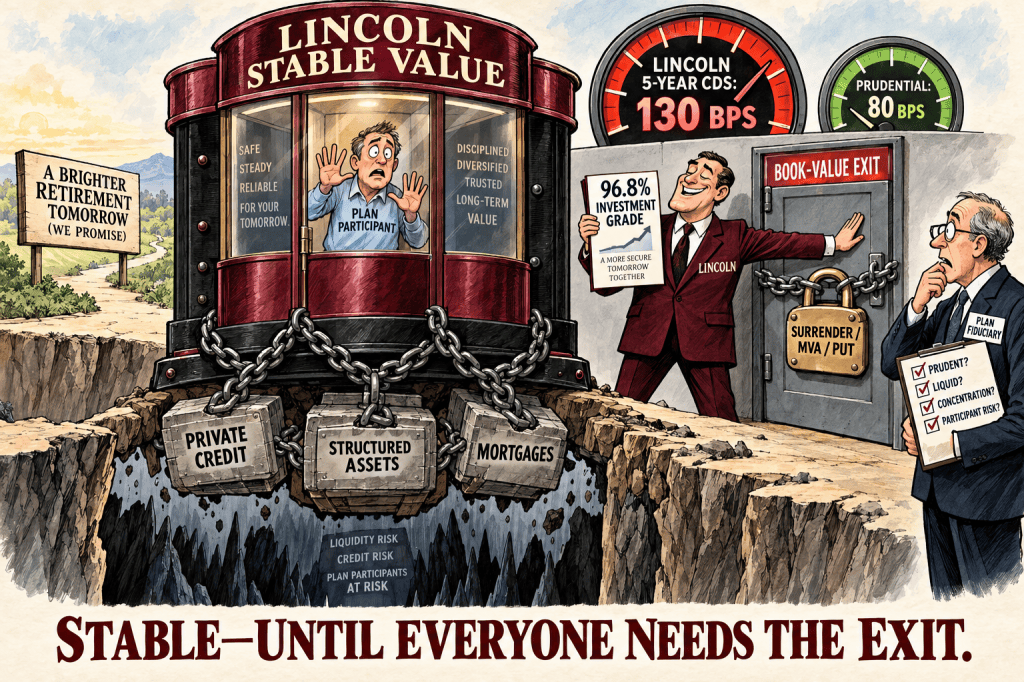
Lincoln Financial’s new stable-value marketing piece for 401(k) and 403(b) plans is carefully constructed to reassure retirement-plan fiduciaries. It boasts that 96.8% of its general-account portfolio is “investment grade,” emphasizes “disciplined risk management,” and describes private credit as a source of attractive returns and diversification.
But Lincoln omits the market measure that is hardest to spin: the price investors demand to insure Lincoln National’s debt against default.
Lincoln’s CDS spread is roughly 62% higher than Prudential’s
On September 14, 2026, Lincoln National’s five-year credit-default-swap spread was approximately 130.5 basis points. Prudential Financial’s comparable five-year CDS was approximately 80.5 basis points on September 15.
| Five-year CDS | Spread | Approximate annual protection cost on $10 million |
| Lincoln National | 130.5 bps | $130,500 |
| Prudential Financial | 80.5 bps | $80,500 |
| Lincoln premium over Prudential | 50.0 bps | $50,000 |
Thus, the market was charging approximately 62% more to insure Lincoln National debt than Prudential debt.
That does not mean Lincoln is about to fail. It means sophisticated market participants continue to price Lincoln as a materially weaker credit than Prudential. For an ERISA fiduciary concentrating millions of dollars in a single Lincoln fixed-annuity promise, that relative risk is directly relevant.
Lincoln’s risk has not simply disappeared
Lincoln’s CDS has retreated from its 52-week high of approximately 164.5 basis points. But the September level of roughly 130 basis points remained:
- Well above the 52-week low of approximately 91 basis points;
- About one-third above the approximately 98-basis-point level quoted in September 2025; and
- Far above Prudential’s approximately 80-basis-point spread.
Lincoln’s CDS also demonstrated how quickly market perceptions can change. In March 2023, its five-year CDS reportedly jumped to approximately 299 basis points, up from 185 basis points earlier that month.
That history matters because a fixed annuity is not a diversified bond fund. It is a concentrated contractual claim on one insurer. A fiduciary needs an exit mechanism before credit deterioration becomes a solvency event—not after.
“96.8% investment grade” does not answer the real questions
Lincoln’s headline sounds impressive, but it conceals several problems.
First, the percentage rests heavily on NAIC designations and private ratings. Lincoln’s own second-quarter disclosure says that private credit represents approximately 20% of its general account and that private-letter ratings cover approximately 6% of the general account. It also reports that 91% of the private-credit portfolio is “investment grade.”
That is not the same as saying these assets have observable market prices, active secondary markets or ratings from the major nationally recognized agencies. The label “investment grade” does not make a privately originated loan liquid.
Second, Lincoln’s marketing piece discloses substantial exposure to asset categories that can become difficult to value or sell during market stress:
| Lincoln allocation | Percentage |
| Structured assets | 17.7% |
| Mortgage loans | 17.6% |
| Alternatives | 3.3% |
Those categories total 38.6%, although they overlap conceptually with Lincoln’s separately reported private-credit exposure and therefore should not simply be added to the 20% private-credit figure. The overlap itself illustrates the disclosure problem: Lincoln presents multiple classification systems without giving fiduciaries a clean asset-level reconciliation.
Third, Lincoln tells readers that private credit offers “attractive returns.” It does not explain who receives those returns. Participants receive the annuity’s declared crediting rate. Lincoln keeps the difference between what its general-account assets earn and what it credits to contract holders. Lincoln’s SEC filing expressly describes this spread as a source of profit.
Lincoln therefore promotes the higher yield of private credit while withholding the spread between that portfolio yield and the much lower rate paid to retirement participants.
Lincoln discusses industry credit spreads—but not its own
The marketing piece states that investment-grade corporate spreads tightened during the second quarter and returned to historically narrow levels. Yet it never provides:
- Lincoln National’s own CDS spread;
- Its CDS trend over one, three or five years;
- A comparison with Prudential, MetLife, TIAA or MassMutual;
- The market spreads on Lincoln’s holding-company debt;
- Statutory surplus and unrealized-loss trends;
- Private-credit defaults, amendments or payment-in-kind exposure;
- The percentage of assets without observable market prices;
- The amount that could be liquidated within 30, 90 or 180 days;
- The contract’s actual withdrawal value; or
- A meaningful downgrade-triggered exit provision.
That is the central sleight of hand. Lincoln discusses “credit spreads” as a favorable general-market development while declining to disclose the market price of Lincoln’s own credit risk.
A 420% RBC ratio is useful—but it is not the entire answer
Lincoln separately reports an estimated risk-based-capital ratio above 420%. It also reported improved holding-company liquidity during the second quarter. Those are legitimate positive factors and should be acknowledged.
But RBC is a regulatory capital calculation built partly upon regulatory asset classifications. It is not a real-time market price of default protection, and it does not eliminate:
- Illiquid-asset valuation risk;
- Private-rating risk;
- Single-insurer concentration;
- Holding-company and subsidiary interdependence;
- Reinsurance counterparty risk;
- Surrender and withdrawal restrictions; or
- The risk that a plan cannot exit at book value after deterioration begins.
Lincoln’s own proposed reinsurance transaction was expected to consume approximately $200 million of statutory capital, or roughly ten RBC percentage points. That does not make the transaction imprudent, but it illustrates why fiduciaries must monitor movements beneath the headline ratio.
The important CDS qualification
Lincoln National’s quoted CDS generally references debt of the publicly traded holding company. The stable-value contracts are issued by insurance subsidiaries, including The Lincoln National Life Insurance Company. The CDS spread therefore is not a direct price for insurance-subsidiary policyholder claims.
But dismissing it for that reason would be equally misleading. Holding-company CDS incorporates the market’s assessment of the consolidated enterprise, including earnings capacity, capital flexibility, leverage, reserve risk and the ability to extract dividends from regulated subsidiaries. It is a forward-looking warning signal that can move much faster than insurer financial-strength ratings.
A prudent analysis uses both:
- Insurance-subsidiary financial-strength ratings, statutory capital and policyholder priority; and
- Holding-company CDS, bond spreads, equity performance and other market indicators.
The fiduciary question Lincoln’s brochure avoids
The issue is not whether Lincoln is presently insolvent. The issue is why a retirement plan should accept:
- A concentrated promise from a comparatively weaker insurer;
- A CDS spread materially wider than a major competitor’s;
- A general account containing substantial private credit, structured assets and mortgages;
- Limited transparency regarding asset valuation and liquidity;
- A crediting rate set substantially at Lincoln’s discretion; and
- No clearly disclosed right to escape at book value if Lincoln’s credit quality deteriorates.
Lincoln’s “96.8% investment-grade” headline does not answer that question. It merely repeats the regulatory labels assigned to the assets Lincoln owns.
The CDS market answers a different and more important question: What does the market charge to assume Lincoln’s credit risk?
In September 2026, the answer remained approximately 130 basis points—about 62% more than Prudential. Any fiduciary overseeing a large Lincoln fixed-annuity position should demand an explanation for that disparity, along with a written exit plan, before accepting Lincoln’s marketing assurances at face value.
Lincoln’s Single Entity Credit and Liquidity Risk in an ERISA Plan
When a Lincoln fixed annuity is offered as a standalone investment option in a 401(k), 403(b) or other participant-directed ERISA plan, participants are not buying a diversified portfolio of bonds. They are acquiring an interest in a contract whose value, liquidity and promised crediting rate depend substantially upon one insurance company.
That distinction is fundamental. The option may be labeled “stable value,” “fixed account” or “capital preservation,” but the label does not eliminate the concentrated counterparty risk underneath it.
The plan selected Lincoln before participants selected the option
Making the Lincoln annuity a voluntary, standalone option does not transfer responsibility for selecting and retaining it to participants.
ERISA fiduciaries decide:
- Whether Lincoln belongs on the investment menu;
- Which Lincoln contract and share class the plan receives;
- Whether it is a general-account or separate-account contract;
- The compensation and spread Lincoln may retain;
- The contract’s withdrawal and termination provisions;
- Whether competing capital-preservation options are restricted;
- Whether the plan receives a downgrade-triggered exit right; and
- Whether Lincoln remains prudent compared with available alternatives.
Participant choice occurs only after the fiduciaries make those decisions. Under Tibble v. Edison International and Hughes v. Northwestern University, fiduciaries have a continuing duty to monitor investment options and remove imprudent ones. The presence of other, better options on the menu does not excuse retaining an imprudent option.
ERISA Section 404(c) is not a safe harbor for the fiduciaries’ own selection and monitoring decisions. It may protect fiduciaries from certain losses caused by a participant’s exercise of control, but it does not transform an imprudently selected or inadequately monitored Lincoln contract into a prudent investment.
Participants can concentrate their entire accounts in one Lincoln promise
A plan-level menu may contain dozens of diversified mutual funds, but the relevant capital-preservation option can still contain essentially 100% exposure to Lincoln.
A participant who places $200,000 in a Lincoln general-account fixed annuity does not own $200,000 of the bonds, mortgages, private loans and structured assets displayed in Lincoln’s marketing materials. Lincoln owns those assets. The participant has an indirect claim based on the annuity contract and Lincoln’s claims-paying ability.
The participant therefore bears two layers of risk:
- Asset risk: The credit, valuation and liquidity risk of the investments Lincoln selects for its general account.
- Issuer risk: The risk that Lincoln cannot—or under contractual or regulatory conditions does not—perform its promise in full and on time.
Diversification inside Lincoln’s general account may reduce the first layer. It does not diversify the second. Regardless of how many loans or securities Lincoln owns, the participant remains exposed to a single contractual promise-maker.
Lincoln’s CDS spread places a market price on that single-entity risk
In September 2026, Lincoln National’s five-year CDS spread was approximately 130 basis points, compared with approximately 80 basis points for Prudential Financial. The market therefore charged roughly 62% more to protect Lincoln National debt against default than comparable Prudential debt.
CDS on Lincoln National Corporation’s holding-company debt is not identical to the credit risk of an annuity issued by The Lincoln National Life Insurance Company. Insurance subsidiaries are separately regulated, and policyholder claims may receive statutory priority unavailable to holding-company creditors.
Nevertheless, the CDS spread is highly relevant. It is a forward-looking market assessment of the consolidated enterprise’s leverage, earnings, reserves, asset quality and capital flexibility. It can identify changing risk much faster than financial-strength ratings.
The appropriate fiduciary response is not to treat CDS as proof that Lincoln will default. It is to ask why the market consistently prices Lincoln as a materially weaker credit than available insurers and whether participants receive enough additional return, contractual protection or liquidity to justify that additional risk.
A Lincoln option paying a lower crediting rate than a stronger insurer presents the most troubling combination: participants assume greater counterparty risk while receiving less compensation.
The fiduciary cannot conduct this analysis without determining the precise legal structure.
Most are Lincoln general account
With a general-account annuity:
- Lincoln owns and controls the supporting assets;
- The plan does not own a segregated portfolio of those assets;
- Lincoln generally determines the crediting rate under the contract;
- Lincoln retains the spread between portfolio earnings and the rate credited to participants;
- The plan depends on Lincoln’s claims-paying ability; and
- Plan-level liquidity depends on the withdrawal and termination provisions negotiated with Lincoln.
Lincoln acknowledges that it expects to earn a spread between returns on its general-account investments and amounts credited to general-account contract holders.
Lincoln’s portfolio disclosures do not eliminate the risk
Lincoln promotes a general account that it describes as approximately 97% investment grade. It also reports that private credit represents approximately 20% of the general account, with approximately 6% of the general account relying on private-letter ratings.
Those disclosures do not answer several material questions:
- How much of the portfolio lacks observable market prices?
- Which private ratings came from major agencies and which came from smaller rating firms?
- How many borrowers received amendments, maturity extensions or payment-in-kind accommodations?
- What portion could be sold within 30, 90 or 180 days without a material loss?
- What unrealized losses would be recognized if assets had to be sold?
- How much of the private-credit portfolio is subject to affiliated sourcing or management?
- How would a downgrade affect capital requirements and liquidity?
- What portion supports the particular insurance entity issuing the ERISA contract?
Calling an asset “investment grade” addresses expected credit loss under a particular rating methodology. It does not establish market liquidity, valuation reliability or the ability to sell the asset at carrying value during stress.
Credit and liquidity risk reinforce each other
Lincoln’s single-entity credit risk cannot be separated from the contract’s liquidity risk.
Under ordinary conditions, participants may be able to withdraw funds at book value for retirement, termination, hardship or transfers permitted by the contract. But participant-level benefit responsiveness is not the same as plan-level liquidity. If the fiduciaries decide to remove Lincoln entirely, the contract may impose:
- A market-value adjustment;
- A surrender charge;
- A multi-year installment or “put” period;
- Restrictions on transfers to competing funds;
- Equity-wash provisions;
- Delayed payment;
- A reduction from book value to market value; or
- A forfeiture of part of the accumulated value.
This creates an especially dangerous form of wrong-way risk. The time when the plan most needs to leave Lincoln—after a downgrade, a sharp CDS widening, deteriorating private-credit performance or regulatory intervention—may also be the time when an immediate exit is most costly or contractually difficult.
A fiduciary cannot prudently say, “We will leave if Lincoln becomes unsafe,” without first establishing that the contract permits the plan to leave at book value before the deterioration becomes severe.
A downgrade clause is essential
A properly drafted downgrade provision should permit the plan to terminate or transfer the contract without a surrender charge, market-value adjustment or extended payout period if specified credit events occur.
Possible triggers include:
- A financial-strength downgrade below a stated rating;
- Multiple downgrades within a specified period;
- A material CDS-spread threshold;
- Regulatory supervision or a capital-restoration event;
- An RBC ratio falling below an agreed level;
- A material adverse change in the issuing entity;
- Transfer or reinsurance of obligations without fiduciary approval; or
- A material change in investment guidelines or private-asset exposure.
CDS should normally serve as a monitoring or escalation trigger rather than the only automatic contractual trigger, because holding-company CDS can be volatile and may not precisely measure the issuing subsidiary. But a sharp or sustained widening should require a documented fiduciary review.
What a prudent Lincoln monitoring file should contain
At minimum, the committee should receive and document:
| Monitoring item | Required analysis |
| Exact issuer | Identify the Lincoln legal entity responsible for the contract |
| Contract structure | General account, separate account or hybrid |
| Lincoln five-year CDS | Current level, trend, 12-month range and peer comparison |
| Financial-strength ratings | Rating and outlook for the actual issuing subsidiary |
| Statutory capital | RBC ratio, surplus and multi-year trends |
| Asset quality | Public credit, private credit, structured assets, mortgages and alternatives |
| Private ratings | Percentage, rating providers and methodology |
| Liquidity | Assets convertible to cash within defined periods |
| Participant withdrawals | Circumstances permitting book-value payment |
| Plan termination | Immediate value, market-value adjustment and installment alternatives |
| Downgrade protection | Trigger, notice requirements and exit rights |
| Crediting rate | Gross portfolio yield, net credited rate and Lincoln’s retained spread |
| Comparators | Rates, credit strength and liquidity from TIAA, MassMutual and other insurers |
| Reinsurance | Counterparties, collateral and any transfer of contract obligations |
Lincoln reports an RBC ratio above 420%, which is a positive consideration. But a headline RBC ratio cannot replace this contract-specific inquiry.
Bottom line
A standalone Lincoln fixed annuity is not merely one more participant-selected fund. It is a plan-selected, concentrated exposure to one insurer, combined with contractual restrictions that may become most consequential precisely when Lincoln’s credit risk is deteriorating.
The fiduciary question is not whether Lincoln is presently insolvent. It is whether the committee:
- Understood the option’s single-insurer structure;
- Distinguished its general-account and separate-account risks;
- Compared Lincoln’s credit strength and CDS spreads with stronger insurers;
- Determined what participants received for assuming the additional risk;
- Investigated Lincoln’s private-credit and illiquid-asset exposure;
- Obtained a meaningful downgrade provision;
- Confirmed the plan could exit at book value during developing stress; and
- Repeated that analysis throughout the life of the contract.
Without that process, calling the product “stable value” merely describes the accounting experience Lincoln promises under normal conditions. It does not establish that the option is diversified, liquid or prudent under ERISA.

