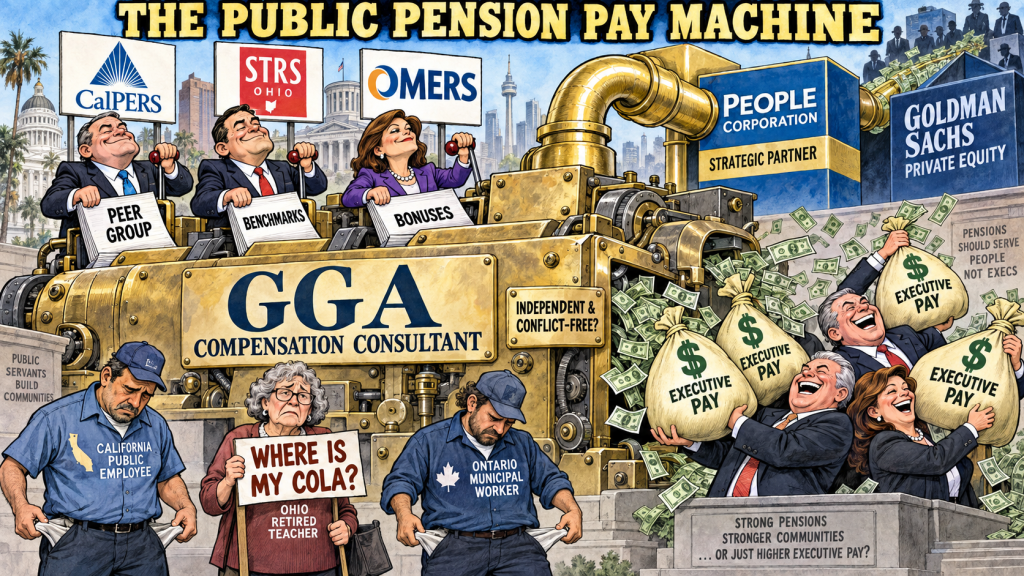
Public-pension executives have discovered a remarkably effective way to set their own pay: hire a consultant, define Wall Street as the labor market, select the best-paid investment organizations as “peers,” and then announce that millions of dollars in compensation are merely what the market requires. What results are government employees making double to triple of what they could make in the private sector.
Global Governance Advisors, or GGA, has become one of the consultants helping public pensions perform this ritual. GGA has advised CalPERS and the State Teachers Retirement System of Ohio, while listing OMERS Ventures—the venture-capital arm of the Ontario Municipal Employees Retirement System—among its clients.
These are not three systems with an obvious record of performance that justifies extraordinary compensation. They are three systems where executive or investment-staff pay has become controversial while participants have endured weak relative performance, benefit insecurity, lost purchasing power or all three.
The consultant does not technically cast the board’s vote. It supplies something nearly as valuable: the supposedly independent report that gives trustees permission to approve what management already wants.
CalPERS: Poor Results, Record Pay
CalPERS is the clearest example. GGA has served as its board compensation consultant since approximately 2020 and was selected again in 2026. Its work includes compensation benchmarking, incentive design and advice concerning executive and board pay.
During that relationship, CalPERS compensation has exploded. CEO Marcie Frost received approximately $1.7 million for fiscal 2024-25 and was subsequently reported as eligible for compensation approaching $2 million. The chief investment officer’s compensation has exceeded $2 million, while hundreds of CalPERS employees now receive compensation that would have been unthinkable at a public retirement system a generation ago. https://calmatters.org/economy/2026/09/calpers-ceo-record-bonus/
CalPERS attempts to justify this by comparing itself with private investment managers and other giant pension organizations. But CalPERS employees do not raise capital, risk their own money or face redemptions when performance disappoints. Their organization receives mandatory contributions from public employers and workers. Its liabilities are supported by taxpayers, and its executives enjoy public-sector job security and benefits. https://commonsense401kproject.com/2026/05/22/calpers-sets-its-own-excessive-pay-off-the-charts/
Even more important, the investment results have not justified the pay. CalPERS has ranked near the bottom of major California public pensions over meaningful three-, five- and ten-year periods. Its private-equity program has failed to produce the extraordinary net returns routinely invoked to justify private-market costs and compensation. Yet the pay ratchet keeps moving in only one direction. https://www.nakedcapitalism.com/2022/04/calpers-consultant-global-governance-advisors-recommends-further-overpaying-grossly-underperforming-calpers-staff.html
GGA’s benchmarking process helps convert failure into a salary increase. If CalPERS compares its executives with better-paid executives at larger or more successful investment organizations, the comparison produces a “market” case for higher pay regardless of CalPERS’ own results. Once CalPERS raises compensation, another pension consultant can place CalPERS in the next client’s peer group. The consultants manufacture a perpetual-motion machine for executive pay.
STRS Ohio: Bonuses While Teachers Lost Their COLA
The State Teachers Retirement System of Ohio hired GGA as its governance consultant in 2024. Even so-called reform trustees were cajoled into hiring GGA despite knowing of their excessive pay support at CALPERS.
STRS Ohio may be an even uglier example of the disconnect between staff rewards and participant outcomes. Ohio teachers endured years without a reliable cost-of-living adjustment. Inflation permanently eroded the value of their pensions. At the same time, investment employees received large performance bonuses based on benchmarks and methodologies that participants and reform trustees repeatedly challenged. A recent academic study has confirmed this twisted relationship. https://commonsense401kproject.com/2026/08/07/ohio-strs-responds-to-charges-it-gamed-its-own-bonuses-with-more-games/
The system’s answer was not to suspend the bonus machine until retirees were made whole. It hired more consultants, debated more governance procedures and defended the compensation structure.
GGA did not create every STRS Ohio compensation practice but GGA accepted a paid role inside a system already notorious for rewarding investment staff while retired teachers lost purchasing power. It is now part of the machinery that legitimizes how that system governs itself.
OMERS: High Pay and Historically Low Relative Returns
GGA also displays OMERS Ventures among the clients on its website. OMERS is one of Canada’s largest public pension organizations and operates substantial private-equity, infrastructure, real-estate and venture-capital businesses.
It has also been the subject of one of Canada’s strongest public-pension compensation critiques.
In 2022, CUPE Ontario released High Pay, Low Returns: Why Are OMERS Executives Paid So Much? The study found that OMERS paid some of the highest absolute executive compensation among major Canadian pension plans even though it was smaller than several of the funds used for comparison. On a per-billion-dollar basis, OMERS paid its top executives more than twice the peer-plan average. CUPE calculated that OMERS members paid approximately 68 percent more executive compensation for every percentage point of investment earnings. https://cupe.on.ca/high-pay-low-returns-why-are-omers-executives-paid-so-much-cupe-ontario-renews-call-for-review-at-omers-with-new-report/?utm_source=chatgpt.com
The underlying performance record made the pay especially difficult to defend. OMERS had underperformed the other major plans in CUPE’s comparison and failed to meet its own ten-year benchmarks. In 2020, it lost 2.7 percent while most other large Canadian public pension funds made money. Nevertheless, CUPE reported that the five highest-paid OMERS executives received roughly C$8 million in bonuses in the relevant year and more than C$32 million over two years.
CEO Blake Hutcheson’s compensation was approximately C$5.14 million in 2021 and C$5.16 million in 2022. Individual OMERS executives have received still larger amounts in particular years. A separate dispute exposed the scale of deferred compensation below the CEO headline: former OMERS Infrastructure chief Michael Rolland sued for approximately C$65 million in allegedly unpaid compensation after receiving a C$5 million payment in 2020.
The public record establishes that GGA claims OMERS Ventures as a client. It does not yet disclose the scope of that assignment or prove that GGA designed OMERS’ executive-pay program. That missing information is itself important. OMERS should disclose every GGA contract, invoice, peer group, compensation study and conflict statement, including work performed for OMERS Ventures, OMERS Private Equity, OMERS Infrastructure, Oxford Properties and the OMERS Administration Corporation.
The Private-Equity Pipeline Behind the “Independent” Consultant
GGA describes itself as independent and “conflict-free.” Its principals appear to own the consulting firm. That narrow legal description, however, does not tell the whole economic story.
GGA has a formal strategic partnership with People Corporation, a Canadian benefits, retirement and human-resources conglomerate serving more than 2.6 million plan members. GGA’s own website expressly acknowledges that People Corporation is financially backed by Goldman Sachs’ Merchant Banking Division.
That description understates the relationship. Goldman Sachs investment funds acquired People Corporation in 2021 for approximately C$1.13 billion and took it private. People Corporation is therefore not simply an unaffiliated vendor appearing next to GGA at an occasional conference. It is a private-equity-controlled strategic partner through which GGA offers clients group-benefit consulting, defined-contribution plans, group retirement services and pension advice. GGA even supplies a dedicated People Corporation contact using a GGA-branded email address.
The structure resembles the broader public-pension consulting model visible at firms such as Callan and Meketa. The consulting firm’s principals may technically own the advisory entity, permitting it to market itself as independent. But technical ownership is not the same thing as economic isolation. Outside financial power and private-market money can enter through strategic partnerships, joint marketing, referral relationships, research sponsorships, conferences and the broader ecosystem of investment managers seeking public-pension assets.
In GGA’s case, the private-equity connection is not conjecture. Its declared strategic partner is controlled by Goldman Sachs private-equity funds. GGA also openly says it serves private-equity clients while advising the boards of public pensions that allocate billions to private markets and set compensation for executives running those portfolios.
That does not prove that Goldman Sachs dictated a CalPERS salary recommendation or that People Corporation participated in the STRS Ohio engagement. It does destroy the usefulness of the simplistic label “conflict-free.” A consultant embedded in a commercial alliance with a private-equity-owned retirement conglomerate must disclose the entire economic relationship before a public board relies on its advice.
The Compensation Loop
The recurring pattern is straightforward:
- A public pension produces mediocre or disputed results.
- Executives say they cannot retain talent without competing with Wall Street.
- A compensation consultant selects highly paid financial organizations as peers.
- The consultant recommends higher salary opportunities and larger incentive ranges.
- Trustees approve the increase and cite the consultant’s “independent” advice.
- Other pensions then use the newly inflated compensation as a benchmark.
- Participants absorb benefit reductions, missed COLAs, higher contributions and investment risk while staff compensation keeps rising.
The supposed market being measured is partly a market the consultants manufacture.
At CalPERS, poor long-term relative performance did not prevent record compensation. At STRS Ohio, lost retiree purchasing power did not stop investment bonuses. At OMERS, historically weak comparative returns coexisted with some of the highest executive pay in Canadian public pensions.
GGA’s presence across these organizations is not evidence of coincidence worth ignoring. It is evidence that trustees, participants and journalists should examine how a small network of consultants normalizes extraordinary compensation throughout the public-pension industry.
What Must Be Disclosed
Every public pension using GGA should disclose:
- All GGA contracts, proposals, invoices and amendments;
- Every compensation peer group and the criteria used to select it;
- All communications concerning incentive design and performance benchmarks;
- GGA’s complete list of public-pension and private-equity clients;
- Every payment, referral arrangement or revenue-sharing agreement between GGA and People Corporation;
- All services GGA or People Corporation provides to pension investment managers;
- Any communication involving Goldman Sachs Asset Management, Goldman Sachs Alternatives or Goldman-controlled funds; and
- Whether GGA considered funded status, benefit reductions, COLAs and transparent investable benchmarks before recommending higher compensation.
Boards should also prohibit compensation consultants from using private-sector asset managers as peers unless they quantify the enormous differences in capital risk, job security, fundraising responsibility, public benefits and institutional guarantees.
Public-pension executives are not entitled to Wall Street compensation merely because they manage Wall Street products. They manage workers’ deferred wages under a public trust. Their compensation should rise when beneficiaries become more secure and transparent, risk-adjusted performance improves—not simply when a consultant finds someone, somewhere, who is paid more.
GGA has helped public pension boards turn excessive compensation into a governance recommendation. Its partnership with a Goldman Sachs-controlled retirement company makes the need for full disclosure even more urgent.
The people whose money pays these consultants and bonuses deserve to know who is benchmarking whom—and who ultimately profits from the answer.
—————————————————————————————–


Pingback: Pension Staff Are Entering Football Coach Pay Territory While Helping Set Their Own Scoreboard | The CommonSense 401k Project