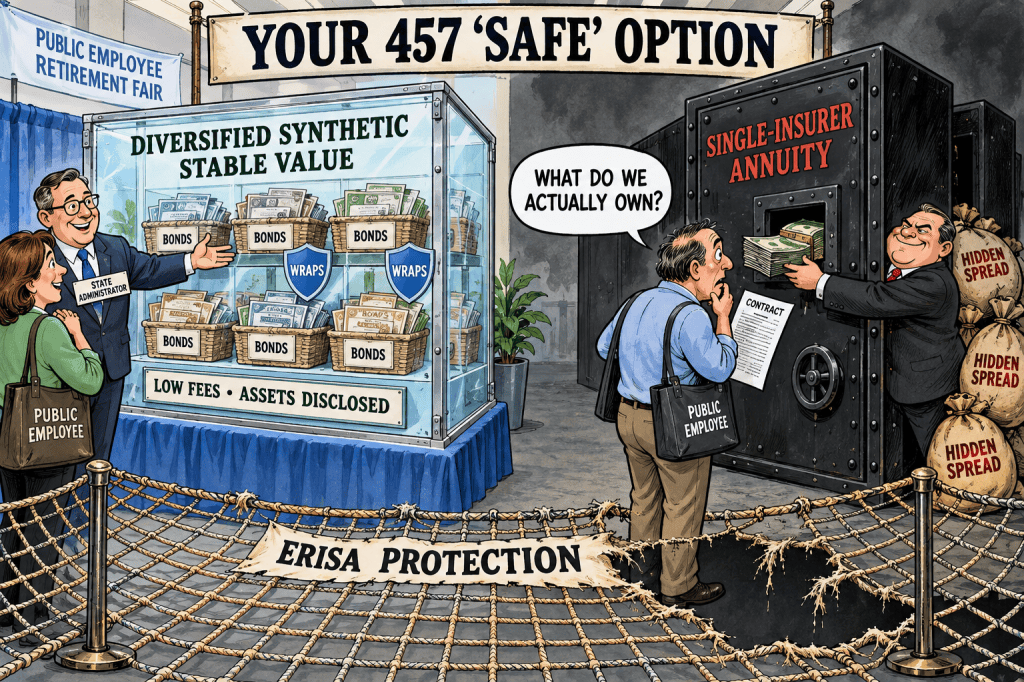
Private-sector employees in a competently run 401(k) can receive a low-cost, diversified synthetic stable-value fund: a transparent portfolio of bonds owned for participants, protected by contracts from several independent banks and insurers. No single insurer holds all the money. The portfolio, fees, market-to-book ratio, crediting rate and wrap providers can be disclosed and monitored.
Millions of state and local government workers get something very different.
Their 457 plan may put the entire “safe” option behind one insurance company. The insurer owns and invests the assets, sets the credited rate and keeps the undisclosed spread between what its portfolio earns and what workers receive. Participants generally cannot see the real investment-management charge because it is embedded in that spread. If the insurer is downgraded, becomes illiquid or loads its balance sheet with private credit, the worker owns an insurer’s promise—not the underlying bond portfolio.
Worst of all, governmental 457 plans are excluded from ERISA’s principal fiduciary and enforcement provisions. Public employees generally cannot bring the same ERISA prudence, loyalty, fee-disclosure and prohibited-transaction claims that private 401(k) participants can bring. State-law, contract and administrative remedies may exist, but they are fragmented and normally much weaker.
This creates two Americas of public retirement savings: government workers whose plans adopted modern, diversified stable value—and everyone left holding an opaque insurer IOU.
The 457 Plans That Got Stable Value Right
The following significant governmental plans have offered a custom or pooled diversified stable-value structure, rather than relying solely on one insurer’s general account. Precise structures and providers can change, so each plan should publish a current annual holdings-and-contract report.
| Plan | Diversified stable-value structure identified |
| California Savings Plus | Large custom stable-value portfolio |
| Indiana Deferred Compensation Plan | Diversified stable value |
| Kentucky Public Employees’ Deferred Compensation Authority | Diversified stable value |
| Maryland Supplemental Retirement Plans | Diversified stable value |
| Minnesota State Deferred Compensation Plan | Diversified stable value |
| Montana Deferred Compensation Plan | Diversified stable value |
| Nebraska Public Employees Deferred Compensation Plan | Diversified stable value |
| New York State Deferred Compensation Plan | Stable Income Fund monitored by a stable-value structure manager |
| Ohio Deferred Compensation | Large custom stable-value portfolio |
| Pennsylvania State Employees’ Deferred Compensation Plan | Stable Value Fund |
| North Carolina 457 Plan | State custom stable-value fund managed by Galliard; combined with the NC 401(k) stable-value structure |
| Virginia Deferred Compensation Plan | Galliard-managed bond portfolio using book-value contracts |
| Oregon Savings Growth Plan | State of Oregon Stable Value Fund managed by Galliard |
| NJ Transit 457 Plan | Diversified stable value |
| City of Milwaukee Deferred Compensation Plan | Diversified stable value |
| City of Seattle Voluntary Deferred Compensation Plan | Participation in the Wells Fargo/Galliard diversified stable-value structure |
These plans demonstrate the central point: a public 457 plan does not need to surrender participant assets to one insurer in order to provide principal preservation and a stable credited return.
Synthetic stable value separates the assets from the guarantee. The plan or collective trust owns a diversified bond portfolio. Several wrap providers can absorb book-value risk. Investment-management fees and wrap fees can be stated in basis points. A weak insurer can be replaced without liquidating the entire portfolio. That is a fundamentally different risk structure from lending every dollar to one insurance company.
The Single-Insurer and Disclosure Hall of Shame
Nevada: the clearest example
The Nevada Public Employees’ Deferred Compensation Program has openly described its capital-preservation option as the Voya Fixed Account—457/401 and, historically, as its “Stable Value/General Account” option. Nevada’s 2026 investment materials still discuss special terms for a five-year Voya Fixed Account contract.
That is not diversified synthetic stable value. It is concentrated exposure to Voya Retirement Insurance and Annuity Company. Voya controls the assets and the rate-setting machinery. Participants receive a declared rate while the insurer retains the spread. Nevada workers should be told the gross portfolio yield, the retained spread, asset composition, private-credit exposure, surrender restrictions and protections following a downgrade. A simple credited rate is not fee disclosure.
Colorado: an insurer-branded substitute
Colorado PERA’s published 457 lineup identifies a Great-West Stable Value Fund. Colorado should disclose whether participants own an independently managed bond portfolio, identify every wrap provider and publish the market-to-book ratio. If it cannot do that, it should stop allowing an insurer-branded product to be presented as equivalent to diversified synthetic stable value.
Florida: a vendor bazaar instead of one fiduciary standard
Florida’s Deferred Compensation Plan directs workers among multiple investment providers. That fragmented architecture makes it unusually difficult for a participant—or a taxpayer—to determine whether every provider’s “fixed,” “guaranteed” or “stable” option is a general account, a separate account or a diversified synthetic fund.
Florida should publish one statewide comparison showing, for every capital-preservation option: legal structure, asset owner, insurer, portfolio yield, participant rate, retained spread, expenses, surrender provisions, market-value adjustments, downgrade rights and guaranty-association status. Until it does, “exceptional investment options” is marketing, not disclosure.
Arizona, Texas, Georgia and Louisiana: prove it
Major public programs including Arizona Smart Save/ASRS supplemental plans, Texas Texa$aver, Georgia Peach State Reserves and the Louisiana Public Employees Deferred Compensation Plan do not provide the public with a simple, current document establishing that their capital-preservation option is a diversified synthetic fund with independently identified assets and multiple wrap providers.
That does not prove every one is a general-account annuity. It proves something nearly as troubling: workers cannot readily tell.
Each plan should answer seven elementary questions:
- Who legally owns the underlying assets?
- Is the option backed by one insurer or several independent wrap providers?
- What securities are in the underlying portfolio?
- What did that portfolio earn before the participant crediting rate was set?
- How many basis points did the insurer, manager and recordkeeper retain?
- What happens after an insurer downgrade?
- Can the plan terminate at contract value without a multi-year surrender penalty or market-value adjustment?
If a plan cannot answer those questions on a public webpage, its “stable value” disclosure has failed.
No ERISA Safety Net
The injustice is sharper because governmental plans are excluded from Titles I and IV of ERISA. The familiar federal duties of prudence and loyalty, ERISA’s prohibited-transaction rules, its participant disclosure regime and its civil-enforcement machinery generally do not protect governmental 457 participants.
A state employee placed in a high-spread, single-insurer annuity therefore may not have the lawsuit that a private employee would have over the same conduct. There may be state fiduciary statutes, open-records laws, constitutional provisions, contract claims or administrative review, but there is no uniform federal substitute for ERISA.
That regulatory gap increases—not decreases—the obligation of governors, treasurers, boards and 457 administrators to demand transparency. Yet too many public plans use the absence of ERISA as freedom from scrutiny.
A Fixed Annuity’s Hidden Fee Is the Spread
An insurer can advertise “no explicit fee” while earning 150, 200, 300 or more basis points between its portfolio yield and the rate credited to participants. Economically, that spread is compensation. Calling it a crediting-rate formula does not make it free.
The conflict is built into the product:
- The insurer selects the assets.
- The insurer values many of those assets.
- The insurer decides how much yield to pass through.
- The insurer keeps the remainder.
- The insurer may also serve as recordkeeper and control the participant disclosures.
Synthetic stable value is not costless, but its costs can be separated and reported: bond-management fee, wrap fee, custody fee and administration. A plan can compare those charges competitively. It can monitor market-to-book value, duration, credit quality and wrap capacity. It does not have to guess how much an insurer kept.
NAGDCA Should Publish the Number
The National Association of Government Defined Contribution Administrators maintains the Public Retirement Research Lab with data covering hundreds of public-sector defined-contribution plans and millions of participants. But its public reports combine 457(b), 401(a), 401(k), 403(b) and other plans and do not separate:
- diversified synthetic stable value;
- pooled synthetic stable value;
- insurer separate accounts;
- insurer general accounts; and
- money-market or Treasury capital-preservation options.
That omission protects the weakest products from comparison.
NAGDCA should publish, plan by plan, the legal structure of every capital-preservation option, its assets, participant balances, credited rate, gross portfolio yield, explicit fees, estimated retained spread, wrap providers, market-to-book ratio and termination provisions. The information should be public—not confined to a member benchmarking portal.
Based on currently available disclosures, only a small minority of governmental 457 programs—perhaps roughly 10% of the broader market—can readily be identified as offering diversified synthetic stable value. At least 16 significant state and local programs appear to do so. That estimate is necessarily provisional because the industry refuses to publish the data needed for an exact count.
The Reform Is Simple
Every governmental 457 plan should be required to do three things:
- Offer a low-cost diversified synthetic stable-value fund or explain publicly why it does not.
- Disclose every explicit fee and retained insurer spread in dollars and basis points.
- Adopt a contractual downgrade provision permitting an immediate contract-value exit when an insurer’s financial strength materially deteriorates.
Public employees should not receive weaker retirement protections merely because their employer is the government. If California, Ohio, New York, North Carolina, Virginia and Oregon can provide diversified stable value, Nevada and every opaque vendor-driven program can do it too.
The technology exists. The managers exist. The wrap capacity exists. What is missing is accountability.
Principal sources
- NAGDCA/EBRI, The State of Public Sector DC Plans: 2021: https://www.nagdca.org/download/the-state-of-public-sector-dc-plans-2021/
- IRS, governmental-plan treatment and ERISA exclusion: https://www.irs.gov/government-entities/indian-tribal-governments/irc-section-414d-governmental-plans-for-tribes
- Nevada 2026 investment lineup: https://defcomp.nv.gov/uploadedFiles/defcompnvgov/content/Meetings/2026/05.InvestmentLineUp.pdf
- Nevada fee disclosure identifying the Voya Fixed Account: https://defcomp.nv.gov/uploadedFiles/defcompnvgov/content/Home/Features/NevadaFeeBrochureFinal.pdf
- North Carolina Stable Value Fund materials: https://www.myncretirement.gov/documents/custodian-nc-401k-and-nc-457-plans-stable-value-fund
- Virginia Stable Value Fund profile: https://dcp.varetire.org/sites/default/files/2024-12/fund-profile-vr20.PDF
- Oregon Savings Growth Plan: https://www.oregon.gov/pers/mem/Pages/Oregon-Savings-Growth-Plan.aspx
- New York Stable Income Fund: https://www.nysdcp.com/rsc-preauth/investing/options-and-concepts/understanding-the-stable-income-fund/

