By Chris Tobe | | September 24, 2026
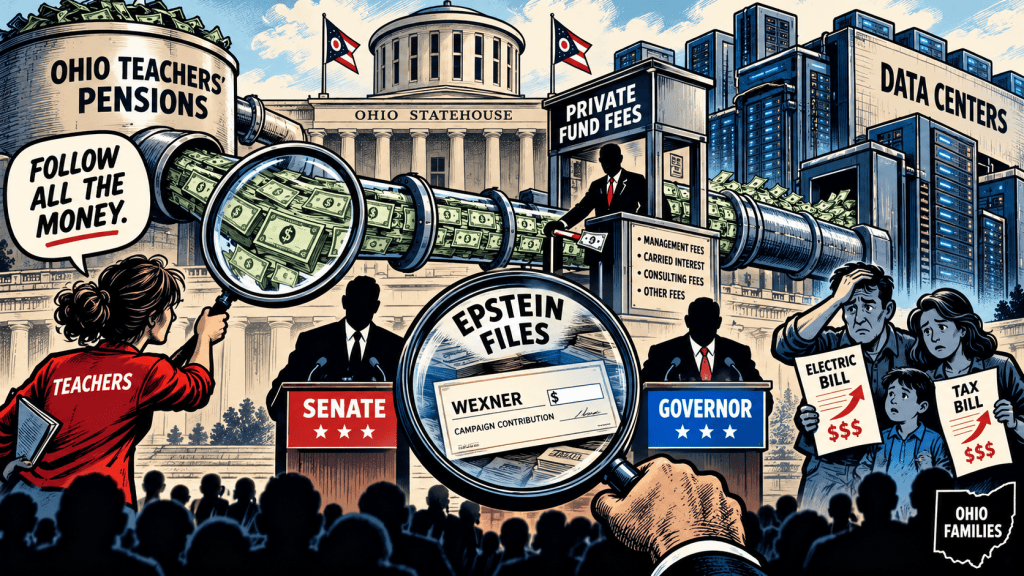
The Associated Press has put Leslie Wexner’s political money and Jeffrey Epstein at the center of Ohio’s U.S. Senate race. Good. But Ohioans should ask a larger question before they vote for senator and governor: Who gets rich from the state’s pension funds, public subsidies and electric grid, and who has the power to make them show their books? While Jeffrey Epstein is dead many key members of his network what many call the Epstein Class are still active. How do the leading candidates for Senate and Governor feel about divestment from Epstein linked Apollo in Ohio taxpayer funded pensions?
AP reports that Wexner contributed about $116,000 toward Jon Husted from 2001 through 2025, mostly during Husted’s state political career. That includes a $3,500 contribution to his Senate campaign in July 2025. Husted later joined Republicans who blocked a Democratic attempt to compel release of Epstein records; in November, he supported the stand-alone disclosure bill. Wexner testified that he never asked Husted to block disclosure.
Husted’s campaign has responded by pointing to donors to Sherrod Brown whose names appear in Epstein records, including Abigail Wexner and Larry Summers. There are thousands of wealthy Americans and celebrities named in the Epstein files, Brown probably has far less Epstein linked donors than most US Senators. This is a false flag.
Wexner says Epstein deceived him and denies knowledge of, or participation in, Epstein’s crimes. Survivors’ demands for answers deserve far more serious treatment than dueling campaign ads. AP recounts Maria Farmer’s allegation of a 1996 assault in New Albany, where Epstein had a house while working for Wexner. That is part of why this story matters in Ohio beyond television spots.
The pension trail AP’s election story leaves open
For decades, Wexner was a powerful Ohio political donor and Epstein’s major financial patron. A later, separate money relationship points to Apollo co-founder Leon Black, who paid Epstein more than $150 million for purported tax and estate services, including after Epstein’s 2008 conviction. Black has been held in contempt of congress for refusing to answer questions. These are the two major funders of Epstein as after Wexner slowed his financial support Black stepped up.
But Ohio has an obligation to examine the public money in the second relationship. As I have documented, Ohio retirement systems have invested with Apollo-managed vehicles. My examination of Ohio’s Epstein blind spot and the STRS teacher-pension debate ask for a fund-by-fund accounting. Black is Apollo largest shareholder and stepped down from the CEO role in 2021 after disclosure of his millions paid to Epstein.
How much did Ohio teachers, public employees and taxpayers pay Apollo-managed funds, by year and vehicle? What returns did each investment deliver after all fees? What exposure remains, and what would exiting an illiquid partnership cost? What due diligence was performed after the Black-Epstein payments became public and after the AFT and AAUP sought an SEC investigation in 2026?
The governor’s race is where these questions turn into decisions
Ohio’s governor appoints members of state pension boards and influences economic-development, utility and regulatory appointments. The choice between Vivek Ramaswamy and Amy Acton therefore matters to pension beneficiaries and households facing data-center electricity costs.
Ramaswamy brings particular disclosure questions. I previously examined his crypto holdings, Strive stake and the proposed Ohio cryptocurrency-reserve legislation. His interests and donors warrant careful conflict review whenever pension policy or state investment rules touch digital assets. Many of his donors are clearly in what people describe as in the Epstein class. Acton should face the same public-money test: name the trustees she would appoint, explain her standard for private-market fees and disclose how she would handle data-center subsidies and grid costs.
My data-center investigation describes the potential circular trade: public pensions invest with private-market managers; those managers finance data centers and power projects; communities supply tax benefits and infrastructure; households may pay higher utility costs. A follow-up traced campaign money and oversight questions involving Husted, Ramaswamy and Auditor Keith Faber.
Four disclosures voters should demand before November
- Campaign money: Husted and Brown should publish a reconciled list of contributions they attribute to people in the Epstein files, stating each person’s actual documented relationship rather than using the word “associate” as a verdict. Ramaswamy and Acton should disclose major donors with financial interests in Ohio pension management, cryptocurrency, data centers, power generation and utilities.
- Pension money: STRS, OPERS and the other state systems should disclose each Apollo-managed holding, commitment, current value, net return and total fees, including carried interest where available. Trustees should release the dates and conclusions of any updated manager review, with lawful redactions narrowly explained.
- Data-center money: Publish the beneficial owners of projects receiving state tax benefits; estimated forgone tax revenue; promised jobs; electricity and water demand; and the allocation of grid costs among developers and ordinary customers. Identify any material pension exposure to the project, its financing or its owners when records permit.
- Power over the money: Both gubernatorial candidates should commit to pension-board appointees who will demand these records and to clear recusal and disclosure rules for financial interests that overlap with state decisions. Senate candidates should state which federal transparency and investor-protection measures they will support.
Ohio voters deserve to know how their Senate and Governor candidates feel about divestment from Apollo holdings by taxpayer funded pensions. https://commonsense401kproject.com/2026/08/05/wydens-epstein-report-should-trigger-pension-divestment-from-jpmorgan-and-apollo/
Ohio has spent months debating who took a check from whom. The victims deserve justice, and voters deserve honest facts. The next question is larger: When the check comes out of teachers’ pensions, taxpayers’ subsidies or families’ electric bills, who follows it all the way to the recipient?
Editor’s sourcing note: The AP donation and voting account is linked above. The pension and data-center connections are subjects of my previously published investigations; the requested transaction-level fee and ownership disclosures remain unanswered. No inference of criminal participation follows from a donation, a mention in Epstein documents, a pension investment or a shared investment sector.

