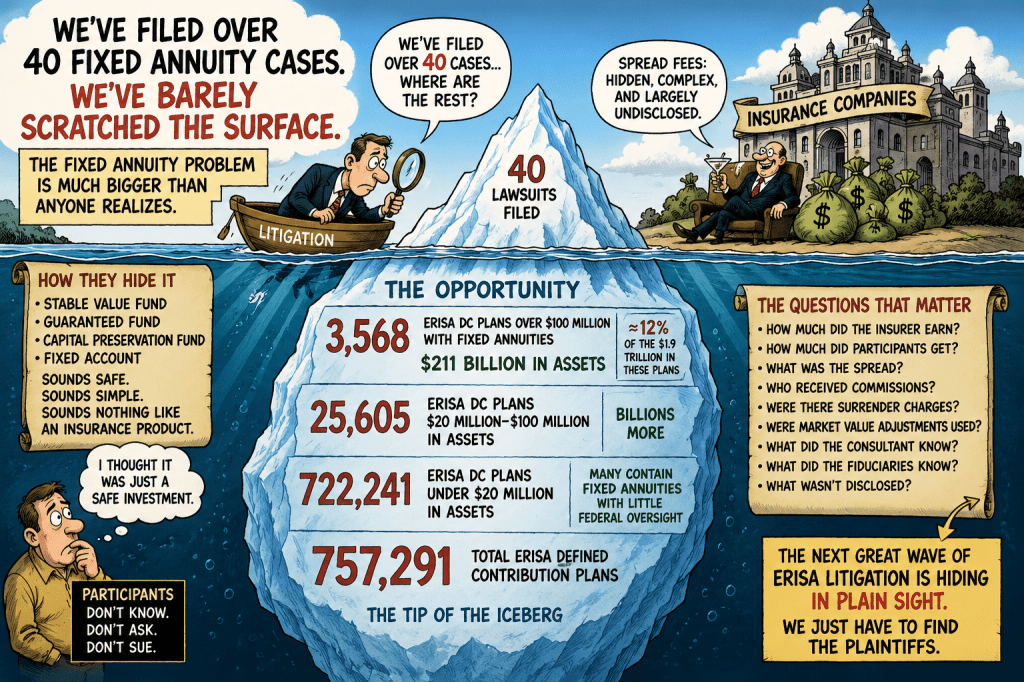
People sometimes ask me whether we’ve found most of the bad fixed annuity cases. Not even close. Over the past several years I’ve worked as an investment expert with ERISA plaintiff law firms helping investigate and file more than 40 fixed annuity excessive fee and prohibited transaction lawsuits. Those cases have uncovered hidden spread fees, insurance company conflicts, excessive compensation, and fiduciary failures that most participants never knew existed. But every time another case is filed, I come away with the same thought. We’re only scratching the surface.
The biggest problem isn’t developing legal theories anymore. It’s finding participants. Insurance companies have spent decades making sure participants don’t know they own an annuity. Instead, they see names like Stable Value Fund, Guaranteed Fund, Capital Preservation Fund, or Fixed Account. It sounds safe. It sounds simple. It doesn’t sound like an insurance product generating hidden compensation. So I decided to see how big this market really is.
I started with 9,404 ERISA defined contribution plans with more than $100 million in assets. I eliminated the low-cost providers—primarily Vanguard, Fidelity, State Street, and Schwab—and concentrated on the higher-fee insurance marketplace. That left about 4,000 plans. Then I reviewed the Form 5500 for every one of them. One by one. I wanted to know which plans actually offered fixed annuities and how much money participants had invested.
The answer surprised even me. I found 3,568 plans holding more than $211 billion in fixed annuity assets. Read that number again. $211 billion. And that’s only in the larger plans. There are another 25,605 ERISA defined contribution plans with between $20 million and $100 million in assets. Then there are the small plans. America has approximately 722,241 ERISA defined contribution plans with less than $20 million in assets. Based on my years inside the insurance business, I would not be surprised if roughly one-third of those plans also contain fixed annuities. In total there are approximately 757,291 ERISA defined contribution plans. Those numbers tell me something. The plaintiff bar hasn’t found all the cases. The plaintiff bar has barely started.
What surprised me even more was what I didn’t find. If you listen to today’s conferences, you’d think lifetime income annuities were taking over the retirement business. They aren’t. My review found that approximately 97% of the insurance products were traditional fixed annuities. Separate account products represented about 2%. Lifetime income annuities represented less than 1%. Variable annuities represented less than 1%. The product generating almost all the headlines is barely visible.
The product sitting quietly inside thousands of retirement plans is the one almost nobody discusses. Why? Because hidden fees are hard to litigate. Mutual funds tell you their expense ratio. Insurance companies generally don’t tell participants how much they make on the spread between what they earn and what they credit participants. That’s where much of the money is. I’ve seen this business from both sides.
Before becoming an expert witness, I spent seven years as an officer of seven Transamerica insurance companies. I know how these products are built. I know how the spreads work. I know why state regulation has been so attractive to insurance companies. And I know why participants rarely ask questions. They don’t know what to ask. That’s why I assembled this litigation list. Not because I think every plan belongs in court. But because every plan deserves to be investigated.
The next 40 cases won’t be hard to litigate. The hard part will be finding the participants who have no idea they own one of these products. When I look at 3,568 plans, $211 billion, and more than 757,000 ERISA defined contribution plans**, I don’t see the end of fixed annuity litigation. I see the beginning. ::
 The CommonSense 401k Project
Ask me about impact of terminal wealth on fifucisry duty to consider sltetnative investments. In one word…BOOM!
Yahoo Mail: Search, Organize, Conquer
LikeLike