Kentucky Republicans love talking about fiscal conservatism. They love local control.
They love complaining about government picking winners and losers. They love attacking ESG and Wall Street influence.
Then a multibillion-dollar data-center developer shows up. Suddenly the free market apparently needs a tax exemption.
Local control becomes an inconvenience. Corporate secrecy becomes economic development.
And Wall Street private equity becomes our new best friend.
Kentucky’s exploding data-center controversy is becoming a remarkably clean test of whether the state’s political establishment actually believes what it has been selling voters for years.
And the 2026 election gives Kentuckians an opportunity to demand an answer.
The Data-Center Gold Rush Wasn’t Free
I wrote in May about Kentucky’s emerging data-center gold rush.
The sales pitch sounds wonderful: artificial intelligence, billions of dollars of investment, construction jobs and the magic phrase every politician loves—”economic development.”
Look underneath the hood.
Kentucky created extraordinary sales-tax advantages for qualifying data centers. Some of these benefits can extend for decades.
Meanwhile, the infrastructure required by hyperscale data centers can be enormous. These facilities can consume staggering amounts of electricity. Communities have raised questions about water, transmission infrastructure, noise, land use and who ultimately pays for grid expansion.
Kentucky legislators themselves have effectively acknowledged the ratepayer problem.
House Bill 544, appropriately called the Kentucky Ratepayer Protection Act, was introduced in 2026 to require that data centers above 100 megawatts bear the capital and operating costs of infrastructure constructed to serve them rather than shifting those costs onto everybody else.
Think about what that tells us. Kentucky first raced to attract data centers.
Now Kentucky needs legislation to make sure ordinary electric customers aren’t stuck paying for them. That isn’t anti-technology. That’s basic accounting.
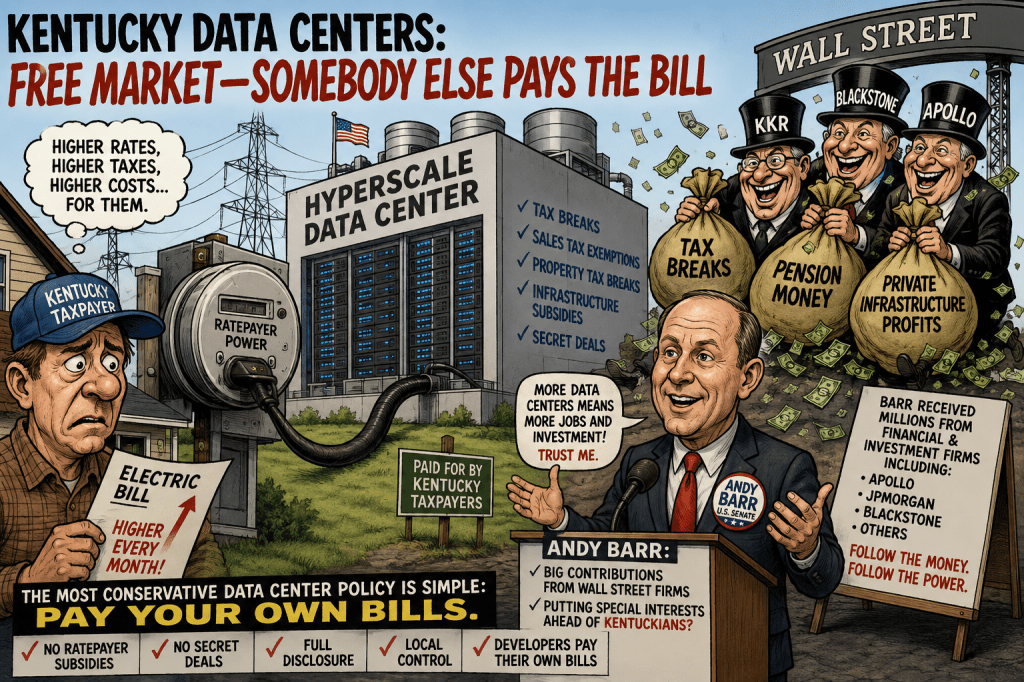
The Most Conservative Data-Center Policy Is Simple: Pay Your Own Bills
If Meta, Google, Blackstone, KKR, Apollo or another multibillion-dollar corporation wants to build a data center in Kentucky, fine.
Build it. But buy your own land. Pay your own taxes. Pay for the electric infrastructure you require.
Pay the real cost of the power you consume. Pay for the water infrastructure you need.
Disclose what you’re asking government to provide. And let the people who actually live in the affected community know what is happening before the deal is effectively done.
Why is that controversial?
Apparently corporate welfare becomes “economic development” when the corporation is large enough.
Kentucky’s Local-Control Problem Is Getting Bigger
The backlash isn’t theoretical anymore.
Oldham County has already experienced a major fight over a hyperscale project. Mason County has become another battleground. Across Kentucky, counties are discovering that they may have to create zoning, noise, water, infrastructure and siting policies for an industry moving much faster than local government.
In Mason County, the fight became so intense that two women made national news after refusing a reported $26 million offer connected to a proposed hyperscale data-center development.
Whatever one thinks about their decision, it destroys the idea that opposition to these projects consists simply of environmental activists trying to stop technology.
This is rural Kentucky.
These are property-rights questions.
These are local-control questions.
These are electricity-rate questions.
Those used to be conservative issues.
And Then There Is the Secrecy
Kentucky Senate Bill 330 tells another revealing story.
The bill would restrict government agencies from using nondisclosure agreements to hide information about data-center projects beyond what Kentucky law already protects. It specifically addresses public records, public meetings and information concerning potential impacts on utilities and communities.
Again, ask the obvious question:
Why did Kentucky need such a bill in the first place?
When taxpayers provide incentives, utilities build infrastructure and local communities absorb the consequences, “confidential economic development” cannot become a magic phrase that makes public accountability disappear.
A corporation is entitled to protect legitimate trade secrets.
It is not entitled to privatize government.
Follow the Pension Money Too
There is another part of this story almost nobody in Kentucky politics wants to discuss.
Data centers aren’t simply a technology story.
They have become a gigantic Wall Street infrastructure asset class.
Blackstone, KKR, Apollo, Brookfield and other alternative-asset managers are pouring capital into digital infrastructure, electricity generation, transmission and data centers.
Where does Wall Street get enormous amounts of long-duration capital?
Pension funds.
Including public pension funds.
So Kentucky can potentially subsidize the data-center ecosystem with one pocket while public retirement systems finance the Wall Street funds participating in it with another.
The taxpayer can appear on both sides of the transaction.
That’s why “follow the money” matters more than the ribbon-cutting press release.
Allison Ball Demonstrates the Contradiction
Kentucky Auditor Allison Ball provides an especially interesting example of the political contradiction.
Ball built a national profile attacking ESG and warning about conflicts between Wall Street political agendas and public pension fiduciary responsibilities.
Yet while Ball served as state treasurer and sat on the Kentucky Teachers’ Retirement System board, KTRS approved substantial commitments to KKR funds.
I previously identified as much as $95.5 million in new KKR commitments during Ball’s tenure.
KKR has also participated in the State Financial Officers Foundation sponsorship ecosystem. Ball has longstanding connections to SFOF, and her former Treasury official O.J. Oleka eventually became SFOF’s CEO.
And KKR is a major participant in the data-center and digital-infrastructure boom.
That doesn’t prove wrongdoing.
It does demonstrate why Kentucky voters should stop accepting political branding as a substitute for following actual money.
If ESG conflicts matter, conflicts matter.
If Wall Street influence matters, Wall Street influence matters.
The principle shouldn’t disappear depending upon which asset manager is writing the check or which investment happens to fit today’s political agenda.
Andy Barr Is an Especially Useful Test Case
That brings us to Republican U.S. Senate nominee Andy Barr.
Barr has spent years at the intersection of Kentucky politics and the financial-services industry.
His campaign fundraising makes the relationship impossible to ignore.
According to federal campaign-finance records, Barr’s authorized committees raised roughly $10 million from January 2025 through June 2026.
In earlier research, I documented contributions associated with major financial firms including Apollo, JPMorgan and Blackstone.
That matters because these aren’t random industries sitting on the sidelines of the data-center boom.
Alternative-asset managers, private-credit firms, banks, utilities and technology companies are financing an unprecedented buildout of AI infrastructure.
The question isn’t whether accepting a legal campaign contribution proves corruption. It doesn’t.
The question is much simpler:
When the interests of enormous financial contributors collide with Kentucky taxpayers, electricity customers, pension beneficiaries and local communities, whose interests come first?
That is a perfectly legitimate question for Barr—and every other candidate—to answer.
Robert Stivers Should Answer It Too
Kentucky Senate President Robert Stivers has publicly defended data-center development.
Good.
Then let’s have the debate.
But don’t give Kentuckians another economic-development argument consisting primarily of enormous investment numbers.
Tell us the denominator.
How much public subsidy?
How much electricity?
How much new generation?
How much transmission?
How much water?
How many permanent jobs?
How much tax revenue would have been collected without the exemptions?
Who pays if projected electricity demand doesn’t materialize?
Who pays for stranded infrastructure?
And what protections prevent residential and small-business ratepayers from subsidizing hyperscale customers?
Those aren’t anti-business questions.
They’re the questions any competent investment analyst would ask before putting money into a deal.
Kentucky taxpayers deserve at least the due diligence Wall Street demands for itself.
This Is Bigger Than Data Centers
The real issue in 2026 isn’t whether Kentucky should have data centers.
Of course Kentucky will have data centers.
AI is real. The infrastructure supporting it will require extraordinary investment.
The issue is who bears the risk and who collects the return.
That’s the question politicians don’t put on the economic-development billboard.
If a project succeeds, private investors can make billions.
If government grants decades of tax advantages, somebody else pays taxes.
If a utility builds billions of dollars of infrastructure, somebody ultimately pays the utility bill.
If public pension money flows through expensive private funds into infrastructure projects, retirees bear investment risk while Wall Street collects management fees and carried interest.
And if local citizens discover the details only after confidentiality agreements have been signed and political decisions have effectively been made, democracy becomes another externality.
Kentucky Needs a Data-Center Bill of Rights
Every candidate running statewide in Kentucky should be asked to support a few simple principles:
No ratepayer subsidies. No secret government deals. Full disclosure of tax incentives. Genuine local control over siting. Public disclosure of projected electricity and water consumption. Developers responsible for project-specific infrastructure costs. Transparent pension-fund exposure to data-center investments. And public disclosure of political contributions from companies and investment managers financially benefiting from the boom.
Republican, Democrat or independent—that should not matter.
These are taxpayer protections.
Follow the Power
Kentucky’s data-center story ultimately comes down to two kinds of power.
There is electrical power—the gigawatts these facilities require.
And there is political power—the ability of enormous corporations, Wall Street firms, utilities and their lobbyists to convince government that their private investment deserves public assistance.
Kentuckians should follow both.
Andy Barr should be asked about it.
Robert Stivers should be asked about it.
Allison Ball should be asked about it.
Every legislator who votes on another data-center subsidy should be asked about it.
And every candidate asking Kentuckians for a vote in November should have to explain exactly where they stand.
Because Kentucky doesn’t have to choose between technological development and protecting its citizens.
It can welcome AI investment while demanding that billion-dollar corporations pay their own bills, disclose their deals and stop treating Kentucky taxpayers as silent limited partners.
That’s not anti-business.
That’s common sense.
Send Kentucky Republicans a message on Date Centers by defeating Andy Barr

