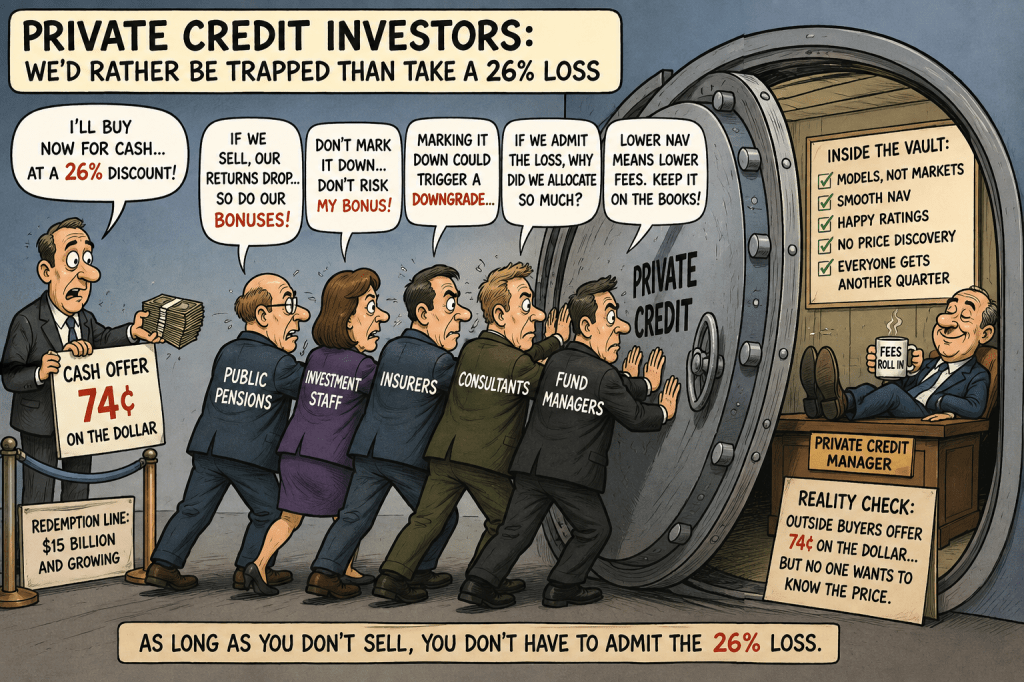
Bloomberg just accidentally demonstrated one of the biggest problems in private credit. https://www.bloomberg.com/news/articles/2026-08-27/private-credit-investors-prefer-to-be-trapped-than-take-26-loss
A buyer showed up with cash.
Cox Capital Partners offered investors immediate liquidity for shares of five non-traded private-credit BDCs managed by HPS, Apollo, Ares and Blue Owl. The average offer was reportedly at a 26% discount. There is already nearly $15 billion of redemption requests backed up in private-credit funds.
Yet investors barely sold. Cox reportedly attracted less than $5 million of orders for an offer that could have purchased as much as $90 million.
The Magic of Private-Market Accounting
Suppose a pension owns a private-credit investment carried at $100.
Someone offers $74 in cash.
The pension has two choices.
Sell it for $74 and immediately recognize a $26 loss.
Or keep reporting something much closer to $100 based upon the fund manager’s NAV and wait.
Guess which choice is more attractive to an institution whose investment staff may receive performance bonuses based partly upon reported investment results?
This is precisely the problem I have been writing about.
Private assets are commonly valued using models rather than continuous exchange prices. That can smooth reported returns, delay recognition of deterioration and make private assets appear less volatile than comparable publicly traded investments.
Earlier this year I called this the basic private-market accounting rule:
If you don’t trade it, you don’t have to price it.
The new Bloomberg story gives us something much better than a theoretical argument. It gives us an actual price offered by an outside buyer.
74 cents on the reported dollar.
That does not establish that every underlying loan is worth 74 cents. A secondary buyer also demands compensation for illiquidity, uncertainty and profit. But that is exactly the point.
A reported NAV is not the same thing as the amount of cash an investor can actually obtain for the investment today. Given this 74 cent price there are probably other Private Credit contracts that would sell at 60 cents, 80 cents or 90 cents. Even 90 cents a 10% loss is a huge problem
Public Pensions Have a Powerful Reason Not to Find Out
This becomes especially troubling with public pension funds.
Many public pension investment staffs are compensated based upon investment performance. Private equity and private credit valuations feed into that reported performance.
Imagine what happens if a pension portfolio carrying billions of dollars of private assets suddenly has to mark those investments to observable secondary-market prices.
Reported performance falls. Reported “alpha” disappears. Funding ratios may deteriorate.
Questions get asked by trustees, legislators and taxpayers.
And performance bonuses can disappear.
That doesn’t mean every pension employee is deliberately mispricing investments. It means the incentive structure overwhelmingly rewards not discovering the market price.
I previously estimated that American public pensions could be carrying hundreds of billions of dollars of unrecognized private-market losses if observable discounts were broadly applied. Whatever the exact number ultimately proves to be, Bloomberg has now supplied another important piece of evidence for the underlying thesis: investors facing a substantial cash discount frequently prefer the manager’s NAV to price discovery.
Insurers Have an Even Bigger Reason to Avoid Price Discovery
Now take the same problem and put it inside a life insurance company.
The stakes become much larger.
Life insurers increasingly own enormous portfolios of private placements, mortgages, structured credit and other illiquid assets. Those assets back products Americans have been taught to regard as “safe”: fixed annuities, indexed annuities, stable-value contracts and pension-risk-transfer annuities.
The problem isn’t merely whether those investments eventually default.
It is what happens if their economic values deteriorate without the deterioration being reflected promptly in accounting values and ratings.
An insurer forced to recognize substantial losses can face declining statutory capital, ratings pressure and ultimately higher funding and liquidity pressure.
And a downgrade can alert precisely the people the insurer does not want alerted:
annuity holders.
That creates a potentially dangerous feedback loop.
Private-credit losses are recognized → insurer capital weakens → ratings come under pressure → annuity owners become concerned → surrender and liquidity demands increase → the insurer needs liquidity → illiquid assets may have to be sold → previously hidden losses become real.
That is why private-credit valuation isn’t some academic accounting debate.
It can become a liquidity problem on both sides of an insurance company’s balance sheet.
Columbia Already Identified the Ratings Problem
The Columbia Business School paper Rating Without Market Discipline makes this even more troubling.
The researchers found that privately rated insurer bonds carrying the same ratings as publicly rated bonds were roughly twice as likely to suffer impairments, while also being downgraded less frequently.
In other words, deterioration can potentially remain hidden in two places at once:
the valuation and the rating.
An illiquid private asset can avoid continuous market price discovery while its private rating can also be slower to reflect deterioration.
That is an extraordinarily convenient combination for an insurer.
A security can remain near par on the books.
Its investment-grade rating can remain intact.
The insurer avoids recognizing the full economic loss.
Capital ratios look stronger.
The insurer’s own rating is less threatened.
And annuity owners remain unaware of the deterioration occurring inside the balance sheet supporting their guarantees.
By the time the annuity is downgraded it is in free fall and since annuities do not have downgrade clauses holders may ride them to default
Columbia’s Private Credit Ratings Paper May Be the Most Important Annuity Risk Paper of 2026
The Same Incentive Exists Everywhere
That is the real private-credit story.
The private-credit manager doesn’t want the loss recognized because lower NAV hurts performance and fees.
The public pension doesn’t want it recognized because lower returns can hurt performance numbers and bonuses.
The insurer doesn’t want it recognized because losses can weaken capital and potentially threaten ratings.
The consultant doesn’t necessarily want price discovery either, because acknowledging a huge valuation problem raises the obvious question of why so much money was allocated to the asset class in the first place.
And the investor who refuses a $74 cash offer can continue carrying an investment at the manager’s much higher reported NAV.
Everyone gets another quarter.
Bloomberg Has Given Us a Market Test
This is why Bloomberg’s new article matters.
We have spent years hearing that private credit’s lack of volatility demonstrates its stability.
Perhaps some of that “stability” exists because nobody wants to conduct the experiment Bloomberg just described.
Put the asset up for sale.
Ask for cash.
See what somebody will actually pay.
Cox did that.
The average offer was approximately 74 cents on the dollar. Investors overwhelmingly declined to transact.
That doesn’t prove NAV should universally be marked down 26%.
It proves something arguably more important:
There can be an enormous difference between a private asset’s reported value and the price at which somebody is actually willing to provide immediate liquidity.
That difference is liquidity risk.
And when investors can avoid recognizing that difference simply by refusing to sell, it also becomes an accounting and governance problem.
The Biggest Version of This Problem May Be Sitting Inside Your Annuity
The financial press understandably focuses on wealthy investors trapped behind private-credit redemption gates.
But the much larger retirement issue may be insurance.
Annuity owners generally don’t see the underlying private-credit prices at all. They see a guaranteed account value and an insurer credit rating.
Behind that guarantee may sit hundreds of billions of dollars of private placements, mortgages, structured credit and other assets without transparent daily market prices.
That is why I have argued that America’s largest private-credit exposure to ordinary individuals isn’t necessarily a private-credit fund.
It is the insurance balance sheet backing their annuity.
The Biggest Private Credit Fund in America Isn’t a Fund—It’s Your Annuity
The Bloomberg story therefore shouldn’t reassure anyone because investors refused to accept a 26% haircut.
It should raise the opposite question:
What would happen to pensions, insurers and private-credit funds if everybody actually had to discover what these assets were worth in cash today?
Private markets have built an enormous financial system around avoiding that question.
Bloomberg just showed us why.


Pingback: State Guaranty Associations Behind Annuities Are Still a Joke—And Private Equity Has Made the Joke More Dangerous | The CommonSense 401k Project
Pingback: New England Law Paper Exposes the Private-Credit Time Bomb Behind “Guaranteed” Annuities | The CommonSense 401k Project