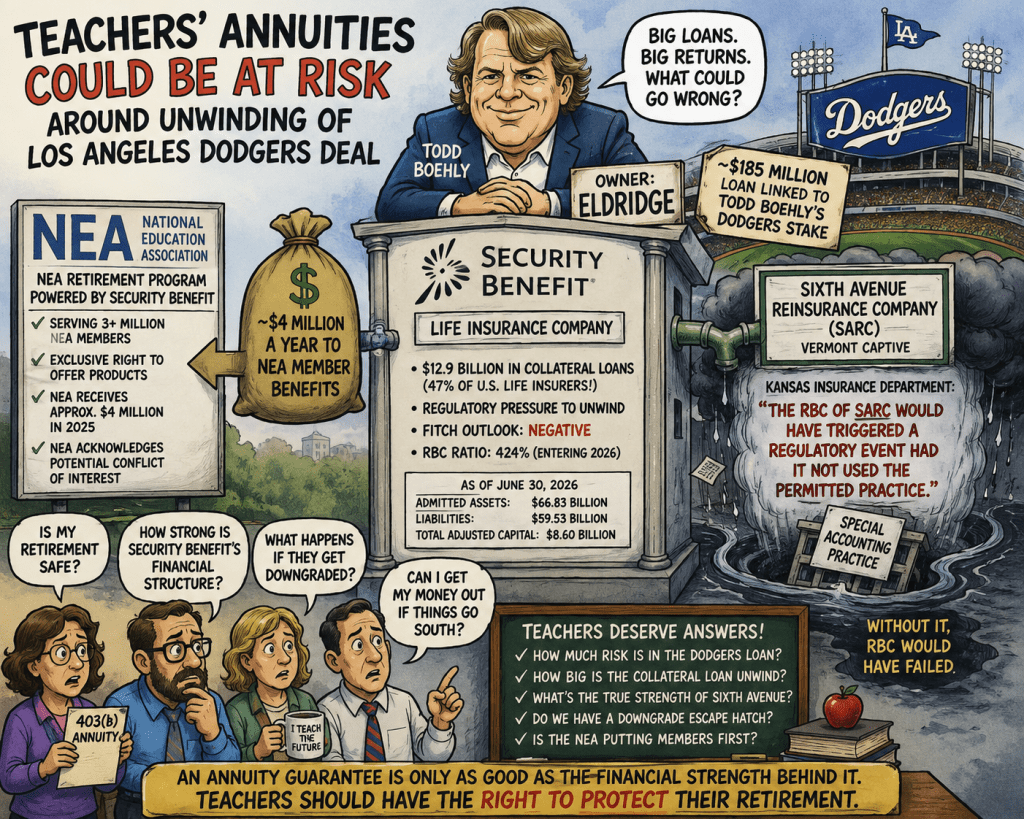
The widening insurance controversy surrounding the Los Angeles Dodgers is no longer just a story about billionaires, private credit and professional sports. It may also be a story about schoolteachers and their retirement savings.
Security Benefit Life Insurance Company has a huge presence in the K-12 retirement market. More importantly, Security Benefit has a remarkably close financial relationship with the National Education Association’s Member Benefits organization. The NEA Retirement Program says it has served more than 3 million NEA members through its relationship with Security Benefit.
And the relationship isn’t merely an endorsement.
Security Benefit pays NEA Member Benefits for the relationship. NEA Member Benefits currently discloses that the payment was approximately $4 million in 2025, that Security Benefit receives the exclusive right to offer products through the NEA Retirement Program, and that NEA Member Benefits generally cannot promote competing retirement investment programs to its members. NEA even acknowledges that this arrangement creates a “potential conflict of interest.” NEA Retirement Specialists, when making recommendations to members, offer only Security Benefit products when appropriate.
That makes what is happening at Security Benefit important to teachers.
The Dodgers Are in the Insurance Story
Security Benefit is controlled by Todd Boehly’s Eldridge organization. Boehly, of course, is also part of the ownership group of the Los Angeles Dodgers.
The Financial Times recently exposed how deeply Security Benefit embraced a form of investment called a collateral loan. At year-end 2024, Security Benefit reportedly held about $12.9 billion — roughly 47% of all collateral loans held by the entire U.S. life insurance industry. Regulators have been concerned that existing rules allowed insurers to hold substantially less capital against some collateral loans than they might have to hold against the underlying assets themselves.
One particularly eye-catching example reportedly involved approximately $185 million connected to Boehly’s interest in the Los Angeles Dodgers.
Security Benefit disputes the implication that these investments represent excessive risk. It says its collateral loans are secured, originated at no more than 80% loan-to-value, and have experienced zero principal losses since inception. The company reported an RBC ratio of 424% entering 2026.
But Security Benefit is nevertheless preparing to substantially reduce or restructure the collateral-loan portfolio before new NAIC capital rules take effect. Its own plan contemplates repayments, recapitalizations, capital injections, restructuring assets into rated securities, risk transfers and reinsurance. Security Benefit acknowledges that failure to take effective management actions could have a material adverse effect.
And this month Fitch supplied another warning sign.
Fitch maintained Security Benefit Life’s A- financial-strength rating, but changed the outlook on issuer ratings from stable to negative, focusing particularly on the collateral-loan portfolio and the execution risk associated with reducing it. Security Benefit strongly disagrees with Fitch’s decision.
That doesn’t mean Security Benefit is about to fail. It means somebody responsible for protecting retirement savers should be asking questions.
Tom Gober’s Bigger Concern: Look at the Reinsurance
Forensic insurance accountant Tom Gober has been warning about captive and affiliated reinsurance structures for years. The Security Benefit structure provides an extraordinary example of why.
Security Benefit owns Sixth Avenue Reinsurance Company, or SARC, a special-purpose financial insurance company domiciled in Vermont. Security Benefit ceded to Sixth Avenue certain guaranteed-lifetime-withdrawal-benefit obligations associated with annuities issued principally in 2018, 2019 and the first half of 2020.
Here is where it gets remarkable.
Vermont permitted Sixth Avenue to use an accounting practice different from normal NAIC statutory accounting. Security Benefit’s own statutory disclosure showed that the practice increased Sixth Avenue’s surplus by hundreds of millions of dollars.
The Kansas Insurance Department’s examination report couldn’t be much clearer:
“The Risk-Based Capital of SARC would have triggered a regulatory event had it not used the permitted practice.”
Security Benefit’s audited statutory statements repeat essentially the same disclosure. Without the permitted accounting treatment, the reported statutory value of its investment in Sixth Avenue would have been deeply negative.
That does not establish that Sixth Avenue or Security Benefit is currently insolvent. The excess-of-loss reinsurance supporting the permitted asset has economic value, and Vermont has legally authorized the treatment.
But it raises exactly the question Gober has been asking regulators for years:
How much of an insurer’s apparent capital is hard capital, and how much depends upon reinsurance, affiliated structures, regulatory exceptions and accounting treatment?
Now Put the Teacher Back Into the Picture
This is where the story becomes much more troubling.
The NEA tells teachers that it is proud to partner with Security Benefit. Its website says the relationship has lasted more than 20 years and reaches more than 3 million members. Security Benefit offers 403(b)s and annuities through the program, while NEA Member Benefits receives millions of dollars annually from Security Benefit.
Meanwhile Security Benefit is working through one of the most significant balance-sheet restructurings in the annuity industry.
Its collateral-loan concentration has attracted regulatory attention. The capital treatment of those loans is changing. Fitch has changed its issuer outlook to negative. Security Benefit is planning substantial changes to the portfolio. And buried deeper in the structure is a Vermont captive whose RBC would have triggered regulatory intervention without a special permitted accounting practice.
None of that proves teachers will lose money.
It proves something much simpler:
NEA Member Benefits should be asking Security Benefit some very hard questions on behalf of its members.
How much NEA retirement money ultimately depends upon Security Benefit’s general account? Which NEA annuity guarantees are exposed to Security Benefit credit risk? Which liabilities have been reinsured? How much exposure ultimately reaches Sixth Avenue or other reinsurers? What happens if Security Benefit is downgraded? Can teachers transfer their money without surrender charges or other penalties? And does the NEA program have a contractual downgrade provision that allows members to escape if Security Benefit’s financial condition materially deteriorates?
Those questions matter because an annuity guarantee is ultimately only as good as the financial structure standing behind it.
Teachers Need a Downgrade Escape Hatch
I have argued repeatedly that retirement annuities should contain meaningful downgrade provisions. A retirement saver shouldn’t have to wait until an insurance company actually fails before being allowed to protect himself or herself.
The Security Benefit story demonstrates why.
A teacher doesn’t need to understand collateral-loan RBC charges, Vermont captive accounting, excess-of-loss reinsurance or the capital structure behind the Los Angeles Dodgers.
The teacher needs something much simpler:
If the financial strength supporting my retirement guarantee deteriorates substantially, can I get my money out?
The NEA receives millions of dollars from Security Benefit and says it performs ongoing due diligence to protect its members.
Now would be a very good time for the nation’s largest teachers union to demonstrate exactly what that due diligence means.
Ask Security Benefit about the Dodgers. Ask about the $14 billion-scale collateral-loan restructuring. Ask about Sixth Avenue Reinsurance. Ask what happens after another downgrade. And most importantly, ask whether teachers have the contractual right to leave before a financial problem becomes a retirement crisis.
APPENDIX: NEA’s Security Benefit Annuity Relationship Has Been Litigated Before
The financial relationship between the National Education Association and Security Benefit is not new — and neither are questions about whether NEA’s financial incentives could conflict with the interests of teachers buying retirement products.
Nearly twenty years ago, NEA members brought a proposed class action over essentially this relationship.
Daniels-Hall v. NEA: Nationwide, Security Benefit and the Valuebuilder Annuities
In Daniels-Hall v. National Education Association, filed in federal court in Washington in 2007, two teachers sued the NEA, NEA Member Benefits Corporation, Nationwide Life Insurance Company, Security Benefit Life Insurance Company and related entities over the NEA Valuebuilder 403(b) program.
The proposed class potentially covered more than 57,000 NEA members and more than $1 billion in annuity investments. The complaint sought to reach NEA members participating in the Valuebuilder program dating back to 1991.
The history is particularly interesting today.
During the 1990s, Nationwide was NEA’s exclusively endorsed provider. After 2000, Security Benefit replaced Nationwide. According to the Ninth Circuit’s description of the allegations, NEA didn’t merely permit the companies to advertise to its members. NEA allegedly helped negotiate the annuity terms, exclusively endorsed the products, aggressively marketed them to teachers, and monitored the Valuebuilder program.
And there was money flowing the other direction.
According to the court’s description of the complaint, Nationwide and Security Benefit paid royalties and annual fees to NEA, paid the salaries of approximately 110 NEA Member Benefits representatives, and contributed to NEA charitable foundations.
Security Benefit alone was alleged to have generated approximately $2 million a year in royalty income for NEA.
The plaintiffs also alleged that Nationwide and Security Benefit received payments from investment companies whose mutual funds were placed inside the Valuebuilder annuities.
That is remarkably close to the conflict-of-interest issue that remains relevant today.
The Allegations Were About More Than Investment Performance
The teachers alleged that NEA did not adequately disclose the nature and amount of the payments it received from Nationwide and Security Benefit.
At the same time, according to the complaint, NEA marketed Valuebuilder as an attractive retirement solution for its members even though plaintiffs alleged that some Valuebuilder fees were as much as ten times those of comparable annuity contracts.
The Ninth Circuit summarized the plaintiffs’ theory as NEA exploiting the trust of its members for financial gain.
A contemporary Los Angeles Times investigation had already raised similar concerns. It reported that Valuebuilder investors could face total annual expenses ranging from roughly 1.73% to 4.85%, depending upon the investments and insurance features selected. The newspaper also reported substantial endorsement revenue flowing to NEA and that Security Benefit sponsored numerous NEA conferences.
Forbes had raised the issue even earlier. In 2005, Neil Weinberg of Forbes reported that Nationwide had reportedly paid NEA about $3 million annually under the previous arrangement. When NEA later solicited bids, according to Forbes, Great-West proposed a low-cost mutual-fund-only alternative charging approximately 0.15% annually with no surrender charge — but was unwilling to pay NEA for an endorsement. NEA ultimately selected Security Benefit, explaining that members wanted access to in-person financial representatives. https://www.forbes.com/forbes/2005/0425/100.html?
That history deserves renewed attention today.
Security Benefit Actually Bought the Old Nationwide NEA Business
There is another important historical connection.
According to accounts of the litigation, Nationwide was NEA’s exclusive provider from approximately 1991 through 2000. Nationwide then reportedly sold approximately $860 million of NEA Valuebuilder accounts to Security Benefit for $72 million.
So the present NEA-Security Benefit relationship did not arise from nowhere. Security Benefit effectively acquired an already-established NEA retirement franchise and then continued developing it.
SEC filings from the period also contain Security Benefit commission schedules specifically for the NEA Valuebuilder Variable Annuity TSA & IRA, providing documentary evidence of the sales and compensation infrastructure surrounding the product.
The Teachers Lost — But Not Because a Court Found the Arrangement Prudent
This distinction is important.
The lawsuit was ultimately dismissed, and the Ninth Circuit affirmed in 2010. But the court did not conduct a trial and conclude that the payments, fees or conflicts alleged by the teachers were prudent or harmless.
Instead, the case largely failed on an ERISA coverage problem.
Most of the teachers involved were public-school employees. The Ninth Circuit concluded that the school districts’ 403(b) arrangements were governmental plans exempt from Title I of ERISA. It also concluded that NEA’s marketing and endorsement program did not itself constitute an ERISA pension plan and that the individual Valuebuilder annuity contracts had not been “established or maintained” by NEA in the manner necessary to create an ERISA plan.
In other words, the defendants won primarily at the courthouse door.
The decision therefore should not be read as judicial approval of the underlying financial arrangement.
Fast Forward to 2026: The Conflict Never Really Went Away
What makes Daniels-Hall particularly relevant now is how recognizable the structure remains.
Today, NEA Member Benefits openly discloses that Security Benefit has the exclusive right to offer products through the NEA Retirement Program and that NEA Member Benefits generally may not promote competing retirement investment programs to its members.
NEA also discloses that its Retirement Specialists, when making recommendations to members, offer only Security Benefit products when deemed appropriate.
And Security Benefit continues paying NEA Member Benefits for the relationship.
The disclosed payment was approximately $4 million in 2025.
To NEA’s credit, today’s disclosure is much clearer than the arrangement described in the old litigation. NEA Member Benefits expressly tells members that receipt of the Security Benefit payment creates a “potential conflict of interest” and says it conducts ongoing due diligence on Security Benefit.
But that disclosure creates an obvious follow-up question:
What exactly does that ongoing due diligence consist of?
Twenty years ago, teachers challenged NEA’s financial relationship with the insurance companies selling them annuities.
Today the issue is potentially more serious than whether an annuity charges excessive fees.
Security Benefit has its own captive regulator blocks from its Topeka headquarters – the Kansas Department of Insurance.
NEA annuities via Security Benefit do not have downgrade provisions, so teachers are out of luck if a spiral of downgrades occur.
There so-called guaranty is provided by an unfunded Kansas Guaranty Association https://commonsense401kproject.com/2026/08/30/state-guaranty-associations-behind-annuities-are-still-a-joke-and-private-equity-has-made-the-joke-more-dangerous/
Security Benefit’s balance sheet now includes the private-credit, collateral-loan, affiliate and reinsurance issues discussed in this article. If NEA Member Benefits receives roughly $4 million annually from Security Benefit while granting Security Benefit exclusive access to its retirement program, then NEA’s acknowledged conflict makes rigorous independent monitoring of Security Benefit’s financial condition especially important.
NEA should be able to show its members that its due diligence has examined not merely product fees and investment performance, but also Security Benefit’s credit quality, liquidity, affiliated investments, collateral loans, reinsurance arrangements, Sixth Avenue Reinsurance, permitted accounting practices, capital adequacy and potential exposure of NEA annuity holders if Security Benefit were downgraded.
The history makes the question difficult to dismiss.
NEA teachers raised concerns about the financial incentives behind these annuities nearly twenty years ago. The insurer changed from Nationwide to Security Benefit, the disclosures improved, and the annual payments grew. But the fundamental question remains: When the organization recommending the retirement product is being paid millions of dollars by the company selling it, who is independently watching the insurer for the teachers?


Pingback: State Guaranty Associations Behind Annuities Are Still a Joke—And Private Equity Has Made the Joke More Dangerous | The CommonSense 401k Project
Pingback: Security Benefit May Be the Biggest Annuity Risk Since AIG—and the State Guaranty System Is Not Ready | The CommonSense 401k Project