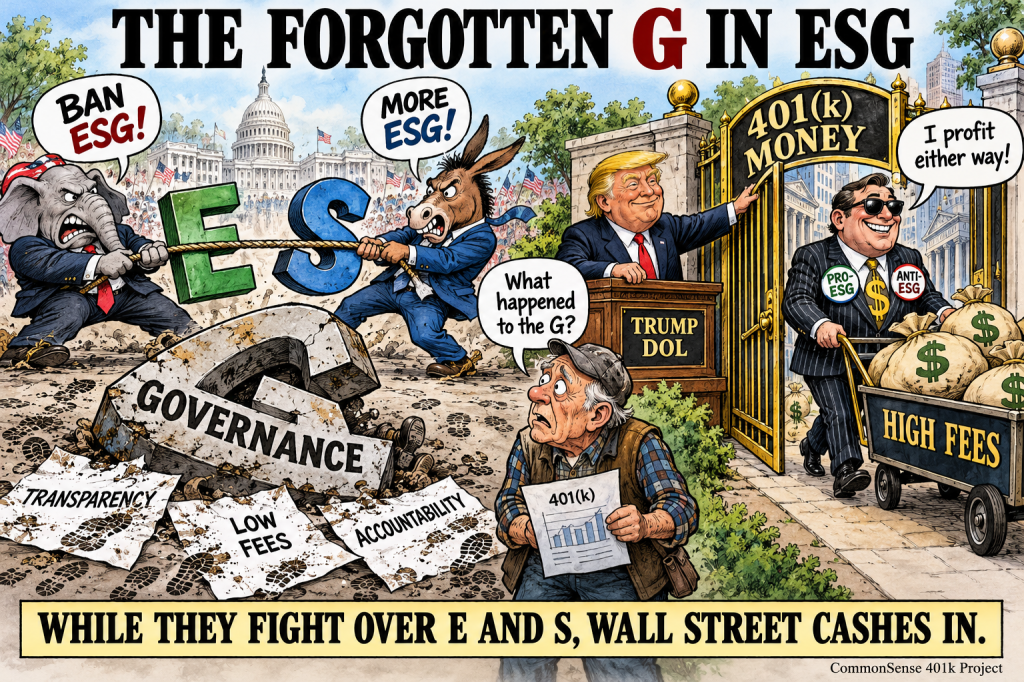
By Christopher B. Tobe, CFA, CAIA | The CommonSense 401k Project
I support considering environmental, social and governance factors when they help protect retirement savers. Climate exposure, workforce practices, conflicts of interest and corporate accountability can affect investment results. Fiduciaries should examine those risks.
But ESG has become a political football. Republicans attack the E and S. Democrats celebrate them. Too often, both sides ignore the G—and Wall Street collects the fees.
Governance means opening the books, controlling conflicts, verifying performance, understanding liquidity and protecting participants from excessive costs. An investment does not become well governed because its manager signs a sustainability pledge. Nor does it become prudent because a politician calls it “anti-woke.”
The Trump Department of Labor deserves especially sharp criticism. Its alternative-investment agenda would expand access to expensive, opaque structures while offering fiduciaries additional protection from litigation. That is a peculiar way to put workers first.
Trump’s DOL attacks the label while opening the door to the products
President Trump’s August 7, 2025 executive order directed the DOL to facilitate alternative investments in retirement plans, consider safe harbors and prioritize actions to curb ERISA litigation. The department rescinded its 2021 supplemental private-equity caution on August 12, 2025.
The March 2026 investment-selection proposal would establish a process-based prudence safe harbor. It identifies performance, fees, liquidity, valuation, benchmarking and complexity as factors for review.
Those are legitimate subjects. The problem is what counts as an adequate answer—and how much protection the government would give fiduciaries who accept the industry’s answers.
The proposal’s fee framework considers not only risk-adjusted expected returns but other “value,” including benefits, features and services. I see a dangerous opening: high fees can be defended through a growing collection of claimed benefits that are difficult for participants to measure.
Will workplace sales access be repackaged as financial education? Will proprietary-product marketing become participant engagement? Will a consultant’s endorsement help turn an expensive investment into a supposedly valuable service package?
Those are risks the DOL should close off explicitly. A sales opportunity for a provider is not automatically a benefit for a worker.
The department should demand stronger evidence before workers’ money enters opaque products. Instead, this proposal risks making a documented process a shield for accepting weak evidence.
Pro-ESG and anti-ESG can be the same business strategy
The administration’s hostility to ESG is especially hollow when the private-market firms positioned to benefit have promoted ESG themselves.
KKR says it became a signatory to the UN-supported Principles for Responsible Investment in 2009. Blackstone identifies its signatory status beginning in July 2021. Signing the PRI expresses a commitment to incorporating ESG into investment practices. It is not independent certification that every fund is transparent, inexpensive or prudently managed.
In my earlier Allison Ball article, I examined KKR’s reported former sponsorship of the State Financial Officers Foundation alongside its ESG commitments and Kentucky pension business. The governance question is who finances the political infrastructure surrounding investment decisions—and what the public can see about those relationships.
A firm can market sustainability to one audience while maintaining relationships with an anti-ESG political network. That does not establish an illegal payment or purchased decision. It does expose how little an ESG label tells us about actual accountability.
Wall Street can sell to both camps. Participants pay either way.
ESG does not require expensive investments
There are low-cost ESG-screened index mutual funds and ETFs. Vanguard’s ESG U.S. Stock ETF, for example, lists an expense ratio of 0.09%.
A fiduciary can evaluate an ESG-screened index option using familiar questions: What does it own? What does the screen exclude? How much does it cost? How does it change diversification, sector exposure and expected risk?
Some screened portfolios may differ only modestly from an unscreened alternative. Others may differ substantially. Nobody should declare their returns “indistinguishable” simply because both are index funds. The comparison must be demonstrated.
But the existence of low-cost screened products destroys the argument that considering ESG requires paying private-equity fees or accepting an opaque insurance contract.
If two options genuinely serve participants’ financial interests equally, an ESG preference can help decide between them. A higher-fee manager should have to substantiate its financial case rather than sell a moral excuse for the fee.
Keep the tiebreaker from becoming a fee loophole
The regulatory history matters. The 2020 rule used an “indistinguishable” financial comparison. The Biden DOL’s 2022 rule broadened the formulation to investments that equally serve the plan’s financial interests over the appropriate time horizon, allowing collateral benefits to break a genuine tie.
It also retained the prohibition against sacrificing returns or taking additional investment risk to pursue unrelated objectives.
My position is straightforward: keep that participant-first constraint real. Do not broaden the tiebreaker further, and do not allow speculative collateral benefits to manufacture financial equivalence.
The Trump DOL’s alternative-investment proposal is a separate regulatory initiative. But its expansive treatment of other “value” raises a related danger: higher costs being justified by benefits whose value to workers is asserted rather than proved.
Neither party should permit ESG, education, diversification or lifetime-income branding to become an all-purpose excuse for higher fees, more risk and less transparency.
Governance starts with the investment contract
The G must apply to the product holding participants’ money, not merely the companies in a manager’s sustainability report.
Private-fund interests can be securities, and their advisers may be SEC registered. That does not give the fund the same regulatory structure and public disclosure obligations as an SEC-registered mutual fund. Adviser registration is not mutual-fund registration.
Private-equity and private-credit valuations often depend on models and managerial judgments rather than current market transactions. That creates a governance conflict when valuations also influence reported performance, fundraising or compensation. An audit does not turn an estimate into an executable market price.
The Global Investment Performance Standards provide a framework for performance reporting, including alternative investments. They are voluntary; verification is also voluntary. Fiduciaries should demand the actual performance report, the scope of any compliance claim and independent assurance relevant to the investment being offered. A firm-level marketing statement does not answer every fund-level question.
For a Cayman-domiciled partnership, the questions should be concrete: Which legal entity receives the money? Who holds the assets? What records can the fiduciary obtain? Which court can enforce the investor’s rights? How can the plan exit? Offshore domicile alone does not prove misconduct, but complexity must never substitute for accountability.
Fixed annuities present another governance problem. The insurer declares the credited rate under the contract and can retain an embedded spread that participants cannot readily inspect. A stable account balance does not itself disclose the economic value of the assets supporting the promise, the insurer’s credit risk or the cost of leaving.
Insurance regulation is not the same as mutual-fund regulation. Fiduciaries should demand enforceable protections, clear compensation disclosures and a credible assessment of credit and liquidity risk.
Private real estate and digital assets require scrutiny of their own valuation, custody, leverage and exit arrangements. A registered wrapper cannot erase the risks of what it holds.
An ESG attribute cannot cure a badly governed investment structure.
Indiana exposed the hypocrisy—and the cost of political shortcuts
In 2023, an Indiana fiscal analysis projected that an anti-ESG proposal could reduce pension investment returns by approximately $6.7 billion over ten years, including by restricting access to private markets and active managers.
That estimate was a forecast, not a realized liquidation loss. It does not prove that private partnerships would universally sell for 70 cents on the dollar.
But it exposed a contradiction: sweeping anti-ESG policies can collide with pension investments in firms that have embraced ESG commitments. Politicians cannot coherently condemn an entire investment philosophy while quietly exempting favored high-fee managers.
Nor should Democrats treat those managers’ ESG pledges as evidence of good governance. As I argued in my CalPERS ESG critique, sustainability branding cannot excuse inadequate scrutiny of the investment manager and its contracts.
For illiquid assets, fiduciaries should disclose credible exit-price evidence before anyone orders a political divestment—or claims that maintaining the investment is costless.
Put the G back into fiduciary responsibility
Congress and the DOL should require disclosure of every layer of compensation, valuation methods, relevant performance standards, independent assurance, liquidity restrictions, affiliated transactions and material political or lobbying relationships.
For target-date and other multiasset funds, those disclosures must reach the underlying investments. A reassuring label on the outer fund is insufficient.
Fiduciaries should document why an expensive or opaque structure serves participants better than a transparent, lower-cost alternative. Claimed education benefits should identify actual services, costs, conflicts and limits on product solicitation.
Republicans should stop attacking ESG while promoting high-fee firms that practice it. Democrats should stop accepting ESG branding as a substitute for accountability.
The Trump DOL should stop treating expanded product access and reduced litigation exposure as substitutes for stronger participant protection.
I am pro-ESG when it means examining material risks and holding managers accountable. I oppose using it to excuse expensive, conflicted investments.
The G stands for governance. Open the books. Verify the claims. Protect the participants.
Sources and related Commonsense articles
- Trump executive order on alternative investments
- DOL rescission of the 2021 supplemental statement
- DOL March 2026 proposed investment-selection rule
- DOL 2022 ESG final rule
- KKR on its PRI commitment
- Blackstone on sustainability and PRI
- Vanguard ESG U.S. Stock ETF
- SEC overview of private funds
- CFA Institute GIPS standards
- Federal Reserve review of SVB
- SVB governance-rating analysis
- Indiana projected anti-ESG costs
- Allison Ball’s ESG Shell Game
- CalPERS ESG Failure
- Trump’s 401(k) Woke Shell Game

