By Chris Tobe, CFA, CAIA | The CommonSense 401k Project
There is a dangerous way to make a target-date fund look safer without making workers’ retirement savings safer.
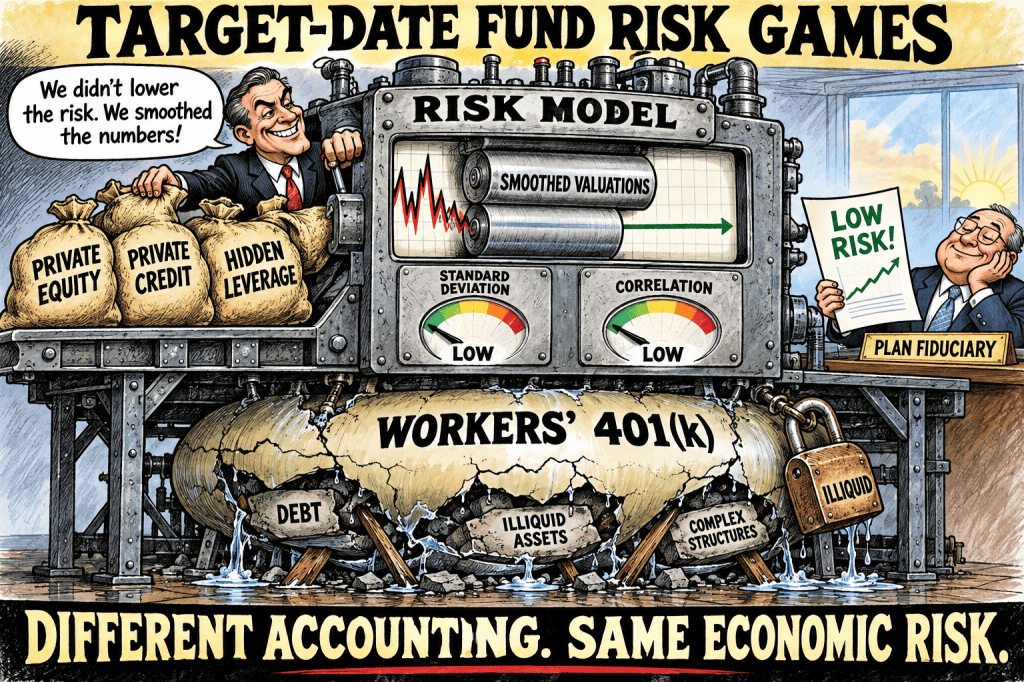
Keep publicly traded stocks and bonds marked to market. Add private equity and private credit valued through infrequent appraisals and discretionary models. Perhaps add insurance contracts whose reported values follow contractual accounting.
Then feed those incompatible return histories into a standard-deviation and correlation model.
The assets with the slowest recognition of changing economic conditions can emerge as the portfolio’s supposed stabilizers.
The spreadsheet can reward the delay in recognizing risk—and justify putting more retirement money into the investments creating that delay.
That is the risk game.
As I argued in “The Diversification Lie,” a smooth reported return is not proof of economic stability. When those returns drive target-date selection, the accounting distortion becomes a fiduciary problem.
Standard deviation measures the numbers supplied to it
Standard deviation measures variation in a return series. It cannot determine whether those returns accurately and promptly reflect changing asset values.
A publicly traded security records market movements as they occur. A private investment may incorporate the same economic deterioration through several subsequent valuation updates.
Spread recognition of a loss over several periods, and measured volatility can fall. The underlying business has not necessarily become safer. Its debt has not disappeared. Its refinancing needs have not diminished.
The IMF has identified stale and potentially subjective valuations, fragile borrowers, and multiple layers of leverage as vulnerabilities in private credit. These are substantive risks that a smooth historical return series may fail to reveal.
Correlation can reward the same accounting delay
Suppose public stocks fall sharply this quarter while private-company valuations adjust next quarter.
A same-quarter correlation calculation can suggest that the two investments move independently. Yet both may be responding to the same economic shock, recorded on different schedules.
That creates an apparent diversification benefit from delayed measurement.
Different businesses can provide real diversification. But fiduciaries must distinguish diversification of economic exposure from differences in when losses enter the books.
A different accounting clock is not a different economic risk.
The allocation model can turn the distortion into a recommendation
In a conventional mean-variance model, an investment offering an attractive assumed return, low volatility, and low correlation can receive a larger allocation.
If those favorable inputs reflect valuation smoothing, the model can allocate more money because the risk was measured poorly.
The same problem can affect consultant scorecards even when no optimizer determines the portfolio. A target-date series may receive a favorable ranking for lower historical volatility, smaller reported drawdowns, or an attractive risk-adjusted return.
Consider two hypothetical funds with similar economic exposures. One recognizes changing values promptly. The other recognizes some changes gradually. A scorecard may penalize the first for volatility and praise the second for stability.
The manager recognizing losses promptly can look worse than the manager recognizing them slowly.
Not every target-date manager uses unadjusted historical data. Some use forward-looking assumptions, public-market proxies, or adjustments for valuation lag. The question is whether those corrections were made, whether they were credible, and whether the committee examined them.
A glossy “lower-risk” chart supplies none of those answers.
A daily price does not establish daily price discovery
A target-date fund can publish a daily net asset value while incorporating underlying private-asset valuations that remain substantially unchanged between periodic updates.
Daily calculation of the outer fund’s price does not establish daily revaluation of everything inside it.
The move from a mutual fund to a CIT does not automatically create this problem. A CIT holding the same publicly priced securities may have substantially similar investment risk.
The concern is what the new structure permits the manager to put inside—and what participants and fiduciaries can discover about it.
If a target-date fund combines market prices, private valuations, and contractual values, its risk analysis must explain how those differences were handled. Simply blending the return series can manufacture an appearance of comparability that the underlying measurements do not support.
Why this becomes a fiduciary issue
ERISA requires fiduciaries to act prudently and loyally and to diversify investments to minimize the risk of large losses, unless the circumstances make diversification clearly imprudent. Those duties concern participants’ actual economic interests.
DOL’s target-date guidance tells fiduciaries to investigate the fund’s strategies and the risks of its underlying investments. Selecting a retirement-year label and accepting the provider’s risk chart does not satisfy that investigation.
A serious fiduciary concern arises when a committee:
- Selects a target-date series because of supposedly lower volatility without investigating valuation lag.
- Accepts diversification claims based on correlations calculated from mismatched valuation schedules.
- Treats smooth returns as a substitute for examining leverage, liquidity, and credit exposure.
- Pays higher fees for a claimed risk reduction that depends materially on untested accounting assumptions.
- Continues relying on the same presentation after receiving evidence that its inputs are unreliable.
These are failures of investigation and judgment that can exist before a market collapse exposes the portfolio.
A subsequent loss does not automatically establish a breach. But fiduciaries should not need a collapse to discover that their selection process compared unlike measurements as though they were equivalent.
Consultants cannot turn questionable inputs into prudent advice by adding a logo
Consultants are hired because committees need expertise. That makes the treatment of valuation smoothing central to the service being purchased.
What data did the consultant use? Were private-asset returns adjusted? Were public-market proxies considered? Did the consultant test whether the recommended allocation survived higher volatility and correlation assumptions?
Did the consultant explain the difference between reported volatility and economic risk?
Where a consultant acts as an ERISA fiduciary, its advice is subject to fiduciary obligations. Its precise legal status depends on its role and the applicable law. A plan committee also retains responsibilities for prudent selection and monitoring of its advisers; hiring expertise does not make those responsibilities disappear.
A particularly troubling situation arises when a consultant understands the smoothing problem but presents the resulting low-risk numbers without a meaningful explanation. Compensation or commercial relationships favoring the recommended products would demand additional scrutiny.
An expert’s presentation should expose the measurement problem. It should not give the problem professional cover.
Congress should make the risk game visible
Litigation alone is an inadequate disclosure system. Workers should not have to suffer losses, locate counsel, and fight through discovery to learn how their default retirement investment was classified as safe.
Congress should require a standardized Form 5500 attachment for target-date and other multiasset funds, covering material underlying investments regardless of their legal structure.
The attachment should disclose:
- How assets are valued and how often underlying valuations substantively change.
- The volatility and correlation assumptions actually used to justify allocations.
- Whether and how those assumptions address smoothing and valuation lag.
- How estimated risk and recommended allocations change under prescribed alternative assumptions.
- Material leverage, withdrawal restrictions, and unfunded commitments.
- Information the manager refused or failed to provide.
The decisive disclosure is a side-by-side test: Does the “safer” portfolio still look safer when the accounting assumptions change?
The law should require consistent sensitivity methods while identifying adjusted results as estimates. It should also require investment providers to supply the information and committees to document their review.
“Proprietary” should not be an excuse for concealing the material assumptions used to allocate workers’ retirement savings.
Workers deserve economic risk analysis
Standard deviation and correlation are useful tools when the data and assumptions suit the question. They become misleading when treated as complete measures of risk across assets whose values are recognized on fundamentally different schedules.
A portfolio can become more leveraged, less liquid, and more expensive while its reported volatility falls.
Calling that portfolio safer without investigating the measurement distortion is a claim fiduciaries should have to substantiate.
Retirement money should be allocated according to economic risk—not according to which manager has the smoothest accounting.
- https://commonsense401kproject.com/2026/05/04/the-diversification-lie-how-private-equity-and-private-credit-use-corrupt-accounting-to-hijack-pension-and-401k-allocations/
- https://commonsense401kproject.com/2026/10/11/401k-who-is-your-regulator-dol-sec-iowa-nevada-or-the-caymans/
- https://commonsense401kproject.com/2026/10/02/the-401k-ips-illusion-when-weak-policies-protect-fiduciaries-and-the-industry-more-than-participants/
- https://commonsense401kproject.com/2026/09/07/principal-is-building-an-illiquidity-layer-cake-for-your-401k/
- https://commonsense401kproject.com/2026/08/31/liquidity-is-a-retirement-risk-erisa-fiduciaries-need-to-start-taking-seriously/

