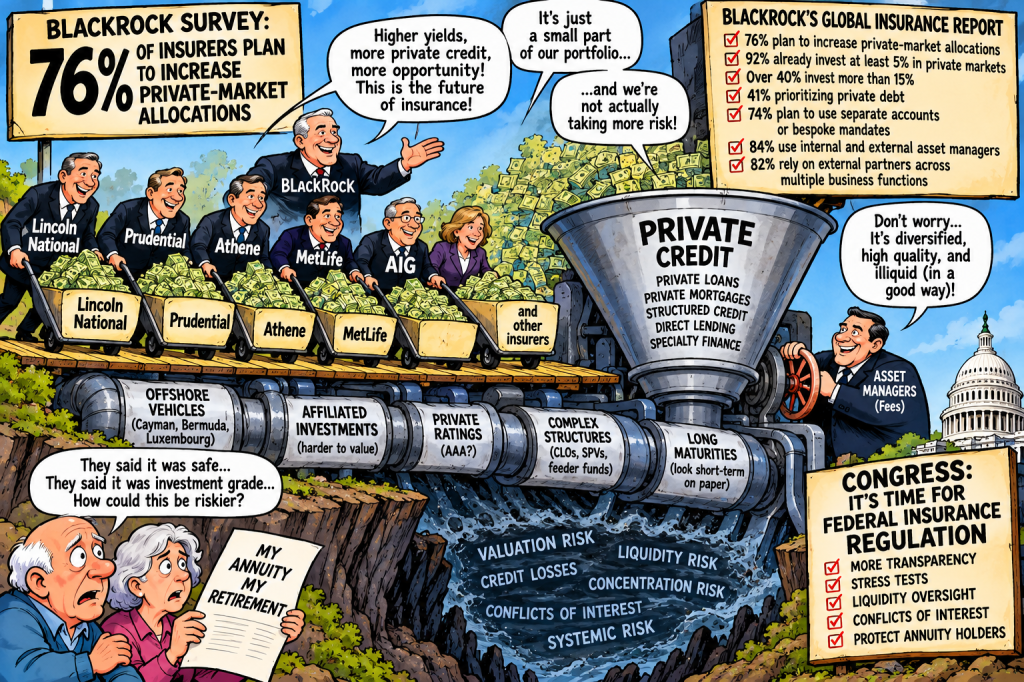
BlackRock’s new survey of insurers representing more than $24 trillion in assets shows that 76% plan to increase private-market investments. Coming one week after Wharton’s alarming research on private-equity-owned insurers, the findings raise a bigger question: Who is measuring the risks being transferred to America’s annuity holders and pensioners?
Chris Tobe, CFA, CAIA The CommonSense 401k Project | October 27, 2026
BlackRock Just Confirmed What Wharton Warned About
Last week, I wrote about an important new Wharton research paper documenting how private-equity-owned insurance companies were increasing risks through affiliated investments, private credit, and structured securities.
My article from last week, “Wharton Exposes the Private Equity Insurance Risk Machine — And Why the Entire Annuity Industry May Be Forced to Follow,”, warned that traditional insurance companies would face competitive pressure to adopt similar investment strategies.
Now BlackRock has released its 2026 Global Insurance Report, and the results suggest this transformation is already well underway.
BlackRock surveyed 463 senior insurance executives across 31 markets, representing more than $24 trillion in investable insurance assets.
The findings are extraordinary.
| BlackRock’s findings | 2026 results |
| Insurers planning to increase private-market allocations | 76% |
| Insurers already investing at least 5% in private markets | 92% |
| Insurers investing more than 15% in private markets | Over 40% |
| Insurers prioritizing increased private-debt allocations | 41% |
| Insurers using internal and external asset management | 84% |
| Insurers planning greater use of external asset managers | 49% |
| Insurers reporting external partnerships across two or more business functions | 82% |
Source: BlackRock, 2026 Global Insurance Survey, released October 27, 2026.
These are survey responses, not independently verified portfolio-level risk measurements. They do not establish that 76% of insurers are taking imprudent risks.
But they show that private markets have moved from a specialized investment strategy to a mainstream component of insurance balance sheets.
Private equity no longer needs to own an insurance company to influence how that insurer invests its policyholders’ money.
That should concern everyone depending on fixed annuities, pension risk transfer annuities, or other long-term insurance guarantees.
The Most Disturbing Finding: 76% Want More Private Markets, but 82% Say They Are Not Increasing Risk
BlackRock reports that 82% of insurers plan to maintain their overall investment-risk profile.
At the same time, 76% plan to increase their private-market allocations.
How can both be true?
There are legitimate explanations. An insurer might reduce other exposures, diversify its investments, or purchase private assets with genuinely strong credit protection.
But the apparent contradiction also exposes a major problem with insurance risk measurement.
Private credit can appear less volatile than publicly traded bonds because it is not priced continuously in an active market.
A publicly traded corporate bond may decline sharply in market value when credit spreads widen.
A privately originated loan may continue to appear on an insurer’s books at or near its adjusted carrying value, even when selling it would require a substantial discount.
The absence of a daily market price does not eliminate the economic loss.
It may simply delay its recognition.
When you stop measuring market volatility, you have not eliminated risk. You may have eliminated the evidence of risk.
That is especially dangerous when insurers use historical volatility, accounting valuations, or favorable private ratings to justify increased allocations to illiquid investments.
The BlackRock survey does not prove that insurers are understating risk. But it makes independent verification more important.
Wharton Found the Hidden Risk. BlackRock Shows How Broadly Private Markets Have Spread.
The two studies should be read together.
The September 2026 Wharton paper, Buying from the Family: Private Equity-Owned Insurers and Their Affiliated Investments, by Amy W. Huber, Stefan Huber, Bella Shan, and Christina Zhu, examined how private-equity-owned insurers invest in securities issued by affiliated businesses.
The researchers found that PE-owned insurers were more likely to purchase affiliated structured securities, sometimes paid higher prices for them, and were less inclined to recognize impairment or sell deteriorating affiliated investments.
Their analysis of NAIC stress-test results was especially alarming.
Under a severe scenario broadly comparable to the 2008 financial crisis, the researchers estimated that affiliated structured-credit exposure could generate approximately four additional percentage points of losses across PE-owned insurers’ fixed-income portfolios.
That compares with an average equity buffer of 7.6% of fixed-income investments.
In other words, the additional modeled losses alone could consume more than half that measured buffer.
The calculation involves extrapolating stress-test results from broadly syndicated CLOs to other structured securities, so it is an estimate rather than a prediction of insurer insolvency.
Nevertheless, it demonstrates why the apparent stability of private-credit investments during normal conditions may be misleading.
BlackRock now supplies the broader industry context.
Its survey shows that private markets are no longer confined to insurers controlled by private-equity firms.
Traditional insurers increasingly invest through external asset managers, separate accounts, and customized mandates.
The risk identified by Wharton is not necessarily identical across these arrangements. An independent insurer hiring a private-credit manager does not automatically have the same conflicts as an insurer buying securities from an affiliated issuer.
But the expansion raises common questions about valuation, liquidity, capital requirements, and who ultimately controls investment decisions.
Wharton documented a specific mechanism of risk. BlackRock demonstrates the enormous scale of the industry’s movement into private assets.
Together, they make a compelling case for federal scrutiny.
The Insurance Industry Is Becoming a Private-Credit Financing Machine
BlackRock reports that 84% of surveyed insurers use a hybrid investment-management model, combining internal capabilities with outside managers.
Nearly half expect to increase their reliance on external asset management.
Even more revealing, 82% report external partnerships covering at least two business functions, including investments, capital, liability and product design, or distribution.
BlackRock describes this evolution as a more modular insurance industry.
That sounds efficient.
But from a regulatory perspective, it raises an important question:
When an insurer depends on a network of outside asset managers, reinsurers, investment originators, and affiliated financial entities, who is responsible for evaluating the risks of the entire arrangement?
Consider a hypothetical insurer that purchases private-credit securities originated by an outside asset manager.
The securities are privately rated.
The underlying loans are held through investment vehicles.
The insurer reports the investments at statutory carrying values.
The asset manager earns fees for originating and managing the loans.
The insurer receives the yield, assumes the investment risk, and promises to pay annuity holders for decades.
This arrangement may be perfectly legitimate.
But it can also create conflicts when the asset manager benefits from placing loans with an insurer regardless of whether those loans represent the best available investments for policyholders.
The potential conflicts become more serious when ownership, financing, reinsurance, or other business relationships connect the participants.
Wharton’s findings show why affiliated transactions deserve special scrutiny.
BlackRock’s findings show why regulators also need to examine the increasingly complex relationships between nominally independent insurers and their investment partners.
A 15-Year Private Mortgage Does Not Become Safe Because Its Interest Rate Resets Every Three Months
One of the biggest weaknesses in insurance asset/liability analysis is the distinction between interest-rate duration and actual liquidity.
Consider a private commercial mortgage with a 15-year maturity and an interest rate that resets quarterly.
Its sensitivity to changes in benchmark interest rates may be relatively low.
But its principal remains exposed to the borrower for 15 years unless it is prepaid or refinanced.
If commercial real estate values decline, the borrower encounters financial difficulty, or refinancing becomes unavailable, the insurer may face a substantial loss.
And if the insurer needs cash immediately, selling the mortgage may require a large discount.
A three-month rate reset does not produce a three-month investment.
It does not guarantee repayment of principal.
It does not guarantee market liquidity.
It does not eliminate credit-spread risk.
Yet insurers can present portfolios with relatively short interest-rate duration and favorable credit ratings without providing enough information about the underlying contractual maturities and stressed liquidation values.
This is especially important for general-account fixed annuities.
A retirement plan may hold an institutional fixed annuity for 20 or 30 years without a fixed contractual maturity date.
The insurer may model the expected liability duration at a substantially shorter period based on participant withdrawals and expected plan behavior.
Meanwhile, the supporting assets may include privately originated loans with contractual maturities extending well beyond their apparent interest-rate duration.
The question is not simply whether the insurer’s reported asset duration matches its modeled liability duration.
The question is whether the insurer can produce cash when it needs to pay policyholders during a severe credit crisis.
That requires an entirely different level of disclosure.
BlackRock’s Own Business Interests Deserve Scrutiny
BlackRock is not a neutral academic observer.
It is one of the world’s largest asset managers and an increasingly important participant in private markets, including through its acquisition of HPS Investment Partners.
It has a commercial interest in providing investment-management services to insurance companies.
That does not invalidate its survey. The findings are valuable precisely because they reflect what insurance executives say they intend to do.
But it should affect how regulators interpret the industry’s enthusiasm for private markets.
Asset managers benefit when insurers allocate more capital to investment products and mandates they manage.
Insurers may benefit from higher expected yields.
Insurance executives may benefit from improved reported profitability and competitiveness.
The annuity holder, however, does not necessarily receive a proportional share of those benefits.
In a traditional general-account fixed annuity, the insurer typically retains the difference between its investment earnings and the crediting rate promised to policyholders, after expenses and other costs.
When investment yields increase, the insurer may retain some or much of the additional spread.
But if those higher yields reflect greater credit, liquidity, or valuation risk, policyholders remain exposed to the insurer’s ability to honor its guarantees.
This creates an obvious question:
Are insurance companies increasing private-credit exposure to improve retirement security, or to increase the investment spread retained by insurers and their financial partners?
That question deserves far more scrutiny than it receives.
The Race to the Bottom May Already Be Underway
My Wharton based article argued that private-equity-owned insurers could create competitive pressure on traditional insurance companies.
The logic is straightforward.
If one insurer can offer attractive annuity rates or lower pension risk transfer premiums because it invests in higher-yielding private credit, competing insurers may face pressure to increase their own portfolio yields.
They can accept lower profits, lose business, or pursue similar investments.
BlackRock’s survey suggests that private-market investing is now widely embedded in insurers’ strategies.
It does not prove that competition has forced every insurer to take more risk.
But it supports the concern that the industry is moving in a common direction, even while individual insurers differ in their investment policies.
This matters enormously for pension risk transfers.
A pension sponsor shopping for an annuity may prefer the insurer offering the lowest premium.
A lower premium can leave more assets available for the sponsor or reduce the cost of terminating the pension obligation.
But if the lower price is made possible by assuming greater private-credit risk, pensioners may bear consequences that are not reflected in the initial transaction price.
Under a pension risk transfer, retirees typically lose the protection of the PBGC for transferred benefits and instead depend on the insurer’s contractual promise and applicable state guaranty protections.
That makes the insurer’s investment portfolio a critical component of retirement security.
A fiduciary cannot adequately evaluate that promise merely by reviewing a financial-strength rating.
The insurer’s private-credit concentration, asset-manager relationships, liquidity, and stress-test results are equally relevant.
Remember AIG: Ratings Do Not Prevent Liquidity Crises
The insurance industry has been here before.
AIG held an AAA credit rating in early 2005.
By September 2008, following successive downgrades, it was rated A− and required an emergency $85 billion Federal Reserve rescue.
AIG’s problems included mortgage-related securities, derivatives collateral requirements, securities lending, and the inability to raise cash when confidence disappeared.
The crisis did not require every regulated insurance subsidiary to become legally insolvent.
Liquidity demands at the broader financial group became overwhelming before a formal bankruptcy.
The comparison with today’s private-credit insurers is not exact.
AIG’s derivatives and securities-lending exposures differed from the private-credit investments highlighted by Wharton and BlackRock.
But the underlying lesson remains important.
A highly rated financial institution can become a systemic threat when deteriorating assets, leverage, credit downgrades, and liquidity demands reinforce one another.
BlackRock reports that 61% of surveyed insurers expect a soft landing for the global economy over the next year.
Only 18% identify recession as a leading macroeconomic concern, down from 35% in 2025.
That optimism may prove justified.
But retirement security should not depend on the majority of insurance executives correctly forecasting the next recession.
The entire purpose of capital requirements and insurance regulation is to ensure that promises survive when optimistic assumptions prove wrong.
Why Fixed Annuities Need Downgrade Clauses
In my article “Annuity Derisking in Retirement Plans,”, I argued that retirement plans should demand stronger protections against insurer credit deterioration.
A general-account fixed annuity exposes participants to the financial strength of one insurer.
The insurer may own thousands of investments, but the participant generally owns a contractual claim against that insurer rather than a diversified interest in the underlying assets.
One protection is an enforceable downgrade clause permitting the retirement plan to exit at book value if the insurer’s financial strength deteriorates.
Insurers may resist such provisions because they create liquidity obligations at precisely the time the insurer could be under financial stress.
That resistance demonstrates why the provisions can be valuable.
But downgrade clauses must be supported by appropriate capital and liquidity requirements. A contractual promise is only useful if the insurer can honor it.
For PRT annuities, comparable protection could involve additional collateral, security arrangements, or replacement-insurer mechanisms rather than simply allowing pensioners to surrender lifetime benefits.
Congress should require fiduciaries to evaluate these protections through competitive bidding and require insurers to disclose their cost.
The value of protection should not be ignored merely because insurers prefer contracts without it.
The NAIC Cannot Regulate This Problem Adequately by Itself
The United States continues to rely primarily on state insurance regulation, coordinated through the National Association of Insurance Commissioners.
The NAIC develops important model laws, valuation rules, and risk-based capital standards.
But it is not a federal regulator with direct nationwide enforcement authority over every insurance company and financial conglomerate.
Meanwhile, the investments supporting American annuities can pass through asset managers, reinsurers, offshore entities, and privately structured investment vehicles operating across multiple jurisdictions.
The financial risks are national and increasingly global.
The regulatory system remains fragmented.
In my September 25 article, “Congress Finally Asks Whether America Needs a Federal Insurance Regulator? The Answer Is Yes,”, I argued that the United States needs meaningful federal insurance oversight.
BlackRock’s survey makes that argument more urgent.
If insurers representing trillions of dollars are increasingly dependent on private markets and external financial partners, regulators need the authority to examine those relationships across the entire corporate structure.
They need to know who originated the investments, who rated them, who values them, who receives the fees, where the assets are legally held, and what happens when the insurer needs cash.
And they need to be able to intervene before a financial crisis exposes risks that statutory accounting failed to reveal.
Congress Should Require Seven Reforms
1. Full disclosure of private-credit investments. Insurers should report private-credit exposures by asset class, contractual maturity, interest-rate duration, credit-spread sensitivity, valuation methodology, rating provider, and liquidity.
2. Independent valuation and rating scrutiny. Privately rated securities and affiliated investments should face independent review, particularly when their favorable ratings reduce statutory capital requirements.
3. Federal insurance liquidity stress tests. Regulators should test simultaneous private-credit defaults, declining recovery rates, credit-spread widening, downgrades, and forced asset sales. The tests should examine both capital adequacy and actual cash availability.
4. Transparency across affiliated and external investment managers. Insurers should disclose ownership relationships, investment-management fees, affiliated transactions, reinsurance arrangements, and material conflicts of interest.
5. Offshore investment transparency. Federal reporting should trace retirement assets through Bermuda, Cayman, Luxembourg, Delaware, and other investment structures to their ultimate economic exposures.
6. Stronger retirement-annuity protections. ERISA fiduciaries should obtain meaningful information about insurer credit and liquidity risk, and evaluate downgrade provisions or equivalent security protections before committing participant benefits to an insurer.
7. A federal insurance regulator with real authority. Congress should establish a federal agency capable of supervising systemic insurance risks, requiring standardized disclosures, examining financial groups, and enforcing capital and liquidity standards across state and international boundaries.
These reforms would not prohibit prudent private-credit investing.
They would require insurers to demonstrate that their assets, capital, and liquidity are adequate to support the promises they have made.
That should not be controversial.
The BlackRock Warning Is Bigger Than BlackRock Intended
BlackRock presents its survey as evidence that private markets have become a mature and strategic component of insurance investment portfolios.
That may be how the asset-management industry sees it.
I see something more troubling.
Wharton has documented how affiliated private-credit investing can weaken investment discipline and magnify losses under severe stress.
BlackRock now confirms that private-market exposure is widespread and that insurers are increasingly relying on external financial partners to manage their assets and businesses.
Together, these findings suggest that the risks associated with private credit can no longer be treated as a specialized problem involving a few private-equity-owned insurance companies.
The issue is potentially much larger.
The entire insurance industry is becoming more connected to private-credit markets, asset managers, and complex financial structures.
And the people who ultimately depend on insurance promises—retirees, pensioners, and annuity holders—may have little understanding of those risks.
The industry’s response will be that the investments are diversified, investment grade, professionally managed, and appropriately capitalized.
Those assurances are not enough.
A privately rated AA security is not the same as cash.
A floating-rate 15-year mortgage is not a short-term liquid investment.
An investment carried at book value is not necessarily worth that amount in a distressed sale.
And an insurance company with adequate reported statutory capital is not necessarily prepared for simultaneous credit losses and liquidity demands.
BlackRock reports that 74% of respondents plan to access private debt through separate accounts or bespoke mandates. That reinforces the need for asset-level transparency and scrutiny of insurer–asset-manager relationships, even when the insurer is not PE-owned.
BlackRock has confirmed the scale of the industry’s private-market expansion. Wharton has demonstrated some of the hidden dangers. AIG demonstrated what can happen when financial risks and liquidity demands overwhelm even a highly rated institution.
Congress should connect the dots.
America needs federal insurance regulation before the next private-credit crisis—not another taxpayer rescue afterward.
Research and related reading
- BlackRock, 2026 Global Insurance Report, October 27, 2026.
- Financial Times, “Insurers bullish on private markets even as government bond yields rise”, October 27, 2026.
- CommonSense 401k Project, “Wharton Exposes the Private Equity Insurance Risk Machine”, October 20, 2026.
- CommonSense 401k Project, “Offshore in Your 401(k): Congress Must Require Wall Street to Show the Entire Chain”, October 15, 2026.
- CommonSense 401k Project, “Congress Finally Asks Whether America Needs a Federal Insurance Regulator”, September 25, 2026.

