A major new Wharton study documents how private-equity-owned insurers favor affiliated investments, pay higher prices, delay recognizing losses, and expose policyholders to greater risks. The danger does not stop with private equity. Traditional insurers must compete with this model, potentially pushing the entire industry toward riskier investments. Congress needs a federal insurance regulator before the next insurance crisis.
By Christopher B. Tobe, CFA, CAIA
The CommonSense 401k Project | October 2026
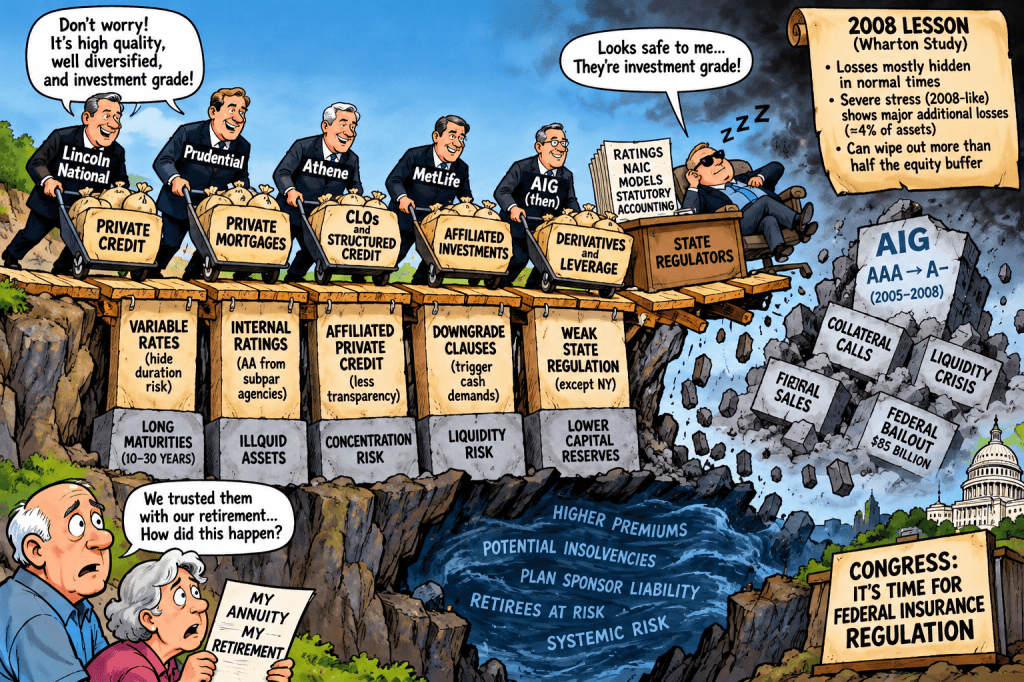
Wharton Has Done What Insurance Regulators Should Have Done Years Ago
A remarkable new 2026 paper from the Wharton School at the University of Pennsylvania provides some of the strongest empirical evidence yet that private-equity ownership is changing the risks borne by American annuity holders.
The paper, “Buying from the Family: Private Equity-Owned Insurers and Their Affiliated Investments,” by Amy W. Huber, Stefan Huber, Bella Shan, and Christina Zhu, examines what happens when the same financial conglomerate controls both an insurance company and the businesses originating the investments that insurer purchases.
The findings should alarm retirement-plan fiduciaries, pensioners, insurance regulators, and members of Congress.
The researchers used detailed statutory insurance filings, security-level transaction records, ownership structures, independent valuations, and NAIC stress tests. They did not merely speculate about conflicts of interest. They examined how affiliated transactions actually differ from arm’s-length investments.
Their findings challenge the comforting insurance-industry narrative that investment-grade ratings, state regulation, and statutory reserves adequately protect annuity holders.
The evidence suggests something much more troubling: insurance companies can become captive financing vehicles for the investment businesses of their owners, while policyholders bear the consequences.
And there is an even bigger problem that deserves attention.
Once private-equity-owned insurers gain a competitive advantage from investing in higher-yielding, less-transparent private assets, what happens to traditional insurers that must compete against them?
They face pressure to follow.
That is how a problem concentrated in private-equity-owned insurance companies can become an industry-wide threat.
The Wharton Findings: Follow the Policyholders’ Money
The numbers are extraordinary.
<text></text>
| Wharton finding | Result |
| Assets of directly PE-owned insurers in 2024 | $696 billion |
| Share of new PE-owned insurer investments going into structured securities | Over 40% |
| Share of those structured-security acquisitions issued by affiliates in 2024 | Over 60% |
| Price premium on affiliated private securities in estimated primary-market transactions | 47 basis points |
| Additional modeled capital loss in a 2008-like stress scenario | Approximately 4 percentage points |
| Average equity buffer relative to fixed-income portfolios | 7.6% |
Source: Huber, Huber, Shan and Zhu, September 2026, pp. 1–5, 20 and 27–28.
The authors find that directly PE-owned insurers allocate approximately twice as much of their new investment capital to structured securities as independent insurers.
More importantly, the majority of those structured-security purchases are issued by companies affiliated with the same private-equity owner.
This is not simply an insurer purchasing a diversified collection of independently originated investments.
It is a financial organization originating investments and then using an insurance company under common ownership to help finance them.
The traditional discipline of independent buyers negotiating prices, rejecting unattractive investments, and selling deteriorating assets can be weakened when the buyer and seller ultimately answer to the same financial conglomerate.
Wharton finds affiliated insurers pay more for the same investments
One of the study’s most revealing findings concerns pricing.
When comparing purchases of the same security on the same day, the researchers find that PE-owned insurers pay higher prices when buying from affiliated issuers.
For privately placed securities classified as primary-market transactions, the estimated premium is approximately 47 basis points of par value.
That is an especially powerful finding because the comparison controls for the security and transaction date.
The higher price benefits the affiliated issuer receiving financing.
But who bears the economic cost of the insurer paying more?
The insurance company does, and ultimately its financial strength supports the promises made to policyholders.
Wharton finds insurers are less willing to recognize deterioration in affiliated investments
The second finding is potentially even more troubling.
When affiliated investments fall below their historical cost, PE-owned insurers are less likely to recognize impairments and less inclined to sell those positions than their other investment holdings.
The researchers find that PE ownership offsets approximately 80% of the increased same-year impairment propensity otherwise associated with affiliated holdings.
This raises a basic question.
Is the insurer making investment decisions for policyholders, or is it protecting the financing needs and reported performance of affiliated investment businesses?
This pattern is consistent with affiliated insurers providing financial support when an independent investor might recognize a loss or exit.
And the researchers do not find that this favorable treatment is rewarded with superior investment performance.
Securities attracting greater affiliated PE-owned insurer investment have lower independent fair-value estimates beginning two years after purchase.
The supposed advantages of affiliated investing are not producing better results in the study’s comparisons.
The Most Frightening Number: Four Percentage Points of Additional Capital Loss
Wharton’s stress-test analysis should attract particular attention from insurance regulators.
Using NAIC CLO stress-test results and extending the findings to the broader structured-security portfolios of PE-owned insurers, the researchers estimate approximately four percentage points of additional portfolio losses under a severe financial-crisis scenario.
That compares with an average equity buffer equal to 7.6% of fixed-income investments.
In other words, the estimated additional losses alone could consume more than half that measured equity buffer.
The estimate extrapolates from stress-tested broadly syndicated CLOs to other structured securities whose stress performance cannot be directly observed.
But that limitation actually exposes another regulatory weakness: many of the private securities that deserve the closest examination are precisely those for which independent market prices and comparable stress data are most difficult to obtain.
If regulators cannot reliably measure the risk of the assets, why should policyholders accept assurances that statutory capital is adequate?
The Next Domino: Traditional Insurers May Be Forced to Take More Risk
Here is where I would take the Wharton findings a step further.
The paper concentrates on insurers directly owned by private-equity firms.
But competition does not stop at corporate ownership boundaries.
Imagine two insurers competing for the same $1 billion pension risk transfer.
One insurer benefits from an affiliated private-credit origination business. It can purchase complex, higher-yielding private securities and potentially benefit from favorable regulatory capital treatment.
The second insurer operates more traditionally, relying more heavily on liquid, publicly traded investment-grade bonds.
If the first insurer can generate higher expected portfolio yields, it may be able to offer the pension sponsor a lower premium while still targeting an attractive profit margin.
What does the second insurer do?
It can lose business, accept lower profits, or move toward investments offering higher yields.
This is the competitive contagion that could transform a private-equity insurance problem into an entire insurance-industry problem.
Traditional insurers do not have to be purchased by Apollo, Blackstone, KKR, or another private-equity manager to adopt similar investment strategies.
They can increase allocations to privately originated loans, commercial mortgages, structured credit, asset-backed securities, fund-finance arrangements, and privately rated investments.
They can hire private-credit managers or establish investment partnerships without changing the insurer’s ultimate ownership.
The incentive is straightforward: if higher portfolio yields permit lower PRT bids, more competitive annuity crediting rates, or larger retained investment spreads, competitors will feel pressure to participate.
Not every insurer will respond by taking more risk. Stronger capital standards, conservative management, and independent investment governance can resist that pressure.
But absent meaningful regulatory discipline, competition can reward the companies most willing to stretch their balance sheets.
That is a classic race-to-the-bottom problem.
And unlike ordinary corporate competition, the potential losers include pensioners who may depend on one insurance company’s promise for the rest of their lives.
Private Credit Can Look Short-Term on Paper While Remaining Illiquid for 15 Years
Another major concern is the way insurers measure asset/liability risk.
A privately originated commercial mortgage may have a contractual maturity of 15 years but reset its interest rate every three months.
Because of the floating rate, the asset can exhibit relatively low sensitivity to changes in benchmark interest rates.
But that does not mean the mortgage is liquid.
It does not mean the borrower can repay principal tomorrow.
It does not mean the insurer can sell the mortgage at book value during a financial crisis.
And it certainly does not mean that a private AA rating guarantees the existence of an active secondary market.
A three-month interest-rate reset does not turn a 15-year private mortgage into a three-month investment.
Yet the industry’s emphasis on interest-rate duration, ratings, and book-value accounting can obscure the distinction between interest-rate risk, credit risk, and liquidity risk.
An insurer can appear to have reasonably matched assets and liabilities while holding assets that cannot be converted into cash without substantial discounts.
The risk becomes especially serious when a policyholder, retirement plan, or regulator needs cash precisely because the insurer’s creditworthiness has deteriorated.
The Wharton paper reinforces this concern by finding that PE-owned insurers concentrate affiliated investments in securities that independent investors find more difficult to value.
It also identifies structures such as rated feeder funds and special-purpose vehicles that can transform private-fund exposure into securities receiving favorable regulatory capital treatment.
The question for Congress is simple:
Are regulatory ratings and capital formulas measuring the actual economic risks, or are financial engineers designing investments to satisfy the formulas?
Lincoln Shows Why This Is Not Just a Private Equity Problem
In my September 21 article, “Lincoln Says Its General Account Is ‘High Quality.’ The CDS Market Says Look Closer,”, I examined Lincoln Financial’s promotion of its general-account investment quality.
Lincoln reported approximately 96.8% investment-grade assets, while also disclosing substantial allocations to private credit, structured investments, and mortgages.
I compared Lincoln National’s five-year credit-default-swap spread of approximately 130 basis points in mid-September with Prudential’s approximately 80 basis points.
These are holding-company CDS quotations, not direct measures of the credit risk of the annuity-issuing subsidiaries. Nevertheless, they provide a market-based signal that deserves attention alongside statutory capital and insurer financial-strength ratings.
My criticism was not that Lincoln was insolvent (yet) but that its current ratings were somewhat contradicted by its higher credit default swap rates..
It was that calling an investment portfolio high quality does not adequately disclose the economic risk borne by a retirement plan holding a general-account fixed annuity.
The Wharton findings strengthen that concern.
Insurers should not be able to rely on favorable ratings and regulatory carrying values while withholding the information necessary to evaluate private-credit liquidity, asset maturity, valuation uncertainty, and stressed losses.
And the competitive pressure from PE-owned insurers may encourage even traditional carriers to increase those exposures.
Pension Risk Transfers: One Insurer Replaces a Diversified Pension Plan
The implications for pension risk transfers are particularly serious.
When a traditional defined-benefit pension plan purchases a group annuity to settle pension obligations, retirees move from a federally regulated pension arrangement into an insurance contract.
The transaction can remove PBGC protection and ERISA plan-level fiduciary oversight of the transferred benefits.
The insurer becomes the entity responsible for paying benefits, often for decades.
In my October 5 article, “AT&T’s Athene Pension Transfer: State Street Must Answer, but the Sponsor Gets Out,”, I discussed the fiduciary-accountability questions surrounding pension transfers to insurers.
The Wharton paper adds another reason why those questions matter.
What happens when the insurer receiving pension liabilities is part of a financial conglomerate that also originates and structures the assets purchased with policyholder-backed capital?
What happens when the insurer favors affiliated investments, pays more for them, and is reluctant to recognize deterioration?
And what happens when a traditional insurer competes for the same pension liabilities by increasing its own private-credit allocation?
The danger is not limited to whether the insurer can pay this year’s benefits.
A PRT annuity may require payments for 20, 30, or 40 years.
Fiduciaries should therefore evaluate the insurer’s ability to meet obligations through future credit cycles, not merely its current financial-strength rating.
The Diversification Lie: Thousands of Investments, One Insurance Promise
In “Annuity Derisking in Retirement Plans,”, I argued that retirement plans need to apply ordinary diversification principles to annuity credit risk.
A general-account insurer may own thousands of bonds, mortgages, and private loans.
But a 401(k) participant invested in its fixed annuity generally does not own those investments.
The participant owns a contractual claim dependent on one insurer’s ability to pay.
The insurer may be diversified internally, but the participant remains exposed to a single insurance company.
That is why I favor enforceable downgrade provisions permitting retirement plans to exit at book value when an insurer’s financial strength deteriorates.
A downgrade clause could allow a plan to transfer its money to another financially sound insurer before severe deterioration makes withdrawal difficult.
The absence of such protections can leave participants captive to the very insurer whose creditworthiness has become questionable.
The Wharton findings make these contractual protections more important, not less.
If insurers hold growing concentrations of illiquid private assets, fiduciaries must understand how they will exit when those assets are hardest to sell.
A downgrade clause is not a substitute for adequate capital or regulation. It is an additional protection that should be evaluated, priced, and disclosed.
Weak State Regulation Is Enabling a National Problem
The United States regulates insurance primarily through state governments.
The NAIC coordinates standards, but it is not a national insurance regulator with independent authority to enforce every model rule.
Meanwhile, the largest insurance and asset-management conglomerates operate nationally and internationally.
Their investment structures can involve Delaware insurers, Iowa-regulated entities, Bermuda reinsurers, Cayman Islands investment vehicles, Luxembourg funds, and affiliated asset managers.
In “Offshore in Your 401(k): Congress Must Require Wall Street to Show the Entire Chain,”, I called for disclosures identifying the entities that ultimately control retirement assets, where those entities are domiciled, how they are compensated, and what restrictions apply when investors want their money back.
The same principle should apply to annuity insurers.
If an insurer invests through a Bermuda or Cayman structure, federal regulators should be able to trace the investment to its underlying economic exposure.
If an insurer purchases securities originated by an affiliate, regulators should be able to determine whether the transaction occurred at arm’s length.
If an investment receives an AA rating from a smaller rating agency, regulators should be able to examine the methodology, conflicts, underlying collateral, and actual trading evidence.
And if an insurer transfers liabilities to an offshore reinsurer, federal regulators should be able to evaluate the entire transaction, including the assets and capital supporting the obligations.
Financial conglomerates operate across state and national borders. Regulatory accountability should not stop at those borders.
Congress Has Already Been Warned
In my September 25 article, “Congress Finally Asks Whether America Needs a Federal Insurance Regulator. The Answer Is Yes,”, I discussed the Congressional Research Service’s examination of private investments and insurance companies.
CRS reported approximately $849 billion in private-credit holdings among life insurers in 2024 and identified concerns involving private ratings, affiliated investments, offshore reinsurance, and regulatory arbitrage.
Those numbers are not limited to directly PE-owned insurers.
The Wharton paper now provides additional evidence of why these issues deserve federal attention.
State regulators are supervising companies whose investment decisions can affect national retirement markets and potentially transmit losses into broader credit markets.
The authors explicitly identify the possibility that losses on affiliated investments could force insurers to sell other securities to restore capital, spreading stress beyond the original private-credit investments.
That is systemic risk.
It cannot be adequately addressed merely by reviewing whether each individual insurer satisfied its state’s statutory capital formula at year-end.
The financial system is interconnected. The regulatory response must recognize those connections.
Elizabeth Warren Is Asking Questions Congress Should Have Asked Years Ago
In “Elizabeth Warren May Be the Insurance Industry’s Only Real Watchdog — and a CFPB-Style Federal Regulator Is Its Worst Nightmare,”, I argued that federal lawmakers need to challenge the insurance industry’s longstanding reliance on state supervision.
Senator Warren’s scrutiny of private-equity-linked insurers reflects a larger issue that should concern both political parties.
Americans depend on annuity contracts for retirement security.
Those promises should not depend on whether a small state insurance department has sufficient resources, independence, or expertise to examine a global private-credit conglomerate.
Congress should establish a national insurance regulator with genuine investigative, supervisory, and enforcement authority.
A CFPB-style model would put the interests of policyholders at the center, but the agency would also need powers the current CFPB does not possess: prudential supervision, capital and liquidity examinations, and oversight of insurance holding-company groups.
The goal should not be to replace every state insurance function.
It should be to establish enforceable national protections against risks that state-by-state regulation cannot adequately control.
Seven Federal Reforms Congress Should Enact
1. Require full transparency of private-credit and affiliated investments.
Large insurers should disclose private-credit exposures, affiliated transactions, underlying asset classes, valuation methods, ratings providers, contractual maturities, and liquidity characteristics in standardized, comparable formats.
2. Require independent valuations of affiliated investments.
Affiliated assets should receive independent valuation scrutiny, especially when they are privately placed, difficult to trade, or purchased from related entities. Regulators should compare carrying values with credible market-based exit values.
3. Establish meaningful federal capital standards for private-credit risk.
Regulatory capital should reflect credit risk, concentration, valuation uncertainty, and liquidity. A privately rated AA security should not automatically receive favorable treatment when its underlying risk cannot be independently verified.
4. Require separate disclosure of interest-rate duration, credit-spread duration, and contractual maturity.
Insurers should not be permitted to use short floating-rate reset periods as a substitute for disclosing long-term principal exposure.
A 15-year private mortgage with a quarterly reset should be reported as exactly that.
5. Conduct federal systemic liquidity stress tests.
Regulators should test what happens when multiple insurers simultaneously experience private-credit losses, rating downgrades, reduced new premiums, and demands for cash.
The stress tests should include the possibility that several insurers attempt to sell similar illiquid assets at the same time.
6. Strengthen retirement-annuity protections.
For ERISA fixed annuities and PRT contracts, Congress should require clear disclosure of insurer credit and liquidity risks, meaningful comparisons among insurers, and competitive evaluation of enforceable downgrade protections.
For PRTs, fiduciaries should obtain competitive bids that explicitly price additional credit protections rather than assume such protections are unavailable.
7. Establish a federal insurance regulator with authority over entire financial groups.
A federal watchdog must be able to examine insurers, affiliated asset managers, reinsurers, and investment structures across state and offshore jurisdictions.
It must also have the authority to intervene before liquidity problems become insolvencies.
Disclosure without enforcement is not enough.
The Entire Industry Is Being Pulled Toward Greater Risk
The Wharton authors deserve enormous credit for bringing hard evidence to a debate too often dominated by insurance-company marketing and reassuring credit ratings.
Their research demonstrates that PE-owned insurers systematically behave differently when investing in affiliated securities.
They buy more structured credit, concentrate purchases among affiliates, pay higher prices in certain transactions, and are less inclined to recognize or exit deteriorating affiliated investments.
Their stress analysis indicates that the resulting downside exposure could be substantial relative to insurer capital.
But the greatest long-term danger may be what happens outside private equity.
When some insurers generate higher investment yields by accepting greater private-credit complexity, opacity, and illiquidity, competitors face pressure to do the same.
Traditional insurers may increasingly adopt the same investment strategies even without being acquired by private-equity firms.
The result could be an industry in which higher private-credit exposure becomes the competitive norm.
This is precisely why relying on state regulators, private credit ratings, and year-end statutory accounting is insufficient.
The financial crisis will not wait for regulators to discover that a portfolio with a short reported interest-rate duration contains 15-year loans that cannot be sold.
And retirees should not have to discover that their supposedly safe annuity is backed by investments whose risks were poorly measured, privately rated, or hidden inside affiliated structures.
The Wharton paper should become required reading for Congress, the NAIC, state insurance commissioners, pension fiduciaries, and every retirement consultant recommending annuities.
It provides evidence that the existing system deserves far more scrutiny.
Congress must now confront the broader question: If competition is pushing the entire annuity industry toward increasingly opaque and illiquid private credit, who is protecting the retirees who ultimately bear the risk?
The answer cannot remain 50 state insurance departments acting separately.
America needs federal insurance regulation, transparent private-credit accounting, credible systemic stress testing, and enforceable protections for annuity holders — before the next insurance crisis, not after.
APPENDIX
Remember AIG: A Highly Rated Insurance Giant Needed an $85 Billion Rescue
The Wharton study’s 2008-style stress test should remind Congress of something the insurance industry would prefer to forget: AIG.
In early 2005, AIG held an AAA credit rating from Standard & Poor’s. By September 2008, after successive downgrades, it was rated A− and required an emergency $85 billion Federal Reserve rescue to avert a potentially catastrophic failure.
AIG did not have to be rated junk before its liquidity crisis became overwhelming.
Its problems involved deteriorating mortgage-related securities, derivatives collateral calls, securities lending, and an inability to raise cash when counterparties lost confidence.
On September 15, 2008, rating downgrades generated more than $20 billion of additional collateral and termination-payment requirements over a short period.
The federal government intervened the next day.
Now consider what the Wharton researchers have found about today’s private-equity-owned insurers.
Their analysis of NAIC stress tests shows that additional losses associated with affiliated investments are largely invisible in moderate scenarios but become substantial under financial-crisis conditions.
Their estimated additional portfolio loss of approximately four percentage points would consume more than half the measured equity buffer of the PE-owned insurers in their sample.
And those losses are additional to the baseline stress losses.
The study does not predict another AIG. It documents a potential source of severe downside exposure that deserves much more scrutiny.
AIG demonstrated how rapidly investment losses, ratings downgrades, collateral requirements, and disappearing liquidity can interact.
Wharton demonstrates that today’s affiliated private-credit investments may contain risks that become visible only under severe stress.
Congress should not wait until another highly rated insurance conglomerate needs emergency federal support to discover that state regulation, favorable ratings, and statutory accounting failed to capture the full risk.
The lesson of 2008 is not that every insurer will fail. It is that even a large, highly rated financial institution can become a systemic threat when opaque credit exposures and liquidity obligations interact.
America needs federal insurance stress testing that measures not only investment losses, but also the cash insurers must produce when confidence disappears.

