By Chris Tobe, CFA, CAIA — Commonsense 401(k) Project
For decades, Wall Street investment consultants have helped steer hundreds of billions of dollars in public pension and 401(k) retirement assets into expensive, opaque, and sometimes underperforming investments. When those investments disappoint, pension trustees and retirement plan sponsors are usually blamed. The consultants who recommended them too often escape accountability.
A $34.55 million settlement involving the Pennsylvania Public School Employees’ Retirement System (PSERS) offers an important opportunity to challenge that pattern.
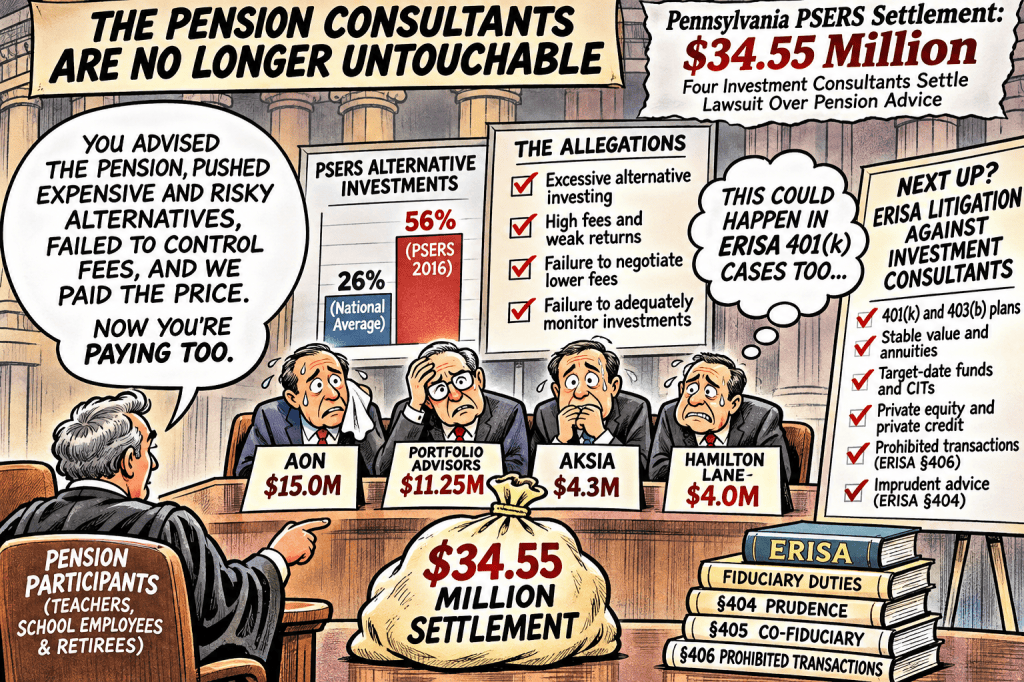
Four prominent investment consulting and advisory firms—Aon Investments USA, Hamilton Lane Advisors, Portfolio Advisors, and Aksia—agreed to settlements arising from litigation over their work for Pennsylvania’s massive public school pension system.
The settlements do not establish that the firms violated their legal duties. Nevertheless, they demonstrate that outside investment advisers can face substantial financial exposure when participants allege that their advice contributed to imprudent investments, excessive costs, and measurable retirement losses.
The next question is whether the same accountability should extend more aggressively to consultants serving private-sector 401(k), 403(b), and defined benefit pension plans governed by ERISA.
My answer is yes—where the facts establish fiduciary status, knowing participation in prohibited transactions, or another legally recognized basis for liability.
Pennsylvania: The Consultants Finally Face the Music
The PSERS litigation is important because the plaintiffs targeted the outside professionals advising the pension system, rather than relying exclusively on claims against public officials or pension trustees.
The reported settlements total:
| Investment adviser | Settlement |
| Aon Investments USA | $15 million |
| Portfolio Advisors | $11.25 million |
| Aksia | $4.3 million |
| Hamilton Lane Advisors | $4 million |
| Total | $34.55 million |
The underlying litigation challenged the consultants’ roles in recommending and overseeing costly alternative investments, including private equity and other illiquid strategies.
Plaintiffs alleged that the system’s investment performance and consultant decisions contributed to higher employee pension contributions under Pennsylvania’s shared-risk provisions.
This last point is especially important.
In many public pension systems, poor investment performance produces higher taxpayer contributions, lower funded ratios, pressure to reduce benefits, or some combination of those consequences. Establishing an individual participant’s legally recoverable loss can be difficult.
Pennsylvania’s shared-risk contribution structure provided a more direct connection between pension investment results and employee contributions.
That made the litigation potentially more powerful.
The plaintiffs were not merely arguing that consultants made questionable recommendations. They alleged that those decisions contributed to actual financial harm to retirement plan participants.
The defendants resolved the claims through settlements, not findings of liability. But the financial consequences for the consulting firms were real.
The Consultant Accountability Gap
America’s public pension systems depend heavily on outside investment consultants.
These consultants recommend asset allocations, evaluate investment managers, advise on private equity commitments, negotiate or review fees, prepare performance reports, and sometimes exercise discretionary authority.
Consultants can wield enormous influence while trustees retain formal voting authority.
This creates a troubling accountability structure.
When an investment succeeds, the consultant can claim credit for its expertise. When it fails, the consultant may argue that the pension board made the ultimate decision.
But what happens when the board relied on incomplete analysis, inadequate fee comparisons, misleading performance presentations, or recommendations influenced by business relationships?
The consultant’s precise legal responsibilities matter.
A nondiscretionary consultant does not automatically become a fiduciary merely because trustees followed its advice. Nevertheless, discretionary authority, control over plan assets, contractual obligations, conflicts of interest, and actual conduct can create substantial legal exposure.
The PSERS settlements provide a reason to examine those responsibilities much more closely.
Consultants and the Private Equity Distribution Machine
I have previously argued that America’s largest pension consulting firms have become an important distribution channel for private equity, private credit, hedge funds, and other alternative investments.
See my earlier investigation:
How America’s Largest Pension Consultants Became the Distribution Arm for Private Equity
The fundamental problem is that alternative investments often generate much higher fees and substantially less transparent reporting than traditional publicly traded stocks and bonds.
Private equity performance can also be difficult to compare with public-market alternatives because of appraisal-based valuations, irregular cash flows, leverage, stale pricing, and differing performance methodologies.
A consultant recommending these investments should be able to answer several basic questions:
- Did the alternative investment outperform an appropriate, investable public-market benchmark after all fees and expenses?
- Were valuation smoothing and stale marks adequately disclosed?
- Did the consultant independently verify the investment manager’s performance and fee representations?
- Were liquidity restrictions, leverage, and capital-call obligations properly evaluated?
- Did the consultant disclose business relationships that could compromise its independence?
- Was the pension board presented with a realistic lower-cost alternative?
If the consultant cannot demonstrate a prudent analytical process, the fact that trustees approved the investment should not automatically end the inquiry.
Consultants should be judged on the quality and independence of their advice—not simply the sophistication of their presentations.
The Public Pension Consultant Problem Goes Beyond Investment Returns
The same consultant-accountability questions extend to governance, executive compensation, and investment staff incentives.
In my September 2026 article, I examined how compensation consultant GGA helped legitimize controversial compensation practices at major pension institutions, including CalPERS, Ohio STRS, and Ontario pension systems.
Boards may rely on outside experts to justify compensation arrangements, investment policies, and performance measurements that trustees lack the resources or expertise to challenge independently.
When consultants are effectively paid to validate decisions already favored by management, independence becomes a legitimate concern.
The questions should include whether compensation benchmarks were appropriate, whether performance numbers were independently verified, and whether incentive arrangements rewarded actual long-term value creation.
A consultant’s professional credentials should not substitute for independent scrutiny.
Chicago Teachers and the Callan Question
I also highlighted teacher and journalist Jim Vail’s examination of the relationship between Chicago’s teacher pension system and its investment consultant Callan.
Teacher Jim Vail’s Exposé on Chicago Teachers vs. Callan: A Case Study in Pension Consultant Capture
The broader concern is whether long-standing consultant relationships can reduce the willingness of pension boards to question performance, costs, or investment strategy.
Consultants can become institutional gatekeepers.
They influence which investment managers receive consideration, how performance is presented, which benchmarks are used, and whether expensive alternative investments remain in portfolios.
These decisions can have enormous consequences.
The Pennsylvania litigation suggests that examining the consultant’s role—not merely the board’s final vote—can be a productive avenue for legal accountability.
That is not an allegation that Callan or any other consultant discussed here committed the same conduct alleged in Pennsylvania. It is an argument for applying comparable scrutiny to the actual duties and conduct of consultants across pension systems.
Creative Planning, RVK, and the Question of Independence
Another development is the consolidation of investment consulting and wealth management businesses.
In September, I examined Creative Planning’s acquisition of RVK, historically one of the significant independent institutional investment consulting firms.
Creative Planning’s Purchase of RVK
The acquisition raises questions about the future of independent institutional investment advice.
When consulting, investment management, recordkeeping, brokerage, and related financial services operate within increasingly interconnected corporate structures, conflicts may become more complicated.
A firm may be capable of providing independent advice despite offering other services. But fiduciaries should examine whether recommendations create direct or indirect economic benefits for affiliates.
The same concerns arise when consultants recommend proprietary products, affiliated managed accounts, private-market vehicles, or recordkeeping arrangements that generate additional revenue.
The consultant should be an independent watchdog for retirement participants—not an undisclosed distribution channel for financial products.
Academic Research Supports the Consultant Accountability Argument
My May 2026 Commonsense article examined the research paper Choosing Pension Fund Investment Consultants, by Aleksandar Andonov, Matteo Bonetti, and Irina Stefanescu.
Consultants, Conflicts, and the Collapse of Public Pension Performance
The research found that pension funds hiring new consultants tend to move toward the investment allocations and private fund relationships already prevalent among those consultants’ clients.
The authors found that a private fund connected to a consultant could be two to four times more likely to receive a commitment.
Yet the research found no corresponding significant improvement in investment performance from consultant-driven allocation changes.
This is not proof that every consultant recommendation is conflicted or imprudent. But it challenges the assumption that institutional consultants necessarily improve investment outcomes.
The Pennsylvania litigation adds another dimension: if consultants influence investments without delivering the benefits promised, should they bear responsibility when legally actionable failures cause financial harm?
ERISA: The Next Frontier for Consultant Litigation
The Pennsylvania settlements are especially relevant to private-sector retirement plans.
In November 2025, I published:
Why 401(k) Consultants Should Be Included as Defendants in ERISA Litigation
My argument was that plaintiffs’ attorneys have concentrated too heavily on plan sponsors, recordkeepers, and investment managers while overlooking the consultants who often designed the challenged arrangements.
These consultants frequently recommend investment menus, prepare fee benchmarking studies, select or evaluate recordkeepers, and advise on target-date funds, stable value investments, and annuity contracts.
Some operate as registered investment advisers. Others also have broker-dealer or insurance relationships. Some serve as ERISA Section 3(21) fiduciary advisers, while others accept discretionary authority under Section 3(38).
These distinctions are critical.
ERISA liability depends on what the consultant actually did, what authority it exercised, and whether its conduct satisfies the requirements of the applicable legal claim.
Four Potential ERISA Claims Against Consultants
1. Breach of fiduciary duty — ERISA Section 404
A consultant functioning as an ERISA fiduciary may face liability for imprudent investment recommendations, inadequate monitoring, excessive costs, or failures to address conflicts of interest.
A consultant with discretion over investment selection is particularly exposed. A nondiscretionary adviser may also be a fiduciary to the extent it provides investment advice for a fee within the applicable legal definition.
2. Prohibited transactions — ERISA Section 406
Consultants providing services to a plan generally qualify as parties in interest under ERISA Section 3(14).
Transactions involving those consultants can implicate Section 406(a), subject to statutory and administrative exemptions.
A consultant that is itself a fiduciary may also violate Section 406(b) if it uses fiduciary authority for its own benefit or receives improper transaction-related compensation.
The Supreme Court’s 2025 decision in Cunningham v. Cornell University makes prohibited-transaction pleading especially relevant. The Court held that plaintiffs need not plead the absence of a statutory exemption as part of their initial Section 406(a) claim. Exemptions remain available as affirmative defenses.
That decision does not mean every consultant payment is unlawful. Reasonable service arrangements may qualify for exemptions, and plaintiffs must still establish the other elements of their claims.
3. Co-fiduciary liability — ERISA Section 405
A consultant that is an ERISA fiduciary may face co-fiduciary liability when it knowingly participates in or conceals another fiduciary’s breach, enables a breach through its own failure to comply with Section 404, or knows of a breach and fails to make reasonable efforts to remedy it.
Merely attending investment committee meetings or providing recommendations does not automatically establish co-fiduciary liability.
4. Knowing participation by nonfiduciaries
Even when a consultant is not an ERISA fiduciary, it may face equitable claims under Section 502(a)(3) in appropriate circumstances.
The Supreme Court’s Harris Trust & Savings Bank v. Salomon Smith Barney decision provides an important foundation for claims involving nonfiduciary parties in interest that knowingly participate in prohibited transactions.
However, available remedies and the requirements for proving knowing participation differ from ordinary fiduciary breach claims.
These distinctions should guide the development of complaints rather than treating every consultant as automatically liable.
ERISA Consultants Have Already Paid Settlements
The Pennsylvania case is not the first indication that consultant-related claims can produce meaningful recoveries.
In Disselkamp v. Norton Healthcare, involving a Kentucky 403(b) retirement plan, Lockton Advisors was included in litigation that ultimately produced a reported $5.75 million settlement.
My earlier article also discussed settlements involving Northern Trust in the AutoZone litigation and Russell Investments in the Royal Caribbean litigation.
These cases involve different services, legal theories, and alleged conduct. They should not all be characterized as identical consultant fiduciary cases.
Nevertheless, they illustrate an important point:
Investment advisers and consulting firms need not remain outside the defendant group merely because the plan sponsor formally approved the investment decisions.
Fixed Annuities, Stable Value, and Pension Risk Transfers: The Overlooked Consultant Defendants
I believe consultant liability deserves particular attention in litigation involving general account fixed annuities, stable value products, and pension risk transfers.
In these transactions, consultants may play a decisive role in determining which insurers receive retirement assets.
The consultant may design the request for proposals, evaluate competing insurers, compare crediting rates, negotiate fees, assess insurer financial strength, and recommend the final transaction.
Yet the consultant’s evaluation may omit economically important risks.
Consider a 401(k) plan whose consultant recommends a proprietary general account annuity paying substantially less than comparable guaranteed products.
A thorough investigation should examine whether the consultant independently evaluated competing products, understood the insurer’s spread compensation, disclosed relevant business relationships, and evaluated the additional single-insurer credit exposure.
The same principle applies to pension risk transfers.
A consultant recommending the transfer of a traditional defined benefit pension obligation to an insurance company should evaluate more than the insurer’s headline credit rating.
The analysis should consider insurer investments, private credit concentration, reinsurance arrangements, downgrade protections, and the consequences of replacing PBGC-backed pension benefits with insurance-company guarantees and applicable state guaranty association protections.
DOL Interpretive Bulletin 95-1 provides an established framework for evaluating insurer selection in pension risk transfers.
Where consultants undertake these responsibilities, their actual performance should be scrutinized.
If a consultant has a financial relationship with the selected insurer, the need for investigation becomes even greater.
But liability requires evidence—not simply the existence of an insurance license, an affiliated brokerage business, or a potential conflict.
What Plaintiffs’ Attorneys Should Demand in Discovery
The Pennsylvania case suggests a practical litigation strategy for both public pension and ERISA plaintiffs.
Rather than focusing exclusively on the trustees’ final decisions, plaintiffs should reconstruct the consultant’s entire decision-making process.
Critical discovery should include:
- Consulting agreements and fiduciary acknowledgments: Determine precisely which responsibilities were delegated and which decisions the consultant controlled.
- Compensation and conflicts: Obtain Form ADV disclosures, direct and indirect compensation records, affiliate agreements, referral arrangements, and relevant revenue-sharing contracts.
- Investment committee presentations: Compare the consultant’s original analyses with the materials ultimately presented to trustees.
- Benchmark and performance records: Identify inappropriate benchmarks, stale valuations, omitted fees, and unexplained changes in performance methodology.
- RFPs and fee negotiations: Determine whether the consultant conducted genuine competitive searches and negotiated meaningful fee reductions.
- Internal communications: Examine discussions of underperformance, liquidity risks, insurer creditworthiness, and alternative investment conflicts.
- Comparable client recommendations: Determine whether consultants systematically recommended the same expensive products across multiple plans.
In ERISA cases, these records may help establish fiduciary status, breaches of prudence or loyalty, prohibited transactions, causation, and recoverable losses.
In public pension cases, they may establish contractual duties, state-law fiduciary obligations, or other actionable misconduct.
The legal theories differ, but the investigative principles are remarkably similar.
The Next Wave of Pension Litigation Should Follow the Consultants
The $34.55 million PSERS settlements should change the way pension litigation attorneys investigate investment decisions.
The consultant is frequently the professional who prepares the analysis, defines the investment alternatives, develops the benchmarks, negotiates with managers, and presents the recommendation.
The pension board may approve the decision, but that does not answer whether the consultant fulfilled its own responsibilities.
For public pension systems, the Pennsylvania litigation provides a concrete example of participant claims against outside advisers resulting in substantial settlements.
For ERISA plans, existing fiduciary, prohibited-transaction, co-fiduciary, and equitable-remedy provisions offer additional avenues for accountability when supported by the facts.
The implications extend beyond private equity.
Consultants involved in expensive target-date funds, opaque collective investment trusts, proprietary recordkeeper products, fixed annuities, stable value arrangements, and pension risk transfers all deserve scrutiny when retirement participants suffer losses.
Wall Street consultants cannot reasonably demand enormous influence over retirement investments while expecting no accountability for the advice they provide.
The Pennsylvania settlements do not prove that every pension consultant has breached its duties.
They do establish that lawsuits targeting outside pension advisers can produce substantial recoveries.
The next generation of public pension and ERISA litigation should investigate not only who signed the investment contract, but also who designed the transaction, who recommended it, who profited, and who failed to protect the retirement participants whose money was at risk.
It is time to stop treating investment consultants as invisible participants in pension litigation.
Sources and Further Reading
Pennsylvania litigation
- PSERS Shared Risk Class Action — Official Settlement Website
- PSERS Court Documents — Complaints, Answers, Class Certification and Settlement Agreements
Commonsense 401(k) Project investigations
- Why 401(k) Consultants Should Be Included as Defendants in ERISA Litigation — November 2025
- How America’s Largest Pension Consultants Became the Distribution Arm for Private Equity — December 2025
- Consultants, Conflicts, and the Collapse of Public Pension Performance — May 2026
- The Consultant Behind the Public Pension Pay Machine — September 2026
- Teacher Jim Vail’s Exposé on Chicago Teachers vs. Callan — December 2025
Academic research
Legal authorities
- ERISA Sections 3(14), 3(21), 3(38), 404, 405, 406 and 502(a)(3)
- Cunningham v. Cornell University, 605 U.S. 51 (2025)
- Harris Trust & Savings Bank v. Salomon Smith Barney Inc., 530 U.S. 238 (2000)
- DOL Interpretive Bulletin 95-1, 29 C.F.R. § 2509.95-1

