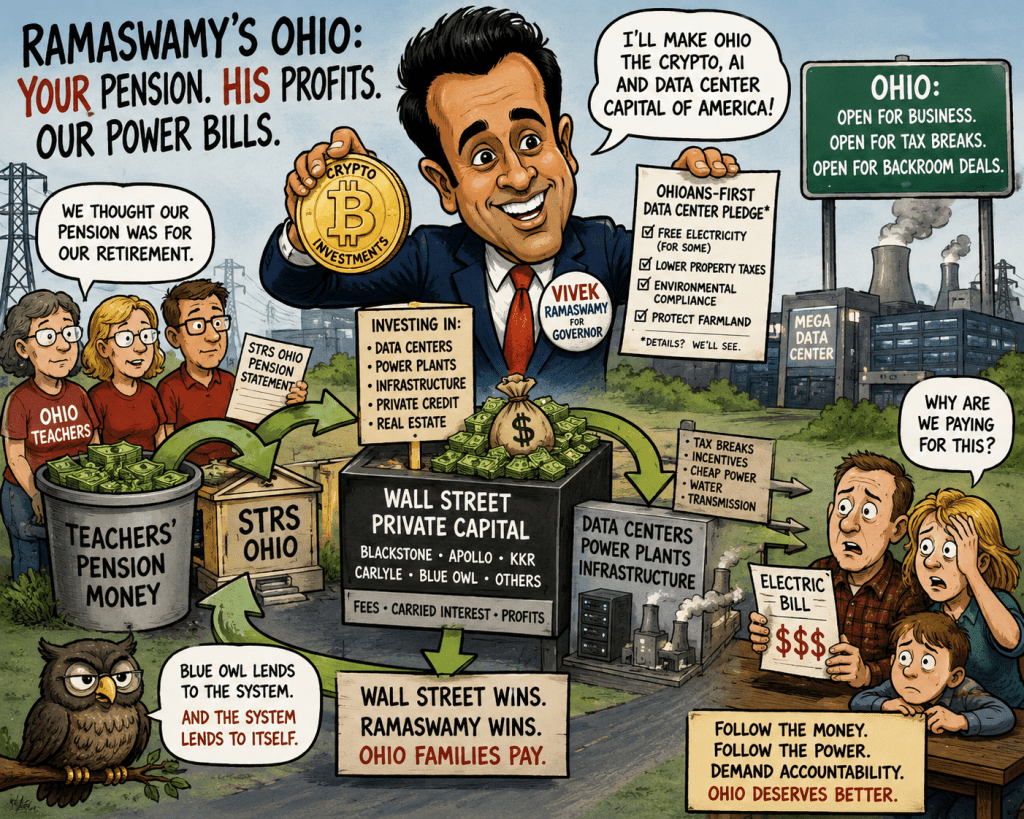
Data centers have become politically radioactive across the country. The backlash is no longer confined to environmental activists. Voters are asking basic pocketbook questions:
Who pays for the electricity?
Who pays for the transmission?
Who supplies the water?
Who gets the tax breaks?
Who owns the data centers?
And in Ohio there is another question almost nobody asks:
How much of the capital ultimately comes from the retirement savings of Ohio teachers and other public employees?
That last question changes the entire story.
Ohio Teachers May Be Financing Both Sides of the Data-Center Boom
STRS Ohio reported roughly $103 billion in investments as of June 30, 2025, with approximately 19.7% allocated to alternatives and another 9.5% to real estate.
That does not mean 29.2% of STRS is invested in data centers.
It means Ohio teachers have enormous exposure to the private-market machinery increasingly financing data centers, private credit, power generation, real estate and infrastructure.
Follow the money far enough and the circle becomes extraordinary:
Ohio teachers → STRS Ohio → Wall Street/private capital → data centers + power plants + infrastructure → Wall Street fees and profits.
Meanwhile, Ohio communities can provide the land, water, transmission infrastructure and tax incentives.
Then Ohio families buy electricity from a grid being transformed by enormous new industrial loads.
That is not an ordinary investment story.
It is an intersection of pension policy, energy policy, tax policy and political power.
STRS Already Owns the Companies Creating the Demand
The story doesn’t begin with obscure private-equity partnerships.
STRS’s disclosed 2024 public-equity holdings included approximately:
- $1.56 billion of Microsoft;
- $1.44 billion of Nvidia;
- $862 million of Amazon;
- $542 million of Meta; and
- roughly $873 million combined in Alphabet shares.
These are among the companies driving the AI computing explosion.
But STRS exposure doesn’t necessarily stop with the customers demanding computing capacity.
Teachers’ retirement money also flows into the enormous private-capital ecosystem financing the facilities, debt, power plants, transmission and other infrastructure supporting that demand.
That creates what might be called the Great Ohio Circular Trade.
Teachers can effectively own the companies demanding AI infrastructure while simultaneously supplying capital to investment managers financing the infrastructure required to serve them.
And those investment managers collect fees along the way.
Carlyle May Be the Cleanest Example
Carlyle says it manages approximately $1.5 billion for Ohio state teachers and public employees.
Carlyle-backed Ark Data Centers, meanwhile, has been expanding in Ohio.
Ark was connected to a proposed/approved approximately $4.5 million Ohio tax incentive for a roughly $136 million expansion.
Republican U.S. Senator Bernie Moreno criticized that arrangement, arguing in substance that Ohio taxpayers shouldn’t be subsidizing Wall Street.
He has a point.
But take the argument one step further.
Ohio public employees supply investment capital to Carlyle.
Carlyle backs a data-center company.
The company seeks Ohio tax benefits.
Ohio’s power infrastructure must accommodate data-center growth.
And the investment manager potentially earns fees and investment profits throughout the process.
That is exactly why Ohio needs look-through disclosure rather than another press release celebrating billions of dollars of “investment.”
Blackstone, Apollo and KKR Are Moving Into the Power Plants
The financial circle gets even tighter.
A Blackstone-led consortium involving Apollo- and KKR-managed vehicles agreed to invest approximately $5.34 billion with Williams in power-generation projects associated with rapidly increasing electricity demand.
Four named projects—Socrates, Apollo, Socrates the Younger and Neo—are in Ohio.
Think about what that means.
Private capital can own or finance the data center.
Private capital can finance the power plant.
Private capital can provide the private credit.
Private capital can own related infrastructure.
And public pension systems can supply capital to the private managers operating at several points in the chain.
That doesn’t establish that a particular STRS partnership financed a particular Ohio plant.
It demonstrates why simply telling teachers that they own “private equity,” “private credit,” “infrastructure” or “real estate” is becoming almost meaningless.
Ohio teachers deserve to know what they actually own.
Blue Owl Shows Why the Labels Don’t Work
STRS Ohio’s relationship with Blue Owl makes the disclosure problem even clearer.
STRS is a Class A member of Blue Owl Credit SLF LLC, a joint venture making senior secured and other loans.
Blue Owl, meanwhile, has made digital infrastructure a major real-assets strategy and closed its third Digital Infrastructure Fund with approximately $7 billion in commitments in 2025.
Again, that doesn’t prove the STRS lending joint venture financed a particular Ohio data center.
It proves something more important from a governance perspective:
An STRS annual report can say “private credit” while the underlying economic exposure may ultimately intersect with the same AI/data-center boom appearing elsewhere as real estate, infrastructure or private equity.
You cannot oversee what you cannot see.
Now Add Vivek Ramaswamy
This is where an investment story becomes an election-governance story.
Republican gubernatorial nominee Vivek Ramaswamy isn’t approaching this enormous economic transformation as a financially detached observer.
His financial interests have included cryptocurrency and a substantial continuing ownership interest in Strive. An April 2026 SEC filing reported Ramaswamy beneficially owning about 5.69 million Strive shares, representing 8.4% of the class.
Ramaswamy has also publicly embraced Bitcoin and supported the policy direction represented by Ohio House Bill 18.
HB 18 is not imaginary. The Ohio Legislature describes it as the Ohio Strategic Cryptocurrency Reserve Act. Its introduced version would amend the investment statutes governing Ohio’s five state retirement systems and address their investment in exchange-traded products while permitting certain state funds to be invested in digital assets.
That matters because data centers, cryptocurrency, AI, private equity, private credit and electric generation increasingly belong to the same financial ecosystem.
Ramaswamy’s own financial interests therefore deserve extraordinary scrutiny whenever state policy touches that ecosystem.
The Governor is the Glue of Data Center Dominance
More importantly for the data-center boom, the next governor will exercise enormous influence over economic-development policy, energy policy, tax incentives and regulatory appointments. And appointments to pension boards.
Ohio’s next governor will appoint members of the Public Utilities Commission of Ohio. State government will confront decisions involving data-center incentives, utility infrastructure, environmental regulation and economic-development subsidies.
Those decisions can move billions of dollars.
When a governor or candidate has significant financial exposure to industries affected by those decisions, disclosure and recusal aren’t partisan attacks.
They are elementary governance safeguards.
Ramaswamy has been forced to Respond to the Backlash
A recent report by Innovation Ohio concluded that Ramaswamy’s personal financial disclosure shows investments spanning virtually the entire Ohio data-center ecosystem, including semiconductor manufacturers, cloud computing companies, industrial real estate investment trusts (REITs), and cryptocurrency-related assets. The report argues that many of these holdings could benefit from state policies affecting tax incentives, utility regulation, infrastructure spending, and economic development.
Ramaswamy’s position has evolved from blatantly pro data center into what his campaign calls the “Ohioans-First Data Center Pledge.”
This so-called pledge causes more questions than answers. How are costs prevented from migrating to other ratepayers?
What happens to Ohio’s data-center tax exemptions?
How will enormous transmission and generation costs be allocated?
Will developers disclose beneficial ownership?
Will local governments be prohibited from signing secrecy agreements?
And will the governor disclose and recuse himself from decisions affecting companies and industries in which he has significant financial interests?
Ohio Republicans Have a Bigger Problem Than Ramaswamy
The data-center controversy shouldn’t be reduced to one candidate.
Ohio has been governed by Republicans for years while many of the financial and infrastructure conditions behind the boom developed.
Now the political danger has become obvious.
The National Republican Senatorial Committee reportedly warned AI companies this month that public anger over data centers threatens Republicans politically in Ohio. Data centers have become a major issue in the Senate contest involving Republican Jon Husted as well.
That is an extraordinary development.
The industry’s political problem has grown large enough that Republicans themselves are warning the technology industry about it.
The appropriate response isn’t better advertising.
It is better policy.
Ohio Has Seen This Movie Before
Ohio should have learned something from House Bill 6 and FirstEnergy.
The lesson wasn’t that electricity companies are evil.
It was that huge amounts of money + political influence + complicated financial relationships + weak transparency can become dangerous.
The names have changed.
Today the ingredients include:
AI.
Crypto.
Private equity.
Private credit.
Data centers.
Utilities.
Public pensions.
Tax incentives.
And enormous political contributions.
The financial structures are far more sophisticated than the old Ohio scandals.
That should make Ohio more cautious, not less.
STRS Should Open the Books Before Ohio Opens the Grid
STRS should publish a comprehensive Data Center and AI Infrastructure Look-Through Report.
It should identify every private fund, co-investment, real-estate vehicle and credit vehicle with material direct or indirect data-center exposure; estimate STRS dollars ultimately exposed; identify Ohio-specific investments; disclose associated natural-gas, pipeline, generation and transmission investments; identify fees and carried interest; and explain how privately valued assets are marked.
It should separately identify exposure to major managers including Blackstone, Apollo, KKR, Carlyle, Blue Owl, Brookfield and others active in digital infrastructure.
And it should disclose relevant political, placement-agent and other conflicts.
Until STRS performs that exercise, nobody should pretend to know exactly how much Ohio teachers have riding on the data-center boom.
The inability of beneficiaries to determine the number is itself part of the problem.
The 2026 Accountability Test
Ohio doesn’t have to choose between banning technology and giving Wall Street a blank check.
There is an obvious middle ground.
Make data centers pay the full incremental cost they impose on electricity and transmission systems.
Require meaningful water and environmental disclosure.
Stop secret economic-development deals.
Disclose tax subsidies.
Protect local governments and landowners.
Require public pension systems to disclose their ultimate economic exposure.
And impose meaningful conflict-of-interest and recusal rules on public officials with financial interests in the industries they regulate.
Ramaswamy’s financial interests make those safeguards especially important if he becomes governor.
His new data-center pledge should therefore be treated as the beginning of due diligence—not the end of it.
Follow the Money Before You Follow the Campaign Ads
The CommonSense lesson is remarkably simple.
When politicians promise economic development, follow the money.
When Wall Street promises diversification, follow the money.
When a pension fund says an investment is merely “private credit” or “infrastructure,” follow the money all the way to the underlying asset.
When a candidate owns investments that could be affected by policies he would oversee, follow the money again.
Ohio teachers supplied the pension contributions.
Ohio residents supply the communities.
Ohio ratepayers supply the electric bills.
Ohio taxpayers supply the incentives.
Wall Street supplies the financial engineering.
And politicians supply the public policy.
The people supplying the money deserve to know who ultimately gets it.
Before Ohio hands the keys to its next governor, voters should demand the same thing a prudent pension fiduciary should demand before investing a dollar: full disclosure, independent oversight and an explanation of every material conflict.


Pingback: Ohio’s Data-Center Money Machine: Husted, Ramaswamy, Faber, SFOF and Wall Street | The CommonSense 401k Project
Pingback: Ohio’s Epstein Election Has a Second Money Trail: Follow the Pensions and Data Centers | The CommonSense 401k Project