By Christopher B. Tobe, CFA, CAIA | September 2026
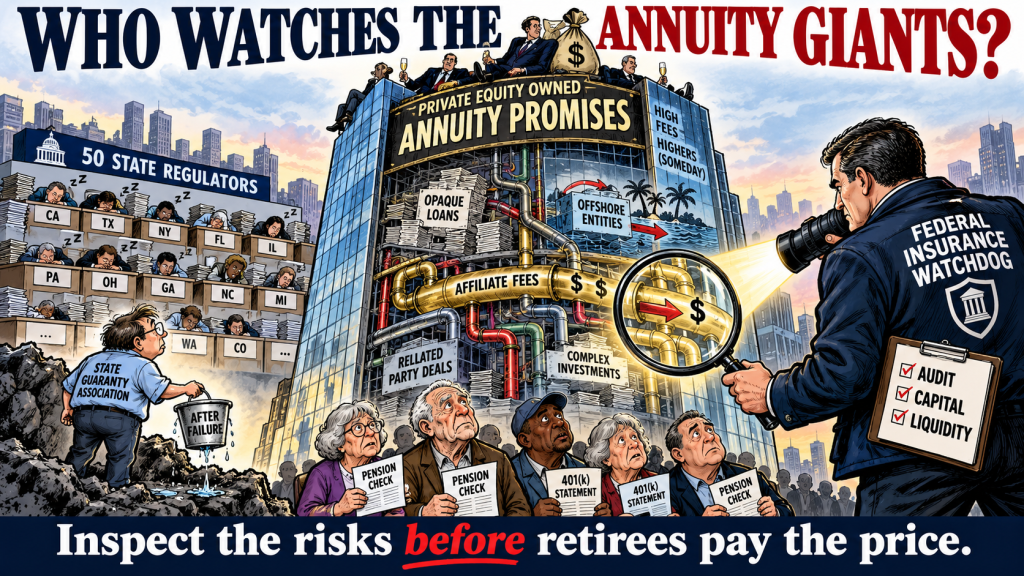
For decades, the insurance industry has sold a simple story: Leave oversight to the states, trust the insurer’s rating, and count on a state guaranty association if the insurer fails. That story gets harder to defend when an insurer is part of a national private-equity and private-credit machine.
Now the Congressional Research Service has put a new federal insurance regulator on Congress’s list of options. Its September 23 report, Private Investments and Insurance Companies, does not outright endorse that option. It does something important: it acknowledges that Congress may need to consider a new federal regulator, stronger federal oversight of state supervision, or other federal approaches to the risks. This is the opening Congress should use.
My preferred answer is a CFPB-style federal insurance watchdog, created by Congress with genuine authority over life insurers, annuity products and the financial groups behind them. Consumer protection alone is insufficient. It also needs prudential examination powers: the ability to see the assets, test capital and liquidity, inspect affiliated transactions, and intervene before a retiree misses a payment. Congress should design the agency to work with state insurance departments, the SEC, the Department of Labor and the Financial Stability Oversight Council, with clear authority and duties rather than another advisory committee.
The CRS numbers should end the complacency
CRS reports that the number of private-equity-owned insurers rose from about 25 in 2017 to 139 in 2024. In 2024 they held about $700 billion in cash and invested assets. Life insurers’ private-credit holdings totaled about $849 billion, or 14% of their balance sheets. Private-equity-owned life insurers represented 18% of the annuity market and 33% of the indexed-annuity market that year. These are industry-wide findings, not claims that every insurer has the same exposure. Read the CRS report.
CRS also says private-equity-owned insurers tend to hold more illiquid private investments and affiliated assets than independent insurers. It discusses private ratings, offshore reinsurance, financial engineering and potential regulatory arbitrage. It notes research finding that private ratings can understate credit risk relative to public ratings, with consequences for regulatory capital. None of those facts proves that an individual carrier is insolvent. Together, they make the case for national examination of the entire insurance and asset-management group. CRS report, “PE Ownership and Insurer Private Assets” and “Policy Issues.”
The federal regulatory gap is explicit. CRS says insurers are chartered and regulated by states and that there is no federal regulator akin to those for banks and capital markets. NAIC model rules do not become law unless states adopt them. A multistate insurer can have a national balance sheet and offshore affiliates while its primary supervision rests with its state of domicile. CRS report, “Investment Regulation of Insurers.”
A guaranty association is a cleanup crew, not a risk regulator
CRS states that guaranty funds have coverage limits, so an annuity holder may not be made whole after insolvency. Most are financed by assessments on other insurers after the failure. A guaranty association does not inspect an affiliated loan today, challenge a private rating tomorrow, or guarantee that a pensioner’s full benefit will be paid through a systemic crisis. CRS report, “Policyholder protection.”
I have argued that the post-failure assessment system is inadequate for a large private-credit-related failure. If several insurers hold similar opaque loans, the survivors asked to pay assessments may be short of cash themselves. Congress should require a publicly tested resolution plan for large life insurers and examine a prefunded, risk-based federal layer of protection for retirement annuities. That proposal requires honest funding, defined coverage and insurer-paid premiums; it must not be marketed as an existing federal guarantee.
What the watchdog should be able to do
Congress should give a new federal agency authority to:
- Examine the entire group. Obtain records from the insurer, controlling asset manager, affiliated funds and reinsurers, including offshore arrangements and assets routed through intermediaries.
- Publish comparable risk disclosures. Report private-credit concentration, related-party exposure, valuation methods, ratings provenance, liquidity stress results, reinsurance recoverables, surrender constraints and material compensation or spreads. Protect genuinely confidential loan details while giving policyholders usable information.
- Challenge capital and valuations. Independently test private ratings and asset prices, impose conservative capital treatment where evidence is weak, and order corrective action before insolvency.
- Police retirement contracts. Require plain-language disclosures and meaningful pre-failure protections for annuities sold to 401(k) and 403(b) plans and used in pension risk transfers, including enforceable remedies after serious deterioration or downgrade. Coordinate with Labor on ERISA fiduciary and prohibited-transaction questions.
- Plan for failure in advance. Require liquidity stress tests and credible resolution plans; assess whether state guaranty associations can meet realistic, simultaneous failure scenarios; and seek congressional authorization for a funded national protection layer.
This is a legislative proposal, not a description of current CFPB powers. As I wrote earlier, CFPB founder Elizabeth Warren has a keen interest as existing federal law generally keeps the business of insurance outside the CFPB’s jurisdiction. Congress would need to create and fund the authority, decide how it shares jurisdiction with states and existing federal agencies, and give it independent examination and enforcement tools. The CFPB model is valuable because it starts with the people who bear the risk and gives a national watchdog the ability to act on their behalf.
The test is whether Congress acts before a collapse
My Security Benefit analysis tied to the current insurance empire that included the LA Dodgers and Lakers and discussion of affiliated private-credit conflicts raise questions about concentration, valuations and liquidity. Those are reasons for rigorous investigation, not findings of insolvency or wrongdoing. A credible regulator would obtain the records, stress the assets and publish defensible conclusions before policyholders are trapped in rehabilitation.
CRS has offered Congress a menu. Congress should choose the option that matches the scale of the business: a national insurance watchdog with consumer-protection, group-supervision and early-intervention powers, backed by a serious plan to fund policyholder protection. Workers and retirees should not discover the limits of state oversight and state guaranty associations only after their insurer fails.

