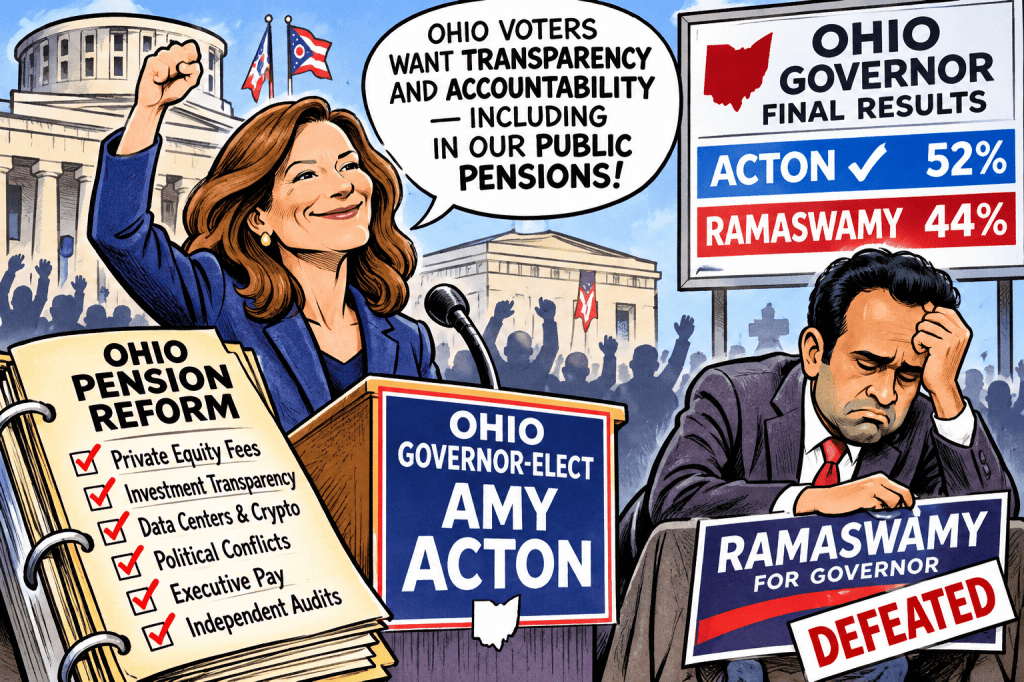
Ohio’s new Democratic governor faces a Republican legislature. But she can begin investigating the billions flowing through public pensions, Wall Street, political networks and private infrastructure without waiting for legislative approval.
By Christopher B. Tobe | The CommonSense 401k Project | November 4, 2026
Amy Acton’s victory over Vivek Ramaswamy represents more than a change in Ohio’s governor’s office.
It creates an extraordinary opportunity to investigate a financial and political system I have been documenting throughout 2026: the intersection of Ohio’s public pensions, private equity, excessive investment-staff compensation, politically connected Wall Street firms, data centers, cryptocurrency and questionable investment performance reporting.
Republicans still control the Ohio legislature. That will make comprehensive pension transparency legislation difficult.
But Acton does not have to wait for the legislature to begin asking the questions Ohio’s political establishment has avoided.
Who is making money from Ohio’s public pensions? Who is measuring the investment performance? Who decides whether pension executives deserve enormous bonuses? And why is so much of the underlying financial information hidden from the teachers, retirees and taxpayers whose money is at risk?
As someone who began investigating pension corruption in Kentucky in 1997, I have seen how pension scandals can survive changes in political leadership. The investment managers stay. The consultants stay. The contracts stay secret. And the money keeps flowing.
Ohio’s new governor has an opportunity to interrupt that cycle.
Ohio STRS Had around 100 staffers making more than the Governor in a rigged bonus system.
Perhaps the strongest reason for Acton to initiate an independent investigation is the academic research I discussed in July:
New Academic Paper: Ohio STRS Had Two Performance Numbers—And Used the Better One to Pay Bonuses
Ohio STRS Responds to Charges It Gamed Its Own Bonuses—With More Games
Researchers Allen Mendenhall and Dan Sutter examined 20 years of State Teachers Retirement System of Ohio performance reporting.
Their findings raise serious questions about how STRS measures investment performance and compensates its investment staff.
- 4 STRS employees earned more than $600,000.
- 20 earned more than $400,000.
- 49 earned more than $300,000.
- 85 earned more than $200,000.
According to their analysis:
- STRS’s reported investment return exceeded the authors’ independently calculated return based on audited financial information in 19 of 20 fiscal years, from 2003 through 2022.
- The average annual difference was approximately 0.33 percentage points.
- The authors estimated a cumulative difference of approximately $9.3 billion when compounded over the period.
- The more favorable internally reported performance figures were used in determining investment-staff bonuses.
Why should investment employees receive substantial bonuses while retired teachers have experienced years of inadequate cost-of-living adjustments?
STRS responded by hiring a consultant GCA who justified excessive bonuses in other plans around the county. The Consultant Behind the Public-Pension Pay Machine: GGA Helped Legitimize Excessive Pay at CalPERS, STRS Ohio and Ontario OMERS
Acton’s first pension investigation should demand a compensation review of the over 100 public pension officials who make more than her $180,203 a year.
.
Ohio Teachers’ Billions, Apollo and the Epstein Questions
In February, I published:
Epstein, Apollo and Ohio Teachers’ Billions
And:
Ohio has devoted considerable attention to Leslie Wexner’s historical relationship with Jeffrey Epstein.
But public pension oversight should also examine Apollo Global Management, whose former CEO Leon Black paid Epstein more than $150 million for purported financial and other services.
Those payments are documented. They do not establish that Ohio pension investments were used to fund Epstein or that every Apollo investment was improper.
The fiduciary questions concern investment due diligence, reputational risk, conflicts, fees and the adequacy of disclosures.
STRS has invested with Apollo-managed vehicles.
In 2021, the Ohio Retired Teachers Association commissioned a forensic review titled The High Cost of Secrecy.
That review estimated approximately $8.6 billion in alternative-investment underperformance against selected benchmarks and more than $420 million annually in previously unreported alternative-investment fees.
Acton’s commission should seek a complete accounting of Ohio pension investments with Apollo and other major alternative managers, including fees, carried interest, returns, fund structures, due diligence and investment committee decisions.
It should examine how the systems responded when the Black–Epstein relationship became public.
It should also examine the broader treatment of STRS reform trustees Wade Steen and Rudy Fichtenbaum, including the investigations and litigation surrounding their efforts to challenge existing investment practices.
The important distinction is between legitimate investigation of conflicts and proof of misconduct.
Pension trustees should be encouraged to ask difficult questions about Wall Street—not discouraged from examining billions in public retirement assets.
Ramaswamy Lost. The Financial Networks Still Deserve Scrutiny.
Throughout 2026, I examined relationships involving Vivek Ramaswamy, private equity, the State Financial Officers Foundation, Ohio officials, pension governance and financial interests in emerging industries.
Among those investigations:
Vivek Ramaswamy, Private Equity and Ohio’s Public Pensions
Ohio STRS: Follow the Money—and Follow QED’s Seth Metcalf, SFOF and Ramaswamy Connection
Ramaswamy, Crypto Money, Data Centers, Jeffrey Epstein and Ohio Pensions
Ramaswamy’s defeat does not make those questions irrelevant.
The political and financial relationships involving pension managers, public officials, campaign contributors, energy companies and private-market investors deserve examination regardless of who wins an election.
The controversy surrounding QED and Seth Metcalf is particularly revealing.
Ohio authorities focused considerable attention on reform trustees associated with a proposed investment concept involving QED.
Yet the central point in my reporting was that STRS ultimately invested no pension money with QED and paid it no investment management fees.
That does not, by itself, resolve whether the trustees’ conduct complied with fiduciary requirements.
But it does raise a legitimate question of investigative priorities.
Why did a proposal that attracted no investment capital receive such intense scrutiny while enormous existing private-market allocations and their underlying fees remained much harder for beneficiaries to examine?
Acton’s administration should request a transparent accounting of the evidence, costs and outcomes of prior pension investigations, while respecting the independence of the Attorney General and courts.
Ohio needs the same investigative intensity applied to billions in existing Wall Street investments that it applied to the people questioning those investments.
Ohio’s Data Center Money Machine May Be the Next Major Pension Problem
One of my most important Ohio investigations concerned the rapidly expanding data center economy:
Ohio’s Data-Center Money Machine: Husted, Ramaswamy, Faber, SFOF and Wall Street
Data centers bring together several risks that are usually examined separately:
Private equity.
Private credit.
Real estate.
Energy infrastructure.
Electricity rates.
Water consumption.
Tax incentives.
Cryptocurrency.
Political contributions.
Public pensions.
These risks can overlap in ways that conventional pension reporting does not reveal.
For example, Ohio teachers may own publicly traded shares of major technology companies driving artificial intelligence demand.
Their pension funds may simultaneously invest in private equity and infrastructure partnerships financing data centers, electricity generation, transmission facilities and other supporting businesses.
That does not prove that any particular private investment is imprudent.
But it creates the potential for concentrated economic exposure across investments that appear diversified on a pension asset-allocation report.
STRS reported approximately $103 billion in investments as of June 30, 2025, including substantial allocations to alternative investments and real estate.
Those allocations are not equivalent to data center exposure. The precise look-through exposure remains a question requiring investigation.
Acton should require executive agencies to disclose their lawful records concerning data center incentives, electricity infrastructure commitments and public subsidies.
Her pension commission should then request corresponding investment information from STRS, OPERS and the other retirement systems.
The questions are straightforward.
Who owns the facilities?
Which pension funds are financing them?
Who receives the tax abatements?
Who pays for transmission upgrades?
Who pays for the water?
What happens if projected AI demand does not materialize?
What happens when a private credit loan must be refinanced at higher interest rates?
And what happens if a data center developer fails after the public has already paid for supporting infrastructure?
Ohio should also examine pension exposure to cryptocurrency exchanges, mining companies, digital-asset lenders and tokenized investment vehicles.
These are not merely technology questions.
They are questions about whether Ohio taxpayers and pension beneficiaries are financing overlapping layers of risk while Wall Street collects fees at every stage.
Are Ohio Teachers Financing the Privatization of Their Own Schools?
Another investigation illustrates why private equity transparency should extend beyond investment performance:
Ohio Teachers Are Financing the Destruction of Their Own Public Schools
Ohio teachers contribute to a retirement system that invests in private equity firms.
Some of those firms own companies providing outsourced educational services, including transportation, staffing, special education services and education technology.
The relationships I examined included firms such as Leonard Green, EQT and Vistria and businesses operating in education-related markets.
This creates a potential conflict between the economic interests of public school employees and the commercial incentives of some businesses financed through their retirement investments.
The mechanism is troubling.
Teachers contribute to STRS.
STRS invests in private equity.
Private equity owns companies selling services to school districts.
Those businesses may profit from outsourcing activities previously performed by public employees.
Taxpayers then pay the private contractors.
That does not establish that a specific STRS investment caused a teacher layoff, reduced wages or damaged an Ohio school district.
But it does justify an investigation into the underlying investments, school district contracts, labor effects and fees.
An independent pension commission should examine whether the retirement systems adequately consider such financially material risks and conflicts when investing in businesses whose commercial strategies intersect with the public services their beneficiaries provide.
What Acton Can Actually Do Without the Legislature
Ohio’s pension systems are independent statutory entities.
Governor Acton cannot simply order their trustees to surrender every private equity contract, rewrite compensation policies, remove investment managers or create new private rights of action.
Those actions may require legislation or the exercise of existing authority by the appropriate pension boards and oversight officials.
But she can act.
I recommend an executive order establishing an Ohio Public Pension Transparency and Investment Risk Advisory Commission within her first 30 days.
The commission should include independent forensic accountants, pension investment specialists, retirees, public-records experts and individuals with experience examining private-market valuations.
It should have no financial ties to the managers or consultants under examination.
Its mandate should include:
- A forensic review of STRS performance calculations and investment-staff bonuses, including the Mendenhall–Sutter findings.
- An examination of GGA and other pension consultant compensation and conflicts.
- A complete requested accounting of private equity and private credit fees, carried interest, underlying holdings and valuation practices.
- A review of Apollo and other major investment managers’ due diligence, economic terms and material conflicts.
- An investigation of direct and indirect pension exposure to data centers, cryptocurrency and related infrastructure.
- An examination of pension investments in companies contracting with Ohio public schools.
- A public report on political contributions, placement agents, lobbying and pension-related charitable payments, using legally obtainable information.
- Recommendations for a permanent independent pension Inspector General and enforceable transparency legislation.
The governor can direct agencies under her authority to cooperate within the limits of law.
She can request participation by the pension systems.
The First 180 Days: A Test of Acton’s Commitment
Days 1–30: Establish the independent commission, adopt strict conflict-of-interest standards and formally request cooperation from the five statewide pension systems.
Days 31–90: Examine the STRS performance and bonus controversy, GGA’s work, existing private equity fee reports, Apollo investment records, and available data center and cryptocurrency exposure information.
Days 91–180: Publish an independent report identifying documented findings, disputed claims, unavailable records, potential conflicts, and recommended statutory changes.
The commission should make its methodology public.
Every significant finding should identify the evidence supporting it.
Pension managers and officials should have an opportunity to respond.
And the commission should not allow another layer of expensive consultants to substitute for independent verification.
Ramaswamy Is Out. The Wall Street Pension Machine Is Still There.
Ohio voters have changed the governor.
They have not automatically changed the pension investment managers, consultants, private equity partnerships, compensation systems or financial relationships that have accumulated over decades.
The STRS bonus controversy remains.
The questions about private-market valuations remain.
The Apollo due diligence questions remain.
The data center and cryptocurrency risks remain.
And the teachers and retirees whose money finances this enormous investment system still deserve more complete information.
I have spent much of 2026 documenting these problems, often finding the same pattern:
Private investment managers collect fees. Consultants validate complicated investment and compensation arrangements. Pension executives receive substantial bonuses. Political networks attract money. And beneficiaries struggle to obtain the information necessary to determine whether the system is working for them.
That pattern is an investigative thesis, not a finding that every institution or individual involved has engaged in misconduct.
But it is more than enough reason for a serious independent inquiry.
Amy Acton has an opportunity to make Ohio a national leader in public pension accountability.
She cannot accomplish every reform by executive order.
She can, however, initiate a credible investigation, mobilize existing oversight authorities, demand explanations and put the evidence before the public.
Ramaswamy lost the election. Now Acton should investigate the pension and Wall Street money machine that will continue operating long after the campaign signs disappear.
Ohio’s teachers, retirees and taxpayers have waited long enough.
Christopher B. Tobe, CFA, CAIA is an investment consultant, pension researcher, author of Kentucky Fried Pensions, and co-author with Edward Siedle of a 2025 investigation into CalPERS. His work focuses on fiduciary accountability, public pension governance, investment transparency and private-market investment risks.

