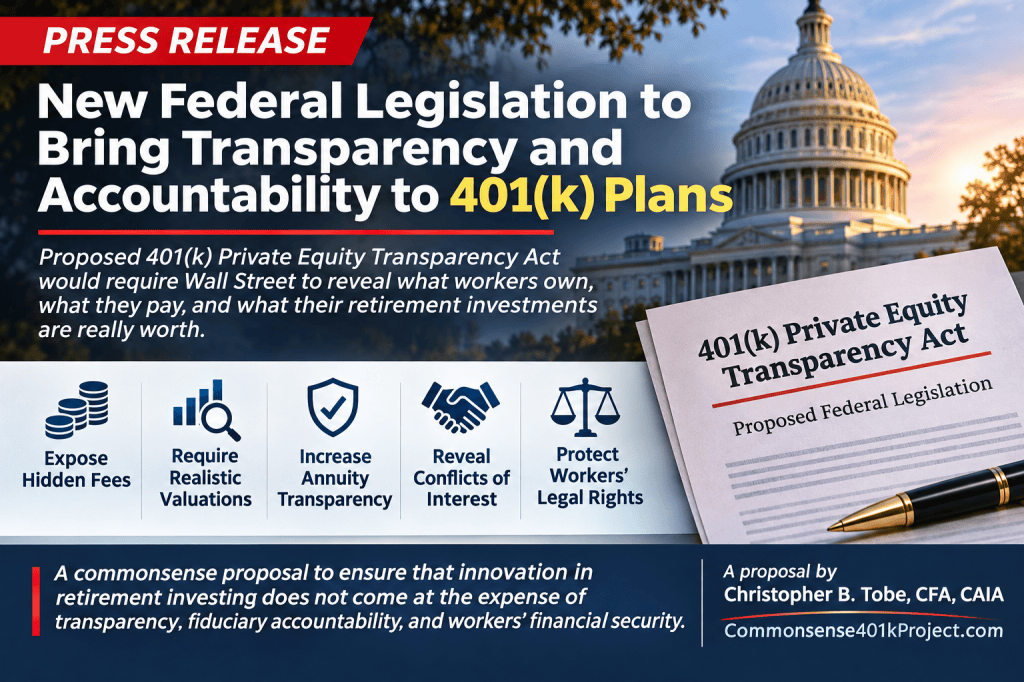
Retirement investment expert Chris Tobe, CFA, CAIA proposes sweeping new protections requiring Wall Street firms to reveal what workers actually own, what they pay, and what their retirement investments are really worth.
FOR IMMEDIATE RELEASE — November 2026
LOUISVILLE, KY — As Wall Street pushes to expand private equity, private credit, and complex insurance products into America’s retirement accounts, investment consultant, author, and ERISA expert witness Christopher B. Tobe, CFA, CAIA, has developed proposed federal legislation designed to bring greater transparency, accountability, and investor protection to the nation’s 401(k) and private-sector 403(b) retirement plans.
The proposed 401(k) Private Equity Transparency Act, a 17-section legislative discussion draft dated November 3, 2026, would require retirement plan fiduciaries, private equity managers, insurers, recordkeepers, and investment consultants to disclose information that is often difficult or impossible for workers to obtain.
The legislation is being advanced as a proposal for congressional consideration to several committees. It has not yet been introduced in Congress.
The central principle is straightforward:
American workers should have the right to know what they own, what Wall Street is charging them, and what their retirement savings would actually be worth if an investment had to be sold.
“For decades, Wall Street has been able to hide critical investment information behind complicated contracts, offshore structures, insurance products, state-regulated Collective Investment Trusts and claims of proprietary information,” said Tobe.
“Now the financial industry wants to bring even more private equity and private credit into retirement accounts. Before that happens, Congress needs to make sure workers are not buying investments whose true costs, risks, and values they cannot independently verify.”
A New Transparency Standard for America’s Retirement Savings
The proposal would establish several major protections:
1. Expose hidden private equity and private credit fees
Private equity investments can involve multiple layers of management fees, carried interest, transaction fees, financing expenses, and payments to affiliated companies.
The proposed law would require disclosure of these expenses throughout the investment structure, including payments that may be buried inside funds, partnerships, portfolio companies, and intermediary vehicles like CIT’s.
It would also require disclosure of revenue-sharing arrangements, shelf-space payments, and financial incentives that may influence which investments are offered to retirement savers.
The objective: Make Wall Street reveal how much money it actually makes from workers’ retirement savings.
2. Stop misleading valuations inside target-date retirement funds
One of the legislation’s most important provisions addresses a growing problem: combining publicly traded investments, privately valued assets, and insurance contracts within the same target-date retirement fund. This in general is not allowed in SEC registered mutual funds, so they are being put in state regulated Collective Investment Trusts choosing states like Nevada with the weakest regulatory controls.
Public stocks and bonds generally have observable market prices. Private equity investments often rely on periodic manager estimates. Insurance contracts may report contractual book values that differ substantially from the amounts obtainable upon plan termination or withdrawal.
These different measurements can create a misleading picture of investment performance, volatility, and liquidity.
The legislation would require consistent fair-value accounting within target-date funds and separate disclosure of estimated exit proceeds.
For private equity, the proposal requires illustrative sensitivity calculations showing what happens if reported private equity values translate into 90, 80, or 70 cents per dollar of manager-reported net asset value.
These are hypothetical scenarios, not claims that all private equity investments trade at those discounts.
For annuities, insurers would be required to disclose estimated plan-level exit proceeds, including surrender charges, market-value adjustments, and payment restrictions.
“A retirement statement should not give workers the impression that every dollar of reported value is immediately realizable,” Tobe said.
“If Wall Street cannot independently support a valuation, that uncertainty needs to be disclosed.”
3. Reveal the true economics of annuities and insurance products
The proposal also targets the opaque economics of fixed annuities, guaranteed investment contracts, and insurance-based retirement investments.
Insurers would be required to disclose their investment earnings, credited interest rates, retained spreads, relevant expenses, and product-level economics.
The legislation would also require identification of the actual insurance company issuing a contract, its state of domicile, regulatory oversight, and important downgrade and withdrawal protections.
These disclosures could help participants and fiduciaries determine whether an insurer is retaining excessive compensation or exposing retirement savings to risks that have not been adequately explained.
4. Require public disclosure of investment policies and conflicts of interest
Every covered retirement plan would be required to adopt and publicly file a written Investment Policy Statement.
The policy would explain how investments are selected, monitored, benchmarked, and removed, including limits on leverage, illiquidity, concentration, and valuation uncertainty as well as fees.
Investment consultants would also have to disclose ownership relationships, private equity affiliations, referral arrangements, and other financial relationships with recommended investment providers.
The proposal seeks to make it much harder for a consultant to describe itself as independent while maintaining undisclosed financial relationships with the firms it recommends.
5. Require liquidity stress tests before retirement savers bear the risk
Private equity and private credit investments may be difficult to sell quickly, particularly during financial crises.
The proposal would require covered pooled retirement investments to evaluate withdrawal scenarios involving 10%, 25%, and 40% of assets over 30- and 90-day periods.
The tests would examine whether retirement funds could meet withdrawals without forcing remaining participants to bear disproportionate losses or become increasingly concentrated in illiquid investments.
This is particularly important for target-date funds, which are frequently used as default investments by workers who never actively select their retirement portfolio.
6. Preserve workers’ right to challenge misconduct in court
The legislation would prohibit predispute mandatory arbitration clauses and waivers of otherwise available collective legal remedies for covered retirement claims.
It would also establish enforceable disclosure rights, including the ability to seek court orders requiring production of information without first proving that an investment lost money.
The proposal recognizes that workers should not have to establish an investment loss before gaining access to information necessary to evaluate potential misconduct.
Why This Matters Now
Wall Street has strong financial incentives to expand private investments into retirement accounts.
Private equity firms and insurers can benefit from access to long-term retirement assets, recurring excessive management fees, and investment structures that may be less transparent than traditional registered mutual funds.
Supporters of alternative investments argue that private assets can improve diversification and offer additional sources of return.
But the potential benefits must be evaluated against their additional fees, valuation uncertainty, liquidity restrictions, leverage, and conflicts of interest.
The proposed legislation would not impose a blanket prohibition on private equity or private credit investments in retirement plans.
Instead, it would require fiduciaries to demonstrate that the expected benefits justify the additional costs and risks, using meaningful comparisons with available alternatives.
If an investment cannot provide sufficient transparency for a meaningful fiduciary evaluation, the proposal would restrict new allocations until the deficiencies are addressed.
Congress Has Already Begun Asking the Right Questions
The proposal builds on growing congressional concerns about alternative investments in retirement accounts.
A June 2026 bicameral letter from congressional lawmakers questioned the risks associated with expanding alternative assets in defined contribution retirement plans. The letter was led by Representative Bobby Scott and Senators Bernie Sanders and Elizabeth Warren, who now will have much greater power to push forward a bill like this in the majority.
The draft also incorporates participant legal protections informed by H.R. 10641, introduced in October 2026.
Tobe’s proposal goes further by combining financial disclosure, uniform valuation requirements, liquidity testing, insurance transparency, consultant conflict reporting, and enforceable participant rights in a single legislative framework.
The proposal is intended to provide congressional offices with detailed statutory language that could be developed into legislation.
Real Enforcement, Not Another Wall Street Disclosure Checklist
The proposal includes direct obligations for investment providers and meaningful penalties for failures to comply.
Under the draft, the Department of Labor could assess civil penalties of up to $2,500 per day for certain material disclosure failures. Courts could impose additional remedies for qualifying violations.
Financial firms would not be permitted to evade mandatory disclosures simply by labeling information confidential or proprietary.
The proposal also requires independent examination of material financial disclosures and creates public, searchable reporting through the federal Form 5500 system.
Importantly, compliance with a disclosure checklist would not automatically establish that an investment was prudent or that a fiduciary had satisfied ERISA.
“Disclosure is essential, but disclosure alone is not enough,” Tobe said.
“Fiduciaries must actually evaluate the information and act when an investment’s fees, risks, conflicts, or valuations cannot be justified.”
A Call for Congressional Action
Tobe is seeking discussion and support from members of Congress, retirement policy specialists, labor organizations, consumer advocates, and other organizations concerned about the security of American retirement savings.
The legislation is being offered as a discussion draft for congressional review and refinement.
The proposal’s objective is not to prevent innovation or competition in retirement investments. It is to ensure that innovation does not come at the expense of transparency, fiduciary accountability, and workers’ financial security.
“Before Congress opens the door wider to private equity and other opaque financial products in 401(k) plans, it should guarantee that workers can see what is behind that door,” Tobe said.
“Retirement savings should not become another source of hidden Wall Street profits and risks that only become apparent after a financial crisis.”
About Christopher B. Tobe
Christopher B. Tobe, CFA, CAIA, is an investment consultant, author, and expert witness specializing in ERISA fiduciary matters, retirement plan investments, annuities, stable value, and public pension oversight.
He is the author of Kentucky Fried Pensions and publishes retirement investment research and commentary through Commonsense401kProject.com.
Tobe previously served as an investment consultant with NEPC and as an executive with Transamerica/AEGON and has extensive experience evaluating retirement investment structures, fiduciary responsibilities, and financial industry conflicts.
He has also co-authored academic research on annuity retirement products and their risks.
Christopher B. Tobe, CFA, CAIA tobecb384@gmail.com 502-648-1303

