By Christopher B. Tobe, CFA, CAIA | The CommonSense 401k Project
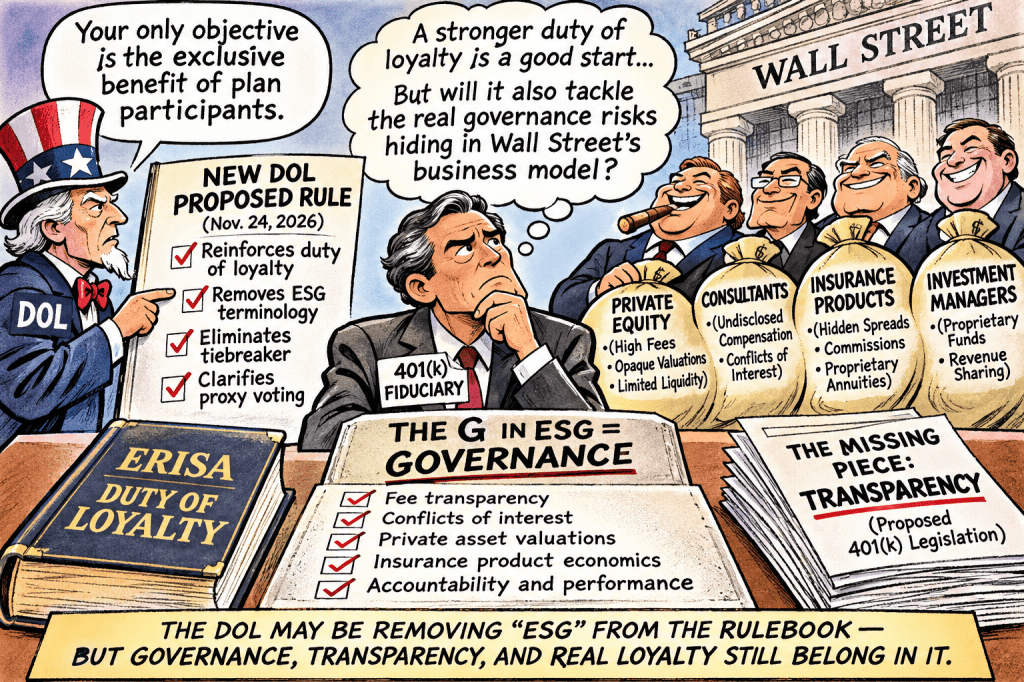
On November 24, 2026, the Department of Labor released its 122-page proposed regulation, Loyalty and the Exclusive Purpose Rule in Selecting Plan Investments and Exercising Shareholder Rights.
The proposal reinforces the central argument of my October 13 article: the most important and frequently neglected component of ESG in retirement investing is the G — Governance.
The Trump DOL wants to eliminate ESG terminology from its investment regulations, eliminate the financial tiebreaker for collateral benefits, remove the participant preference provision and reinforce the fiduciary duty of loyalty.
But will the Department apply that same rigorous loyalty standard to Wall Street, private equity firms, insurance companies, recordkeepers and investment consultants?
Political conflicts are not the only conflicts
The DOL is concerned that retirement plan fiduciaries might use participants’ money to pursue objectives unrelated to their financial interests.
That is a legitimate fiduciary concern.
But the financial services industry has numerous commercial incentives that can also divert retirement assets away from the exclusive benefit of participants.
Consider a 401(k) consultant who recommends an insurance company investment product from which the consultant receives compensation that participants cannot see.
Consider a recordkeeper that promotes its proprietary general account fixed annuity because the embedded investment spread is more profitable than transparent recordkeeping fees.
Consider an investment manager recommending its own private equity or private credit funds through a proprietary target-date fund.
Consider a fiduciary that accepts valuations produced by the same private equity manager whose compensation and fundraising depend upon reported investment performance.
Are these commercial objectives receiving the same regulatory scrutiny as political or environmental objectives?
The duty of loyalty should apply equally to all of them.
The DOL’s two 2026 proposals need to be reconciled
The November ESG proposal specifically references the Department’s March 31, 2026 investment-selection proposal, which would establish a process-based prudence safe harbor for selecting retirement plan investments.
That earlier proposal could facilitate the introduction of private equity, private credit and other alternative investments into millions of Americans’ 401(k) accounts.
The November proposal emphasizes exclusive loyalty to retirement plan participants.
The March proposal could nevertheless make it easier for fiduciaries to defend their selection of expensive and complex investments by demonstrating compliance with specified procedural requirements.
How can a fiduciary demonstrate exclusive loyalty when it cannot independently verify the fees, compensation, valuations and liquidity of the investments it recommends?
A fiduciary should not be able to satisfy its duty of loyalty merely by documenting that it reviewed information produced by a financially interested investment provider.
The November proposal’s recognition that prudence does not displace loyalty or prohibited transaction obligations is particularly important.
Plaintiffs and courts should continue to examine whether investment selection decisions were influenced by commercial compensation arrangements, even when fiduciaries claim to have followed an investment selection process.
The G in ESG begins with transparency
Both Democratic and Republican administrations have devoted significant attention to whether environmental and social considerations belong in retirement plan investment decisions.
I would like to see comparable attention devoted to the following governance issues:
- Undisclosed private equity and private credit compensation.
- Insurance company investment spreads hidden from participants.
- Revenue sharing and undisclosed consultant compensation.
- Self-reported private investment valuations.
- Misleading investment performance benchmarks.
- Offshore investment entities with limited investor protections.
- Withdrawal restrictions and the economic cost of exiting investments.
- Conflicts arising from proprietary investment products.
These are not peripheral political considerations. They directly affect retirement investment costs, risks and returns.
An investment can promote environmental sustainability while having weak financial governance.
An investment can reject ESG principles while having equally weak financial governance.
Neither label protects retirement participants.
Eliminating the tiebreaker does not eliminate excessive fees
In my October article, I supported retaining a narrowly defined financial tiebreaker that would allow consideration of collateral benefits when competing investments genuinely serve participants’ economic interests equally.
The November proposal would eliminate that provision.
The Department is concerned that a tiebreaker could be manipulated to justify decisions based on unrelated objectives.
But there is a broader danger of manipulation that deserves at least as much attention: the justification of excessive investment fees through speculative claims of diversification, participant education, lifetime income or access to private markets.
If an investment manager charges substantially more than a comparable alternative, it should be required to demonstrate the additional economic value that participants receive.
That principle should apply to ESG funds, private equity funds, private credit funds, insurance products and conventional investment products alike.
Proxy voting is a governance issue
The DOL also addresses fiduciary responsibilities for exercising shareholder rights.
Shareholder engagement is not inherently political.
Questions concerning excessive executive compensation, board independence, related-party transactions, accounting practices, misleading disclosures and protection of shareholder rights are fundamental investment governance concerns.
Retirement plan fiduciaries should remain free to address financially material corporate governance risks when doing so serves participants’ interests.
Removing the ESG label should not undermine the ability of institutional investors to hold corporate management accountable.
Why Congress needs to enact retirement investment transparency legislation
The November DOL proposal reinforces the need for my proposed federal 401(k) transparency legislation.
The legislation would require substantially greater transparency concerning the underlying investments, compensation, valuations, liquidity restrictions and legal structures of increasingly complex retirement investment products.
It would also address a growing issue involving target-date funds that combine publicly traded securities with privately valued investments and insurance products.
Fiduciaries cannot meaningfully assess the economic merits of investment products without reliable and independently verifiable financial information.
If the Department of Labor is serious about exclusive loyalty to retirement plan participants, improved governance and financial transparency should be a bipartisan priority.
I would welcome a fiduciary standard that applies the same scrutiny to a private equity manager’s commercial interests as it applies to a fiduciary’s political interests.
A standard that scrutinizes undisclosed insurance commissions as aggressively as it scrutinizes environmental considerations.
A standard that treats opaque valuations and excessive investment fees as fundamental threats to retirement security.
The G in ESG should not disappear simply because the acronym disappears from federal regulations.
Governance is not a political ideology. Governance is the foundation of fiduciary responsibility.
Related articles and regulatory documents
- G in ESG Is for Governance — and Both Parties Keep Ignoring It
- New Federal 401(k) Transparency Legislation Proposed to Expose Hidden Wall Street Fees, Private Equity Risks and Misleading Retirement Investment Values
- New Target Date Products Prove the Need for Federal 401(k) Transparency Legislation
- Revenue Sharing in 401(k) and 403(b) Plans — Why It’s a Prohibited Transaction
November 2026 Department of Labor Proposed Loyalty and Exclusive Purpose Rule

