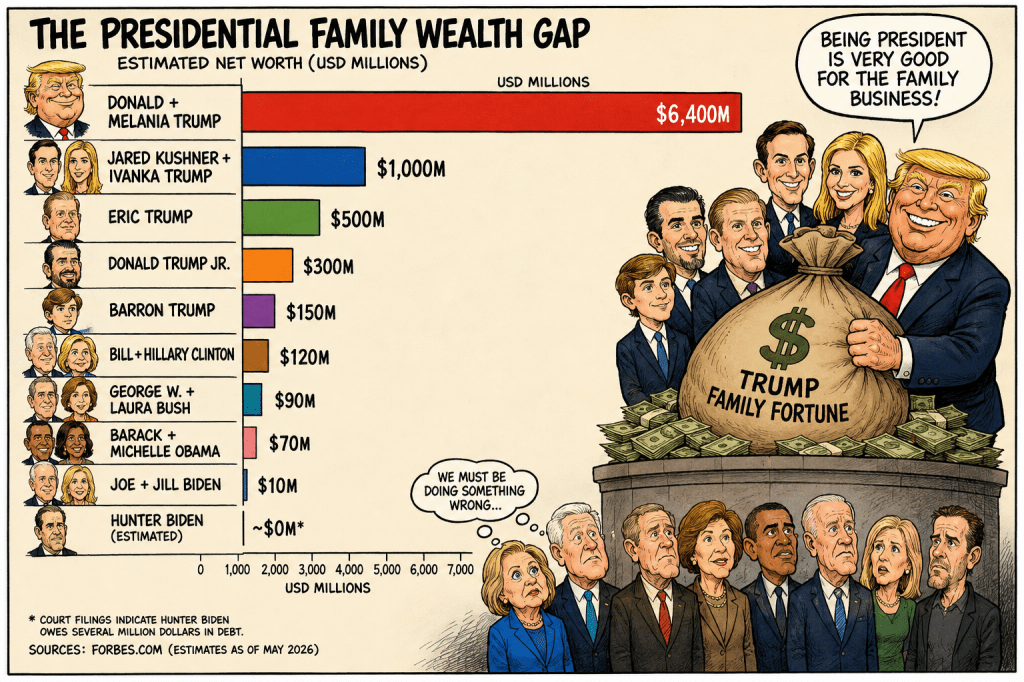
Forget the speeches about public service for a moment. Follow the money.
For decades, becoming president could eventually make a family wealthy. Bill and Hillary Clinton made fortunes from books and speeches. George and Laura Bush did well after leaving Washington. Barack and Michelle Obama signed an enormous publishing deal and built a successful media business.
But the Trump family’s wealth accumulation is operating on an entirely different scale.
And perhaps the most remarkable comparison isn’t Donald Trump.
It’s Barron Trump.
A 20-Year-Old Versus Entire Presidential Families
Forbes estimated Barron Trump’s fortune at approximately $150 million, overwhelmingly attributable to the Trump family’s World Liberty Financial crypto venture. Forbes calculated that World Liberty had added more than $1.5 billion to Trump-family fortunes by October 2025, with roughly $150 million attributable to Barron under its ownership assumptions.
Put that number beside Forbes’ estimates for entire former presidential households:
Presidential family/person
Approximate net worth
Donald Trump
$6.4 billion
Jared Kushner
$1.0 billion
Eric Trump
Hundreds of millions
Donald Trump Jr.
~$300 million
Barron Trump
~$150 million
Barack + Michelle Obama
$70+ million
Bill + Hillary Clinton
$45+ million*
George W. + Laura Bush
$40+ million*
*For consistency, these last three figures use Forbes’ published estimates rather than the higher celebrity-net-worth estimates sometimes quoted online.
Forbes currently estimates Donald Trump at about $6.4 billion and Jared Kushner at $1 billion. Forbes estimated the Obamas at more than $70 million, the Clintons at more than $45 million and the Bushes at more than $40 million in its examination of presidential wealth.
So Barron Trump alone is estimated to be worth more than the Obama, Clinton or Bush presidential household under those Forbes estimates.
That deserves considerably more attention than it has received.
The Difference Is How the Money Was Made
The Obamas’ wealth is hardly mysterious.
They earned money as authors, speakers and media producers after Barack Obama left office. Forbes notes that Barack and Michelle Obama’s memoir rights reportedly sold for $65 million in 2017.
George W. Bush made money from books and more than 200 paid speeches after leaving office. Bill Clinton became extraordinarily successful on the speaking circuit after leaving the White House.
Whatever one thinks about former presidents monetizing celebrity, there is an important distinction:
They weren’t president anymore.
The Trump wealth explosion has occurred while Donald Trump returned to political power—and much of it has come from businesses whose economic value can be affected by government policy.
Crypto is the clearest example.
From $50 Million to $300 Million
Consider Donald Trump Jr.
Forbes estimated Don Jr. was worth about $50 million in November 2024.
About a year later?
Approximately $300 million.
Forbes says crypto accounts for much of that sixfold increase.
Eric Trump’s transformation may be even more dramatic.
Before the crypto boom, Forbes estimated that Eric had accumulated roughly $30 million in liquid assets in addition to his Trump Organization income. By September 2025, Forbes valued him at approximately $750 million, although subsequent declines in his American Bitcoin holdings reduced that figure substantially.
And then there is Barron.
Barron’s First Big Business Venture
Barron wasn’t an established real-estate developer.
He wasn’t running a hedge fund.
He wasn’t a Silicon Valley entrepreneur who spent 15 years building a company.
He was a college student.
Yet Forbes estimated his net worth at roughly $150 million by age 19.
The principal reason was World Liberty Financial.
Donald Trump, Don Jr., Eric and Barron became associated with the crypto venture during the 2024 presidential campaign. Forbes reports that Trump-family entities received extraordinarily favorable economics from the enterprise, including rights to a large percentage of token-sale revenues.
Barron’s estimated share included cash generated from token sales, interests connected with World Liberty’s stablecoin business and billions of still-restricted WLFI tokens whose ultimate value remains uncertain.
Forbes therefore arrived at the extraordinary number:
Barron Trump: approximately $150 million.
Before his 20th birthday.
Then There Is Jared Kushner
Jared Kushner provides another revealing comparison.
After leaving the first Trump administration, Kushner established private-equity firm Affinity Partners.
Forbes now estimates Kushner’s personal fortune at approximately $1 billion. Affinity had attracted billions from investors including sovereign wealth funds from Saudi Arabia and Qatar and other Middle Eastern sources.
That means Trump’s son-in-law alone is worth roughly:
14 Obamas.
22 Clintons.
25 Bushes.
Using Forbes’ published household estimates.
This isn’t a normal presidential-family wealth story.
The $10 Billion First Family
Forbes’ September 2025 investigation reached an extraordinary conclusion:
The broader Trump family, including Jared Kushner, had reached an estimated $10 billion in wealth, nearly doubling since the 2024 election. Forbes attributed much of the increase to crypto, alongside international licensing, private equity and other ventures.
That comparison changes the historical discussion.
The traditional controversy was:
Should former presidents become rich because they were president?
The Trump era presents a much bigger question:
Should a sitting president and his immediate family be able to become dramatically richer through businesses operating in industries that the president’s own administration regulates?
Crypto makes that question particularly difficult to avoid.
World Liberty Financial launched shortly before the 2024 election. Trump and his sons became associated with the venture. Trump returned to the White House. The administration pursued a dramatically friendlier approach toward cryptocurrency.
Meanwhile, the family’s crypto wealth exploded.
Forbes itself describes Donald Trump’s current presidency as extraordinarily lucrative and says billions were added to his fortune, largely through crypto.
CommonSense Bottom Line
Forget partisan labels.
Imagine that Chelsea Clinton had accumulated $150 million from a financial product launched around Hillary Clinton’s presidential campaign.
Imagine that George W. Bush’s children had suddenly become worth hundreds of millions from an industry his administration was simultaneously deregulating.
Imagine that Barack Obama’s son-in-law had raised billions of dollars from Middle Eastern governments after serving as a senior White House official.
Republicans would have investigated it.
And they should have.
Democrats should apply exactly the same standard now.
The issue isn’t whether Donald Trump, Eric Trump, Don Jr., Barron Trump or Jared Kushner are legally entitled to make money.
The issue is whether Americans have constructed a political system in which access to presidential power itself can become one of the world’s most valuable family assets.
The numbers make the question difficult to dismiss.
Donald Trump: $6.4 billion.
Jared Kushner: $1 billion.
Don Jr.: roughly $300 million.
Eric Trump: hundreds of millions.
Barron Trump: roughly $150 million.
And Barron hasn’t even turned 21.
Maybe the most valuable Trump family asset isn’t Mar-a-Lago.
Great investigative work by Bloomberg’s Noah Buhayar and Jeff Kao.
The Trump Labor Department has been trying to make it easier for private equity, private credit, crypto and other alternative assets to enter ordinary Americans’ 401(k) plans. The Department’s March proposal would create a new framework—and importantly, a safe harbor for fiduciaries—when alternatives are included in participant-directed retirement plans.
Now Bloomberg has uncovered something remarkable about the supposed public support for that effort:
Bloomberg examined almost 12,000 comments supporting the DOL proposal and found evidence suggesting that a large block may have been manufactured to look like grassroots support.
The contrast is striking.
More than 30,000 comments opposed the proposal. Those submissions generally contained identifying or individualized information—cities, states, email addresses, signatures or other variations.
The roughly 12,000 supportive comments were different. They were concentrated into five virtually identical templates, with essentially identical wording, punctuation, formatting and even line breaks. The five batches arrived in remarkably similar daily quantities between April 29 and May 5—and then stopped.
That looks less like spontaneous public enthusiasm for private equity and more like what Washington calls astroturfing: manufactured grassroots support.
One Problem: Some of the “Supporters” Were Dead
Bloomberg reporters contacted dozens of people whose names appeared on the comments.
They found five cases in which individuals or relatives said the comments had not been submitted by the named person.
One was Danna Oderman, whose name appeared on a May 3 comment supporting the proposal.
There was a rather substantial problem.
She had died the previous December.
Her son Heath Oderman told Bloomberg that the comment was not from his mother and that its language wasn’t language she would have used.
Another supposed supporter was Lyngrid Rawlings, a former educator and U.S. Foreign Service officer who died in 2024. Her daughter told Bloomberg that using her mother’s name this way was deeply disrespectful.
Bloomberg deliberately investigated unusually distinctive names that could be matched with confidence against public records. That means finding five apparent false submissions does not establish that only five of the 12,000 were bogus. It raises the obvious question:
How many of the other 12,000 are real?
Who Created the Campaign?
That may be the most important unanswered question.
Bloomberg contacted more than two dozen investment firms, trade associations and advocacy organizations that publicly supported the DOL initiative.
According to the investigation, none acknowledged knowing who created the five supportive form-letter campaigns.
Bloomberg’s Silla Brush summed up the finding: big money managers have spent more than a year pushing a receptive Trump Labor Department to open 401(k)s further to private equity, private credit and alternatives, while Bloomberg’s examination found evidence that thousands of supportive comments may have been astroturfed.
That deserves considerably more investigation.
Who wrote the five templates?
Who assembled the names?
Who submitted them?
Who paid for it?
And perhaps most importantly: Did any private-equity manager, asset manager, trade association, lobbying firm, public-relations firm or political organization finance or participate in the campaign?
Follow the Money
There is an enormous economic incentive here.
Private-equity and private-credit managers oversee trillions of dollars, but their traditional institutional market—public pensions, endowments and other sophisticated investors—is increasingly questioning fees, valuations, liquidity and performance.
The American defined-contribution system represents an enormous new pool of capital.
Better Markets has made essentially this point in opposing the DOL proposal: private-market investments bring high fees, illiquidity and limited transparency, while the industry has a huge financial incentive to gain access to America’s retirement accounts.
Private credit provides a particularly awkward backdrop. Investors have recently requested redemptions well above quarterly limits at funds associated with BlackRock, Apollo, Ares, Carlyle and Blue Owl.
In other words:
Some sophisticated investors are trying to get money OUT of private markets at precisely the moment Washington is working to put ordinary 401(k) investors IN.
Academics Aren’t Exactly Clamoring for This Either
This also reinforces what we recently wrote in “More Academics Oppose Private Equity in 401(k)s — Clayton and de Fontenay.”
The intellectual case for putting private equity into ordinary participant-directed retirement accounts is far weaker than the industry’s marketing campaign would suggest.
And after all that additional risk and expense, the incremental return to the 401(k) participant may be puny at best.
The incremental revenue opportunity for Wall Street?
Enormous.
That asymmetry is what should concern fiduciaries.
CommonSense Bottom Line
The Bloomberg investigation doesn’t prove who manufactured these comments or how many are fraudulent. It establishes something important enough on its own:
The supposed grassroots support for putting private equity into Americans’ 401(k)s is sufficiently questionable that Bloomberg found comments attributed to people who were already dead.
That should trigger scrutiny by DOL’s Inspector General, Congress and anyone reviewing the administrative record supporting this rule.
Before DOL relies upon these comments, it should determine who actually submitted them and who financed the campaign.
And until that happens, DOL certainly shouldn’t cite 12,000 supportive comments as evidence that American workers are clamoring for private equity in their retirement plans.
We aren’t dead.
Our opposition is real.
Our comment is legitimate, publicly available, and backed by years of research on fees, conflicts, valuations, liquidity and fiduciary risk.
As for the dead people supposedly supporting private equity?
One wonders who they voted for.
Credit where it is due: outstanding investigative reporting by Noah Buhayar and Jeff Kao of Bloomberg News, with Bloomberg’s Silla Brush highlighting the findings today.
Related CommonSense:More Academics Oppose Private Equity in 401(k): Clayton and de Fontenay — August 3, 2026.
APPENDIX A: NBC — Private Equity Needs Your 401(k) Money
A timely new NBC News investigation provides important context for the private-equity industry’s push into 401(k)s:
“Private equity needs new investors. It’s targeting your 401(k).”
That may be the most important sentence in the entire debate.
NBC’s reporting focuses on something largely missing from Wall Street’s sales pitch: private equity needs new sources of capital.
The industry’s traditional institutional market is under pressure. Fundraising has slowed, distributions to investors have been weak, portfolio companies have remained trapped in funds longer, and institutional investors increasingly face their own liquidity and allocation constraints.
Enter the American 401(k).
The defined-contribution system represents trillions of dollars of potential new capital—much of it arriving automatically every two weeks through payroll deductions.
For private-equity managers, that’s an extraordinarily attractive new market.
Is This About Helping Workers—or Helping Private Equity?
The industry presents private assets in 401(k)s as “democratizing” investments previously available primarily to institutions and wealthy investors.
NBC’s framing suggests another way to look at it:
Private equity needs investors. 401(k)s contain an enormous pool of investors.
That distinction matters.
The traditional institutional investors private equity has served for decades have professional staffs, investment consultants, attorneys and substantial negotiating power. Even they have struggled with private-equity fees, valuations, liquidity, transparency and complicated partnership agreements.
Individual 401(k) participants have none of those advantages.
Yet the Trump Labor Department is working to make it easier to move these investments downstream into participant-directed retirement plans.
Wall Street’s Dream Customer: Automatic Contributions and Limited Liquidity
There is another reason 401(k)s could be especially valuable to private markets.
401(k) contributions are remarkably sticky.
Workers contribute paycheck after paycheck. Employers frequently contribute matching dollars. Participants often remain invested for decades.
That potentially gives private-equity and private-credit managers something they badly want:
a huge, recurring and relatively stable source of capital.
And the fee opportunity is dramatically larger than in today’s low-cost 401(k) marketplace.
A participant can buy broad public-market exposure for only a few basis points. Private-market investments can involve management fees, carried interest, underlying fund expenses, transaction costs and layers of intermediary expenses that are difficult for participants—and sometimes even fiduciaries—to see.
The question isn’t merely whether private equity can be placed inside a 401(k).
The fiduciary question is:
Why does the participant need it?
If an inexpensive diversified public-market portfolio already provides liquidity, daily pricing, transparency and strong long-term returns, the burden should be on Wall Street to demonstrate that the additional fees, leverage, illiquidity and valuation risk produce a meaningful net benefit to participants.
Not merely a new revenue stream for asset managers.
NBC Makes the Bloomberg Story More Important
That’s the connection to the Bloomberg investigation discussed above.
Bloomberg raises serious questions about whether some of the apparent public enthusiasm for private equity in 401(k)s was real.
NBC helps explain why generating enthusiasm would be so valuable.
The potential prize isn’t a small new investment product.
It’s access to trillions of dollars of American retirement savings.
That doesn’t prove who was responsible for the suspicious comments Bloomberg identified. It does make determining who organized and financed those comments considerably more important.
CommonSense Bottom Line
NBC has identified the issue that 401(k) fiduciaries should keep front and center:
Private equity needs new investors.
That is very different from saying:
401(k) participants need private equity.
Before Washington transforms America’s retirement system to solve Wall Street’s fundraising problem, fiduciaries should demand evidence that private equity actually improves participant outcomes after fees, after illiquidity, after leverage and after risk.
Until then, perhaps the simplest question is the best one:
Is private equity being brought into 401(k)s because workers need private equity—or because private equity needs workers’ money?
APPENDIX B: Follow the Money — Schwarzman’s 401(k) “Dream,” Trump and McConnell
There is another name worth adding to the story of Washington’s sudden enthusiasm for putting private equity into workers’ 401(k)s:
Stephen Schwarzman.
The billionaire co-founder and CEO of Blackstone didn’t recently discover the 401(k) market.
He has apparently been dreaming about it for years.
Back in 2017, Schwarzman told investors:
“In life, you have to have a dream.” He then described that dream as greater retail access to alternative investments and said many people were not permitted to put them into “retirement vehicles. He concluded that a regulatory change (from the new Trump Administration) would be a “huge opportunity for the firm.
That dream is now remarkably close to becoming government policy.
From Schwarzman’s Dream to Trump’s DOL
The chronology deserves attention.
2017: Schwarzman publicly describes access to retirement assets as a private-equity industry “dream.”
2020: The first Trump Labor Department issues guidance making it easier for professionally managed 401(k) investment options to contain private equity.
2025: President Trump signs an executive order directing regulators to facilitate alternative investments—including private equity—in defined-contribution retirement plans.
2026: Trump’s Labor Department proposes a regulatory framework providing additional protection for fiduciaries incorporating alternatives into participant-directed plans.
Meanwhile, Blackstone has moved from dreaming to building the infrastructure.
In October 2025, Blackstone created an entire Defined Contribution business unit specifically devoted to expanding private-market investments in retirement plans.
And in January 2026, Blackstone joined Empower’s private-markets retirement program, designed to put private equity, private credit, infrastructure and private real estate into defined-contribution plans through CIT structures.
This isn’t some theoretical policy debate anymore.
There is an enormous business being built around it.
Schwarzman and Trump
Schwarzman hasn’t merely been another Wall Street executive watching Trump from a distance.
After Trump’s 2016 election, Trump selected Schwarzman to chair his Strategic and Policy Forum, putting the Blackstone CEO at the center of a group of corporate advisers to the new administration.
The Washington Post subsequently described Schwarzman as one of Trump’s most generous donors and a key adviser with unusually regular access to the president.
Their social relationship went back even further.
Donald and Melania Trump attended Schwarzman’s infamous 60th birthday celebration in 2007.
Reported estimates put the cost at roughly $3 million to $5 million.
The Park Avenue Armory was transformed to resemble Schwarzman’s enormous apartment.
There were hundreds of guests.
Rod Stewart and Patti LaBelle performed.
If anyone ever needed a visual representation of how different the private-equity economy is from the world of the average 401(k) participant, this party might be difficult to beat.
Then There Was the Hitler Analogy
Schwarzman’s political rhetoric has occasionally been as extravagant as his parties.
When the Obama administration proposed changing the favorable tax treatment enjoyed by private-equity executives in 2010, Schwarzman compared the fight over taxes to war and invoked Hitler’s invasion of Poland in 1939.
He later apologized for the analogy.
But the episode illustrates something important about private equity’s relationship with Washington:
The industry takes government policies affecting its economics extremely seriously.
Carried interest matters.
Tax policy matters.
Regulation matters.
And gaining access to trillions of dollars sitting inside America’s defined-contribution retirement system matters enormously.
And Then There Is Mitch McConnell
This is where the Kentucky connection gets especially interesting.
Schwarzman became one of the biggest financiers of the Senate Leadership Fund, the powerful super PAC closely associated with Mitch McConnell’s Senate political operation.
In the 2018 election cycle, Schwarzman contributed $5 million to SLF.
His support subsequently became much larger.
By the 2020 election, Schwarzman’s contributions to the McConnell-aligned Senate Leadership Fund ultimately reached approximately:
$35 MILLION
That isn’t a typo.
Thirty-five million dollars.
Blackstone executives also showed up prominently among contributors to McConnell’s own campaign operation. The Louisville Courier Journal reported in 2019 that 29 Blackstone employees contributed $95,400 during a single fundraising quarter, one of the largest blocks of Wall Street money flowing into McConnell’s campaign.
Private equity wasn’t merely another industry contributing to Washington.
It had become a major source of political money.
Consider what has happened:
A private-equity billionaire publicly says accessing retirement assets is an industry “dream.”
He becomes a major Trump adviser and donor.
He pours tens of millions of dollars into the political operation associated with Mitch McConnell and the Republican Senate majority.
Trump subsequently directs his administration to open 401(k)s further to private equity.
Blackstone establishes a dedicated business unit to capitalize on the defined-contribution market.
And now Trump’s Labor Department is proposing rules designed to make it easier for fiduciaries to put alternatives into those plans.
Then, during the public-comment process, Bloomberg discovers thousands of suspiciously similar comments supporting the policy—including comments attributed to people who were already dead.
Stephen Schwarzman told us years ago what private equity wanted.
Your 401(k).
He called access to these retirement assets a “dream.”
Blackstone and the rest of the alternatives industry potentially stand to gain access to trillions of dollars of retirement savings—and the fees that come with managing them.
Schwarzman simultaneously became an extraordinarily important financial supporter of the political establishment capable of helping make that dream possible.
Now Washington is opening the door.
The relevant fiduciary question therefore isn’t:
Does Stephen Schwarzman’s dream benefit Blackstone?
That’s pretty easy.
The question is:
. The Washington Post documents Schwarzman’s access to Trump, Trump’s attendance at the lavish 2007 party, and Schwarzman’s $250,000 inaugural contribution.
For the McConnell money, FactCheck puts Schwarzman’s 2020 Senate Leadership Fund contributions at $35 million, while the Courier Journal reporting is independently quoted in a Kentucky pension-litigation filing identifying $95,400 from 29 Blackstone people to McConnell’s campaign in one 2019 quarter.
ERISA plaintiff lawyers looking for the next generation of 401(k) and 403(b) cases may be looking in the wrong place.
The biggest opportunities may not be another mega-plan lawsuit over a few basis points of mutual-fund expenses or forfeitures.
They may be sitting quietly inside mid-sized retirement plans—especially hospitals and other plans dominated by insurance companies.
I recently discussed exactly this with Jeffrey Snyder on Broadcast Retirement Network’s “Retirement Risk Radar: Fresh ERISA Litigation Highlights.” The interview focuses on fixed annuities, hidden insurer spreads, private credit, target-date funds, CIT transparency and emerging ERISA litigation theories. BRN says its programming reaches an audience of more than 2.31 million and is syndicated through major websites and news outlets.
I have worked with ERISA plaintiff firms investigating and filing more than 40 fixed-annuity excessive-fee and prohibited-transaction cases.
I don’t think we’ve exhausted the market.
I think we’ve barely started.
I reviewed the Form 5500s for 9,404 ERISA defined-contribution plans with more than $100 million in assets. After screening out much of the lower-cost Vanguard/Fidelity/State Street/Schwab universe and concentrating on the insurance-heavy market, I reviewed roughly 4,000 plans.
I identified:
3,568 plans with more than $211 BILLION in fixed-annuity assets.
And that doesn’t include the enormous universe of plans below $100 million.
The Plaintiff May Not Even Know He Owns an Annuity
This is one reason these cases haven’t already flooded the courts.
Ask a participant whether his 401(k) owns an insurance-company general-account annuity and he will probably say no.
Ask whether he owns the:
Fixed Account. Guaranteed Fund. Stable Value Fund. Capital Preservation Account.
Now you may have something. The participant sees an account balance and an interest rate.
What he generally doesn’t see is the economics behind it. If the insurer earns 5%, 6%, or more on the assets supporting the contract while crediting participants 2% or 3%, the participant doesn’t receive a mutual-fund-style expense ratio showing the insurer’s economic spread.
That difference can dwarf the investment-management fee disputes that have dominated 401(k) litigation.
A 200-basis-point differential on $50 million is $1 million a year or $6 million in damages over a 6 year class period
That is where plaintiff lawyers should be looking.
Hospitals May Be the Target-Rich Environment
Hospitals deserve special attention.
After years of mergers, acquisitions and recordkeeper changes, some hospital systems have accumulated what I call “Hospital Zombie Funds.”
One acquired hospital brings a VALIC contract. Another brings Lincoln. Another has MetLife.
Twenty years later, the retirement program can resemble an archaeological dig of legacy insurance contracts, separate accounts and forgotten investment options. My review of dozens of hospital plans found examples of tiny legacy investments, sometimes with very few participants remaining.
The litigation question practically writes itself:
Who is monitoring these investments?
ERISA’s continuing duty to monitor doesn’t disappear because an investment came into the plan through a merger.
And insurance contracts can create an especially interesting discovery trail because getting out may involve surrender charges, market-value adjustments, withdrawal restrictions or negotiated termination provisions.
That creates another question:
Did the fiduciaries retain the investment because it was prudent—or because terminating the contract would expose how expensive the original decision had become?
Then find a participant.
The participant often has no idea that the boring-looking “fixed” option inside the plan may be one of its most economically interesting investments.
:
Who got paid?
That can move the case beyond a conventional prudence claim and into potentially much more consequential conflict and prohibited-transaction issues. The precise claim, of course, depends on the particular contract, parties, transactions and facts.
Don’t Ignore the Target-Date Fund
The next frontier may be even larger.
As I discussed on Retirement Risk Radar, plaintiff lawyers should also start looking underneath target-date funds.
The familiar mutual-fund wrapper increasingly competes with collective investment trusts and other structures that can make it harder to see the underlying economics.
the fiduciary investigation should not stop with the target-date fund’s headline fee.
The question becomes:
What contracts and compensation arrangements are hiding underneath it?
That’s where tomorrow’s cases may come from.
The Cases Are Out There. The Bottleneck Is Finding Plaintiffs.
That is the irony. After more than 40 fixed-annuity cases, my biggest concern isn’t that we’re running out of defendants. It’s the opposite.
My Form 5500 review identified 3,568 plans and $211 billion of fixed-annuity assets just among plans over $100 million.
The hard part is connecting potentially problematic plans with participants who have standing to challenge them. So my message to ERISA plaintiff lawyers is straightforward:
Stop assuming the best cases are necessarily at the biggest companies.
Look at the $100 million-to-$1 billion plans. Look at hospitals.
Look at insurance-heavy 401(k)s and 403(b)s.
Follow the contracts. Follow the money.
The plaintiff bar hasn’t exhausted the next generation of ERISA investment litigation.
STRS sends teachers’ pension money to private equity. Private equity makes money privatizing education. Ohio teachers get squeezed at both ends.
A new August 2026 report on Private Equity in Michigan Childcare and K-12 Education should be required reading for every Ohio teacher and every STRS trustee.
Its lesson is brutally simple:
Private equity doesn’t just invest teachers’ pension money. It increasingly makes money extracting dollars from the institutions that employ those teachers.
The Michigan report documents private-equity ownership of childcare companies and contractors providing teaching, special education, behavioral health, transportation and other school services. It argues that outsourcing can transfer money that once paid public employees into contracts carrying corporate overhead and investor returns.
Ohio teachers should recognize the business model.
STRS Helps Supply the Ammunition
STRS Ohio has poured billions into private equity, private credit and other alternatives.
At the same time, Ohio educators are watching the public-school ecosystem become increasingly privatized.
That creates one of the strangest circular money flows in American education:
Teacher contributions → STRS → private equity → education companies → contracts and public subsidies → private-equity profits.
Then teachers are told there isn’t enough money for salaries, benefits or reliable COLAs.
STRS isn’t merely an innocent investor standing outside this process. Its capital helps finance the industry doing the consolidating.
And the people administering this system can be paid extraordinary amounts.
According to STRS compensation data I previously analyzed, its investment staff averaged about $181,000, while its CIO received approximately $914,000—several times what Ohio pays its governor and far above the compensation of most Ohio educators.
Think about that incentive structure:
Teachers provide the capital.
Wall Street gets the fees.
STRS investment staff get Wall Street-style compensation.
Teachers get the pension risk.
And now teachers can also face the economic consequences of privatization in their workplaces.
Michigan Shows What the End Game Can Look Like
The Michigan report describes private-equity-backed contractors supplying critical K-12 positions including teachers, healthcare workers, transportation, food service and special-education personnel.
Detroit alone approved more than $22.5 million for four private-equity- or venture-backed special-education contractors for FY2026.
One company, Stepping Stones Group, grew through repeated acquisitions after its creation by Shore Capital and subsequent acquisition by Leonard Green & Partners. The Michigan report describes 20 additional acquisitions and a 2024 $4.25 million settlement of wage-and-hour claims, which the company denied. This is important for Ohio because the same outsourcing model already operates here.
Soliant, for example, currently advertises contract special-education positions in the Cleveland and Mentor areas.
The economic question is obvious:
Why should a school district pay enough money to support a teacher plus a corporate staffing company plus private-equity investors when it may be able to employ the teacher directly?
The Michigan report cites previous PESP research estimating that one California district could have saved $6 million by bringing PE-backed special-education staffing positions back in-house.
Ohio should run the same calculation.
Ohio Has Another Privatization Accelerator: Vouchers
This is where the Michigan report becomes even more relevant.
Its final section argues that voucher-type programs can subsidize private providers and outsourced educational services, including transportation and before- and after-school programs. Ohio is already far down this road.
Ohio spent approximately $1.09 billion on its five private-school voucher programs in FY2025.
The pro-school-choice organization EdChoice estimates Ohio private-school-choice spending at roughly $1.12 billion, or about 4.2% of combined choice-program and public K-12 current expenditures, ranking Ohio fifth nationally by that measure.
And there is another downstream expense rarely discussed.
As voucher enrollment expanded, Ohio public districts remained responsible for transporting many private-school students. AP reported in 2025 that the combination of driver shortages and expanded school choice left some districts struggling to provide transportation even to their own high-school students.
So public schools can lose students and funding while retaining infrastructure obligations.
That’s a remarkably attractive environment for outsourcing.
Enter Vivek Ramaswamy
Ramaswamy’s own gubernatorial platform says he wants to give parents more “meaningful choices over where and how their children learn.” It also says he wants Ohio to pay excellent teachers more.
Those goals aren’t inherently contradictory.
But there is a question his campaign should have to answer:
Where does the money come from?
If Ohio simultaneously expands school-choice subsidies, encourages privatization and outsourcing, and maintains enormous public-pension allocations to private equity, then “pay teachers more” runs into a financial system taking money out at several other points.
Ramaswamy is particularly relevant because his business career sits comfortably inside the broader private-capital ecosystem rather than outside it. As I have previously documented, his companies and investments intersect with private equity, data infrastructure and financial networks that depend heavily on institutional capital.
So don’t expect an Ohio governor from that ecosystem automatically to ask:
Why are Ohio teachers financing private equity in the first place?
The Epstein Issue Needs to Be Framed Correctly
Ramaswamy should not be accused of having a personal Jeffrey Epstein relationship without evidence. I have seen none.
That isn’t the argument.
The more defensible point is that Ramaswamy operates within the modern elite private-capital ecosystem in which many institutions and financiers overlap with firms touched by the Epstein scandal.
Apollo illustrates why this matters.
Ohio teacher retirement assets have been invested with Apollo-related strategies. Apollo co-founder Leon Black’s enormous payments to Epstein are documented, and the controversy has generated renewed scrutiny of Apollo governance.
That does not make every Apollo investor, executive, politician or business associate an Epstein associate.
It does create a legitimate fiduciary question:
At what point does a governance scandal become serious enough that a public pension reexamines the manager?
Ohio STRS appears much more comfortable asking teachers to bear private-market opacity than asking Wall Street managers uncomfortable questions.
The Great Ohio Irony
Ohio teachers are effectively participating in two different labor markets.
In one:
A teacher is a public employee whose compensation must be restrained because taxpayers supposedly can’t afford more.
In the other:
An STRS investment professional overseeing that teacher’s money can receive hundreds of thousands of dollars annually because STRS says it must compete with Wall Street for talent.
Meanwhile the actual Wall Street firms can take pension management fees and invest in companies positioned to take additional dollars out of education.
That isn’t capitalism versus socialism.
It is something much simpler:
The people closest to the financial plumbing get paid first.
Teachers Should Follow Their Own Money
The Michigan report gives Ohio teachers a roadmap.
STRS should publish a cross-reference showing:
Every STRS private-equity manager → every education, childcare, transportation, staffing, special-education and ed-tech company owned by that manager → every contract those companies have with Ohio public schools.
Then add:
STRS capital committed.
Fees paid to the private-equity manager.
Ohio school dollars paid to its portfolio companies.
Number of public positions outsourced.
Difference between contractor billing rates and employee compensation.
That would reveal something pension reports never show:
Teachers may be financing the companies replacing teachers.
And that is where pension policy becomes education policy.
The Bottom Line
The old argument about STRS private equity was:
Does private equity earn enough after fees to justify its risk and secrecy?
The Michigan study raises a bigger question for Ohio:
What if teachers’ retirement money is helping finance the privatization of the very public-school system that generates their salaries and pensions?
Ohio teachers could then lose three times:
Lower salaries and weaker public-school finances.
Hundreds of millions in opaque investment fees.
And retirement assets exposed to the same private-equity machine extracting money from education.
Meanwhile, some STRS investment employees make multiples of the governor’s compensation to keep that machine running.
That’s not diversification.
That’s teachers financing both sides of their own economic squeeze.
Special-ed teachers, intervention specialists, school psychologists, SLPs and other outsourced personnel
Soliant is advertising 2026–27 contract intervention-specialist positions in Columbus and Cleveland
STRS teacher capital is invested with a PE manager whose portfolio company recruits licensed Ohio educators to work as contractors rather than district employees
Stepping Stones markets these contract services nationwide to school systems; Ohio district-by-district contract search should be next
Same basic model documented in Michigan: PE-owned middleman inserted between public schools and educators
Leonard Green & Partners
Invo Healthcare via Stepping Stones
Behavioral, autism and special-ed services
National school operations; Ohio contracts require district-record search
More consolidation under the same PE owner
EQT Partners
First Student
Outsourced school buses and special-needs transportation
Headquartered in Cincinnati; Ohio operating locations include the Germantown area
STRS invests with the owner of the largest outsourced school-transportation company in North America
Vistria Group
MGT
Outsourced technology, education and operational consulting
National school-market company; Ohio contracts need procurement search
Moves functions traditionally performed inside school systems to a PE-backed contractor
Vistria Group
ESS
Substitute teachers and school staffing
National K-12 staffing company; Ohio footprint needs contract-level verification
Another channel through which teacher shortages become a private-equity revenue opportunity
The ownership relationships are unusually easy to document. Vistria itself describes Soliant as a provider of outsourced workforce solutions to K-12 school districts, and its education portfolio also includes MGT, ESS and other education businesses. Leonard Green lists Stepping Stones as a current buyout investment providing therapy, autism and behavioral-health services for children. EQT identifies First Student as a current portfolio company headquartered in Cincinnati and focused on contracted school transportation.
Table 2 — Vistria may be the most important Ohio/STRS education cross-match
Vistria education investment
Business model
Potential Ohio public-school impact
Soliant
Outsourced teachers, intervention specialists, psychologists and healthcare professionals
Converts vacant district positions into contractor revenue
ESS
Substitute-teacher and school staffing
Takes a recurring function of school employment and monetizes staffing shortages
MGT Consulting
Technology, education and operational outsourcing
Turns school administrative/IT functions into outside contracts
District technology/curriculum appropriations become PE revenue
The Gardner School
Private early-childhood education
Competes in the broader publicly subsidized education/childcare market
This isn’t an inference about Vistria’s strategy. Vistria calls the area “Knowledge & Learning” and says one senior partner has directed about $4 billion across 14 investments in the sector, including Soliant, ESS, MGT and FullBloom.
And Soliant’s Ohio presence is concrete. It is currently advertising a 2026–27 full-time contract Intervention Specialist in Columbus and similar contract special-education positions in Cleveland.
That allows a very punchy formulation:
STRS gives Vistria teachers’ retirement capital. Vistria owns a company recruiting Ohio teachers out as contractors to schools.
We still need to determine whether any particular Ohio district paying Soliant is simultaneously contributing employer pension dollars to STRS for workers whose vacancies Soliant is filling. That requires district contract records before making the strongest version of that claim.
Table 3 — Leonard Green and outsourced special education
Determine acquired companies operating under different names in Ohio
The Michigan report says Stepping Stones was acquired by Leonard Green in 2021 and describes a rapid acquisition strategy; Detroit alone budgeted about $8.7 million for Stepping Stones and another $680,000 for Invo. It further reports that Stepping Stones agreed to a $4.25 million wage-and-hour settlement in 2024 while denying the allegations.
Stepping Stones’ own school-services page says it provides districts with special-ed teachers, school psychologists, therapists, nurses and other contracted personnel.
The Ohio audit question should therefore be: What is an Ohio district paying Stepping Stones per hour versus what the individual educator receives?
That is potentially a much more compelling number than the pension investment itself.
Table 4 — EQT/First Student: probably the cleanest Ohio example
Item
Ohio connection
STRS investment manager
EQT Partners appears on STRS’s 2023 alternative-investment manager schedule
PE portfolio company
First Student
Headquarters
Cincinnati, Ohio
Business
Outsourced K-12 transportation
Scale
Approximately 1,000 school districts when EQT acquired it
PE acquisition
EQT announced a $4.6 billion acquisition of First Student and First Transit in 2021
Public subsidy angle
EQT says First Student’s fleet electrification has received roughly $400 million in EPA grants/rebates nationally
Ohio education connection
Ohio law expressly provides for both board-owned and contractor-owned and operated school buses
Pension loop
Ohio teacher pension capital → EQT → Ohio-based school contractor → public education spending
EQT explicitly says First Student benefits from increasing demand for outsourcing. Its 2021 acquisition announcement described First Student as serving roughly 1,000 districts and valued the combined acquisition of First Student and First Transit at $4.6 billion.
There is another Ohio twist. Ohio’s transportation rules explicitly recognize contractor-operated school buses as part of the state reimbursement structure.
Meanwhile, First Student is not some distant portfolio company. It is headquartered in Cincinnati. EQT also says its electrification program has attracted hundreds of millions of dollars of federal grants and rebates.
So this is a nearly perfect illustration of the circular capital flow:
Ohio teachers → STRS → EQT → First Student → Ohio school transportation spending + federal subsidies.
Table 5 — Ohio childcare: PE penetration comparable to Michigan
The Michigan report found at least 160 PE-controlled childcare centers in Michigan and emphasized KinderCare, Learning Care Group, Goddard, The Learning Experience and Primrose.
Ohio clearly has substantial exposure to several of the same chains:
Childcare chain
PE owner/backer identified by CRS
Ohio footprint
STRS 2023 manager match presently verified?
KinderCare
Partners Group
Numerous Ohio centers including Akron, Cincinnati, Cleveland, Columbus, Dayton and others
Not yet established from STRS list
Learning Care Group
American Securities
Ohio operations need facility count
Not yet established
Goddard School
Sycamore Partners
Locations across 40+ Ohio communities/cities
Not yet established
Primrose Schools
Roark Capital
Ohio presence
Not yet established
Cadence Education
Apax Partners
Ohio presence needs count
Not yet established
The Congressional Research Service identified PE control of eight of the ten largest for-profit childcare organizations, including KinderCare, Learning Care Group, Primrose and Goddard.
KinderCare’s own locator shows a very large Ohio footprint stretching across the Cincinnati, Columbus, Cleveland, Akron, Canton and Dayton markets. Goddard lists Ohio schools in cities ranging from Akron and Cleveland to Cincinnati, Columbus, Dublin, Mason, Westerville and numerous suburbs.
Important distinction: I would not yet put those childcare companies in the direct STRS money-loop table because I have not verified their PE owners on the STRS manager schedule you supplied. They belong in a separate “PE in Ohio Education, but direct STRS LP connection not yet established” table.
Table 6 — Michigan findings applied to Ohio
Michigan report finding
Ohio analogue
Evidence level
PE-owned companies replace/increasingly supply school employees
Soliant is recruiting Ohio intervention specialists and special-ed staff on contract
Verified
Teacher/therapy outsourcing generates PE revenue
Vistria owns Soliant; Leonard Green owns Stepping Stones
Verified
Pension systems can invest with firms that own education contractors
STRS lists Vistria, Leonard Green and EQT
Verified from STRS document
PE transportation company profits from public-school transportation
EQT owns Cincinnati-based First Student
Verified
Privatization can interact with vouchers and nonpublic-school expansion
Ohio districts face major transportation obligations for nonpublic/voucher students
Verified
Public districts can carry costs while education dollars migrate outside district payrolls
Dayton/Columbus transportation dispute demonstrates the structural issue
Verified, though causation needs careful wording
PE staffing can cost more than direct employment
Michigan report cites a California study estimating $6m savings from insourcing
Michigan evidence; Ohio calculation not yet done
The transportation angle deserves special attention. AP reported that Ohio’s expansion of private-school choice has added nearly 90,000 voucher students in four years, while public districts remain responsible for significant transportation obligations. Dayton reportedly operates more routes for nonpublic pupils than for its own students, while Columbus transports more than 3,000 nonpublic students.
That means the Ohio version can go beyond the Michigan report:
The last arrow is documented; what we still need is a district-by-district First Student contract list to quantify the dollars.
The table I would put at the center of your Commonsense article
Ohio teachers provide…
Money flows to…
Which owns…
Which earns money from…
STRS pension contributions
Vistria
Soliant
Contract teachers and special-ed staffing
STRS pension contributions
Leonard Green
Stepping Stones
Special-ed/therapy outsourcing
STRS pension contributions
EQT
First Student
Outsourced school transportation
STRS pension contributions
Vistria
MGT / ESS / Edmentum
Technology, substitute staffing and education services
Ohio tax dollars
School districts
PE-backed contractors
Staffing, transportation and services
Ohio tax dollars
Voucher/nonpublic education system
Private providers
Education and ancillary services
That’s the self-cannibalization story:
Ohio teachers’ retirement money is financing private-equity firms whose portfolio companies can make more money when school districts outsource work traditionally performed by public employees.
The evidence supports that formulation. I would avoid saying STRS investments caused layoffs or lower teacher salaries until we quantify individual Ohio district contracts and compare contractor rates with employee compensation.
The next level is worth doing: mine Columbus, Cleveland, Cincinnati, Dayton, Akron, Toledo and 20–30 other Ohio school districts’ board packets/check registers for Soliant, Stepping Stones/Invo and First Student, then add actual contract dollars and cross-match each payment back to STRS’s PE manager. That could produce a very damaging table with columns for District | PE contractor | STRS manager | Contract $ | Service | Estimated worker pay | PE/contractor spread.
A new University of Kansas paper provides some of the strongest empirical evidence yet that affiliated financial advisers can hurt 401(k) participants by steering their money into proprietary products.
But Wall Street may already be moving the game to a much less transparent playing field.
William Bazley, Gjergji Cici and Junchao Liao studied thousands of 401(k) plans and found that when an adviser is affiliated with the plan’s recordkeeper, participant performance declines. The reason is particularly important: affiliated advisers steer participant money toward the recordkeeper’s proprietary funds. Unaffiliated advisers did not produce the same result.
The damage was concentrated in the proprietary investments. The researchers estimated roughly a 34-basis-point annual reduction in allocation alpha in proprietary funds, while finding no statistically significant comparable reduction in non-proprietary funds.
Even more damning, participants apparently weren’t getting much in return. The researchers found no meaningful improvement in participation, administrative fees or diversification.
Collective investment trusts don’t provide investors the same SEC-registered mutual-fund disclosure framework. Insurance-company general accounts add another layer. Private equity and private credit add valuation, liquidity and fee issues.
The conflict hasn’t disappeared.
It may simply have become harder to see.
Voya Shows Where This Could Be Going
Voya may be the clearest example.
Its MyCompass target-date products are three CIT series trusteed by Great Gray. Voya says those portfolios include either a guaranteed investment annuity contract or stable-value product issued by Voya itself.
And Voya has separately partnered with Blue Owl to develop private-market investments for defined-contribution plans.
The old Kansas conflict involved a proprietary mutual fund.
The new version potentially involves recordkeeping + CIT + insurance + private markets.
That deserves considerably more scrutiny, not less.
AIG Corebridge/VALIC Doesn’t Even Make Us Draw the Corporate Chart
Corebridge essentially provides the chart itself.
Its disclosures say securities and investment advisory services are provided through VALIC Financial Advisors, while VALIC Retirement Services Company provides retirement-plan recordkeeping and acts as transfer agent for certain affiliated variable investment options.
The Kansas researchers found that affiliation matters.
Plan fiduciaries should probably start asking exactly how much money every entity in that chain makes.
John Hancock Calls It “Co-Manufacturing”
John Hancock has provided an unusually revealing description of where target-date funds may be headed.
It describes “co-manufactured” target-date CITs in which an asset manager’s conventional target-date strategy can be recreated as a CIT and some fixed-income exposure replaced by a recordkeeper’s proprietary stable-value product.
Think about what has changed.
Yesterday:
Participant chooses proprietary mutual fund.
Tomorrow:
Employer chooses target-date CIT as QDIA → participant is automatically enrolled → CIT buys proprietary product.
You don’t even need an adviser sitting across the table convincing the participant to buy something.
The default can do it automatically.
Then Come Private Equity and Private Credit
Private markets make the economics even more interesting.
Goldman Sachs developed a private-credit CIT for DC plans carrying roughly a 1% fee including expenses, and Great Gray target-date funds were among the first intended users. Those Great Gray funds also incorporate private investments managed by BlackRock.
Compare that with an institutional index fund costing a handful of basis points.
There is an enormous economic incentive to move retirement assets from cheap transparent public-market investments into products carrying insurance spreads, private-market management fees and other economics.
That doesn’t prove anyone is violating ERISA.
It does tell fiduciaries where they should look.
The Kansas researchers found a conflict when the money trail was relatively simple.
If AA Was the Reason You Bought It, You Need the Right to Leave When It Isn’t AA
The insurance industry wants lifetime-income annuities in 401(k) plans.
A 401(k) fiduciary buys a lifetime-income annuity in large part because the insurance company is AA-rated.
Five years later the insurer gets downgraded.
AA becomes A. Maybe A eventually becomes BBB.
Now what?
If the fiduciary would not buy the annuity from that insurer today, why should participants be trapped in the annuity purchased five years ago?
They shouldn’t be.
The Answer Is a Downgrade Clause
Every 401(k) lifetime-income annuity should have a contractual downgrade provision.
If the insurer falls below a predetermined financial-strength standard, the plan should be able to move the participant’s money or guarantee to another qualified insurer without a surrender charge, market-value adjustment or other financial penalty.
It is a remarkably simple concept:
If AA was the reason the fiduciary bought the annuity, losing AA should give the fiduciary the right to leave.
Otherwise the fiduciary has purchased a 30- or 40-year credit risk with no meaningful exit door.
Vanguard RST synthetic based stable value fund had 6 synthetic GIC Providers. Each had a step-up clause that if one was downgraded that GIC would elapse with no loss and split among the remaining 5 insurers. When AIG was downgraded in 2008 they were able to do this, way before the Federal Bailout.
We Already Have Multi-Insurer Lifetime Income
And here’s the important part: the retirement industry has already demonstrated that lifetime income doesn’t necessarily have to depend upon one insurance company.
AllianceBernstein developed a multi-insurer lifetime-income platform.
An earlier version used three insurers:
ING Life AXA Equitable Nationwide
The insurers split responsibility for the lifetime-income guarantees.
Voya subsequently described the AB Lifetime Income Strategy as using multiple insurers, specifically explaining that several insurance companies split responsibility under the contracts to diversify risk.
So the concept isn’t theoretical is just needs a step up clause to deal with a downgrade of one of the issuers.
Now Add a Step-Up Provision
Suppose a lifetime-income product has three AA insurers:
Insurer A — 33% Insurer B — 33% Insurer C — 34%
Insurer A gets downgraded below the plan’s predetermined credit standard.
Under a properly designed contract, A’s share could be transferred or replaced by B, C or another qualifying AA insurer—without imposing a surrender loss on participants.
That’s the lifetime-income version of counterparty diversification.
And it solves one of the biggest fiduciary problems with annuities.
But It Won’t Solve a Systemic Insurance Crisis
There is an important limitation.
This works beautifully when one insurer screws up.
It works much less well if everybody screws up together.
Suppose A, B and C all loaded their general accounts with similar private-credit loans, private-equity-related investments, commercial real estate and AI/data-center financing.
A gets downgraded.
Its exposure moves toward B and C.
Then B gets downgraded.
Then C.
Now the diversification wasn’t really diversification.
It was three different insurance-company names sitting on substantially correlated risks.
That is why fiduciaries need to examine what’s actually inside insurers—not merely their current ratings.
A multi-insurer structure helps diversify company risk.
It doesn’t eliminate systemic risk.
Here’s Why Insurers Will Fight Downgrade Clauses
Downgrade protection isn’t merely about credit risk.
It attacks one of the most profitable parts of the traditional annuity business:
Captive money.
Once an insurer gets retirement money into its general account under a long-duration contract, getting it back can be difficult or expensive.
That captivity has enormous economic value.
I believe some general-account annuity economics can produce effective spreads in the neighborhood of 300–400 basis points between what the insurer earns on its assets and what participants ultimately receive.
Give fiduciaries a real exit right and suddenly the insurer has to worry about losing the money.
Competition comes back.
An insurer with deteriorating credit can’t simply say:
“Yes, we’ve been downgraded—but read page 137 of your contract. It will cost participants millions to leave.”
With a real downgrade clause, the answer becomes:
“You no longer meet our credit standard. We’re moving to another AA insurer.”
That could potentially compress a 300–400 basis-point spread toward perhaps 100–200 basis points.
Still plenty of money for the insurer.
But potentially a much better deal for participants.
Solve Two Problems With One Clause
This is what makes the downgrade clause so powerful.
It addresses two major annuity problems simultaneously.
Problem #1: Fiduciary Risk
The fiduciary can respond when the credit quality that justified purchasing the annuity disappears.
Problem #2: Excessive Spreads
The insurer loses some of the economic value of holding participants captive for decades.
The threat of losing billions of dollars creates something the annuity marketplace badly needs:
Competition after the contract is signed.
The ERISA Safe Harbor Should Require It
Congress has given fiduciaries substantial protection for selecting lifetime-income providers.
That protection should come with strings attached.
A lifetime-income annuity receiving favorable ERISA treatment should have, at minimum:
a clearly defined financial-strength requirement;
automatic review following a ratings downgrade;
CDS, bond-spread and capital-deterioration monitoring;
a contractual right to terminate or transfer after specified deterioration;
no surrender charge or market-value adjustment following the trigger;
a mechanism for replacing the downgraded insurer;
multiple insurers where economically practical; and
disclosure of the insurer’s actual spread and compensation.
And this becomes even more important as Washington pushes lifetime income deeper into defined-contribution plans. As I argued in Lifetime Income: The Gateway Drug for Insurance Products in 401(k) Plans, once insurance products become embedded in the retirement-plan infrastructure, getting them out may be much harder than getting them in.
The CommonSense Test
Forget 100 pages of actuarial jargon.
A 401(k) committee should ask its insurance company one question:
“If you get downgraded below the rating that caused us to select you, can we move every dollar to another highly rated insurer tomorrow without losing participant money?”
If the answer is yes, show us the contract provision.
If the answer is no, why is an ERISA fiduciary buying the product?
Lifetime income may have a legitimate place in 401(k) plans.
But a lifetime guarantee shouldn’t mean a lifetime hostage situation.
Require downgrade clauses.
Use multiple insurers.
Give fiduciaries an exit door.
And make insurance companies compete to keep retirement money rather than writing contracts designed to prevent fiduciaries from taking it away.
Fix the fiduciary-risk problem and you may cut the excessive-spread problem in half at the same time.
His basic argument is important: private equity firms have built a circular financial machine in which they own private-credit managers, finance AI and data-center investments, own life insurers stuffed with retirement savings, and increasingly use those insurers to buy private-credit assets generated by the same private-capital ecosystem. If those investments blow up, the losses don’t necessarily stop with Apollo, KKR or Blackstone.
They can land on retirees , competing insurers—and ultimately taxpayers. State and Local pensions hold billions in Private Credit directly. 401k plans hold annuities that could default. Corporate Pension plans hold Pension Risk Transfer annuities which could default.
I think Dayen is right. But he may actually understate the problem.
The weak link in this machine is something almost nobody understands:
State insurance guaranty associations are not the FDIC.
Dayen describes state guaranty funds as the mechanism that would step in if a life insurer failed.
There isn’t an Iowa equivalent of the FDIC sitting on hundreds of billions of dollars waiting for Athene to fail. When an insurer becomes insolvent, the state guaranty association generally assesses the remaining solvent insurance companies operating in the state. The surviving companies therefore have to finance the failure after it has already occurred. That design might work reasonably well when some small insurer fails. What happens when the failed company has hundreds of billions of dollars of liabilities? That’s an entirely different question.
And Iowa has become perhaps the most important regulatory jurisdiction in this entire private-equity/annuity experiment.
According to the Financial Times, Iowa now oversees roughly $1.3 trillion of insurance assets, while Iowa-based insurers have transferred approximately $449 billion of reserves to reinsurers in jurisdictions including Bermuda and the Cayman Islands. Iowa Insurance Commissioner Doug Ommen himself has warned that the industry’s move toward private-market investments can involve assets that are less appropriate for retirees and that the resilience of these strategies has not yet been tested through a serious downturn.
That gets directly to the issue I raised recently in:
New York vs. Iowa Annuities: Where Does the Extra Spread Come From?
more credit risk, more liquidity risk, more leverage, more structured credit, more private credit, more regulatory arbitrage, or less capital supporting the same promise.
In 2024, about 49.5% of new investments by PE-owned insurers went into privately placed instruments, compared with roughly 14% for unaffiliated insurers.
Private equity also gets something else enormously valuable from owning the insurer:
permanent captive assets under management.
The insurer can pay the affiliated asset manager billions.
The Financial Times reported that Athene Annuity and Life Company paid Apollo approximately $1.3 billion in management fees in 2024, while KKR’s Global Atlantic paid KKR approximately $536 million.
Think about that incentive structure.
Heads:
Apollo earns asset-management fees and spread income.
Tails:
The insurance subsidiary absorbs investment losses.
Extreme tails:
Policyholders, other insurers, guaranty associations—and potentially taxpayers—enter the equation.
That’s one hell of a business model.
And Athene Isn’t Simply Buying Random Bonds
The affiliated-investment issue deserves far more attention.
S&P Global data reported by the Financial Times showed Athene’s affiliated assets nearly doubled from about $22.6 billion at year-end 2023 to $40.1 billion at year-end 2024.
Athene accounted for roughly 30% of the entire industry’s increase in affiliated assets during that period.
This doesn’t prove the investments are bad.
It proves the conflicts deserve exceptional scrutiny.
The company manufacturing private credit can own the insurer buying private credit.
The asset manager earns fees.
The insurer earns additional spread.
The annuity salesman gets a more attractive crediting rate.
Everybody looks brilliant—until the credit cycle reverses.
Another Problem: Guaranty Coverage Isn’t Unlimited
There is another important qualification to Dayen’s description.
Guaranty associations don’t simply guarantee every dollar of every insurer liability.
Coverage is subject to statutory limits.
The Chicago Fed gives the example of a $400,000 present-value annuity obligation where only $250,000 is protected under a typical state limit—meaning the policyholder could receive substantially less than the promised benefit.
Iowa itself describes statutory coverage limits rather than an unlimited government guarantee.
That’s particularly important for:
wealthy individual annuity owners;
pension-risk-transfer retirees;
corporate retirement plans;
participants with large lifetime-income benefits.
Calling an annuity “guaranteed” without explaining who guarantees it, up to what amount, under which state’s law, backed by what assets, and through what insolvency process is financial malpractice.
Ben Bernanke Already Told Us What Happens When a Giant Insurer Actually Gets Into Trouble
When explaining the Federal Reserve’s extraordinary rescue, Chairman Ben Bernanke testified that AIG’s collapse could have posed “unacceptable risks” to the global financial system.
He specifically said that AIG’s large insurance subsidiaries likely would have been placed into rehabilitation by state regulators, leaving policyholders facing considerable uncertainty about their claims.
That is enormously important.
If state insurance receivership and guaranty associations were such a powerful substitute for a federal backstop, why did the Federal Reserve commit extraordinary resources to keep AIG from collapsing?
Because when the institution becomes sufficiently large and interconnected, policymakers stop asking:
“What does the state guaranty statute say?”
and start asking:
“Will allowing this company to fail crash the financial system?”
That’s the real precedent.
From Executive Life to Athene
The irony is that regulators confronted versions of these issues after Executive Life and Mutual Benefit Life more than three decades ago.
The Minneapolis Fed wrote in 1993 about the incentives and moral hazard created by state insurance guarantees following the Executive Life collapse.
Yet today we have constructed institutions dramatically larger than Executive Life, holding dramatically more complex assets, intertwined with private equity, private credit, offshore reinsurance and now potentially the AI infrastructure boom.
And somehow we’re supposed to believe the same fragmented state guaranty system has become a stronger backstop.
I don’t buy it.
The Real AI–Annuity Bailout Chain
Dayen’s article lets us draw the complete circle:
401(k)s / pensions / retirees >Annuities and pension-risk transfers>PE-owned insurers>↓
Apollo / KKR / Blackstone asset managers>Private credit>AI companies / data centers / PE portfolio companies>Credit losses>Insurance-company losses>State receivership>State guaranty associations>Assessments on surviving insurers>Potential tax credits / taxpayer exposure
When an employer transfers a traditional pension to an insurance company, we are continually told that retirees haven’t lost anything because their pension has merely been replaced by an equally safe insurance-company promise.
That’s nonsense.
Before the transfer, the pension is governed by ERISA and backed by the federal PBGC system.
Afterward, the retiree can become a creditor of an insurance company regulated primarily by whichever state domiciles that insurer, with state guaranty-association protection subject to statutory limitations.
Meanwhile insurers increasingly compete by offering sponsors attractive PRT pricing while trying to earn higher investment spreads.
Where do those higher spreads come from?
See Iowa.
See private credit.
See offshore reinsurance.
See affiliated assets.
And now:
See AI.
CommonSense Bottom Line
David Dayen deserves considerable credit for connecting the AI bubble to private credit, private equity and life insurers.
But the scariest part isn’t simply that taxpayers may indirectly subsidize insurance failures.
It’s that the ostensible safety net may be structurally incapable of handling the failure of one of today’s gigantic annuity companies during a correlated private-credit crisis.
The state guaranty system was never designed to be the FDIC for a $445-billion retirement conglomerate tied into one of the world’s largest alternative-asset managers.
If Athene—or another insurer of similar scale—ever became genuinely insolvent, I have a very hard time believing America’s life insurers would simply write checks large enough to make everyone whole through Iowa’s guaranty-association machinery.
History suggests something else would happen.
Washington would arrive.
That means we may already have created exactly the arrangement Dayen fears:
Private profits.
Private-credit risk.
Retirement money as funding.
State regulation when things are good.
And federal taxpayers when things get really bad.
The bailout may not merely be baked into the AI bubble.
It may already be baked into the American annuity industry.
Appendix: Throughline Synthesis Maps the AI–Private Credit–Annuity Bailout Machine
One day after this article was published, Scott Ortkiese at Throughline Synthesis published an excellent companion piece: “The Bailout Is Already Written: A Short Course on Private Credit, the AI Bubble, and the Life Insurance Trap Set for the American Taxpayer.”
His analysis takes the argument here one important step further by diagramming the plumbing.
The Money Goes in a Circle
The old insurance model was relatively simple:
Policyholder premiums → insurer → mostly public bonds and mortgages → claims and annuity payments
The emerging private-equity insurance model can look very different:
Retiree / annuity premium ↓ PE-affiliated life insurer ↓ Private credit originated or managed within the same alternative-asset ecosystem ↓ AI companies / data centers / neoclouds / infrastructure SPVs ↓ Private valuations and credit ratings ↓ Back onto the insurer’s balance sheet
That is the critical point.
The insurer isn’t merely investing in private credit.
The insurance company can become the permanent funding source for the private-credit machine.
Throughline points to Apollo/Athene, KKR/Global Atlantic, Blackstone’s insurance relationships, Brookfield’s insurers and Ares/Aspida as examples of the convergence between alternative asset management and insurance.
Now Add the $500 Billion AI Financing Push
The timing makes this particularly important.
On August 10, Nvidia announced agreements with Apollo, BlackRock, Blackstone, Brookfield, Goldman Sachs and KKR aimed at mobilizing more than $500 billion of third-party capital for AI infrastructure financing.
That makes the circle easier to see:
Retirement money → insurer → private credit → AI infrastructure → data centers and chips
If everything works, Wall Street earns fees and insurers earn additional spread.
But what happens if AI infrastructure doesn’t generate enough cash flow to support the debt?
And that is where taxpayers potentially enter the picture.
The Sleeper Issue: State Premium-Tax Credits
Throughline emphasizes something David Dayen highlighted and that deserves much more attention.
When an insurer fails, state guaranty associations generally assess surviving insurers.
But in most states, insurers can recover guaranty-association assessments through state premium-tax offsets or credits.
So describing the guaranty system as simply “the insurance industry protecting itself” can be misleading.
The economic chain can become:
Failed insurer ↓ Guaranty association ↓ Assessment on surviving insurers ↓ Premium-tax credit ↓ Reduced state tax revenue
In other words:
Wall Street takes the spread on the way up.
The state can absorb part of the bill on the way down.
That deserves much more scrutiny before trillions more retirement dollars migrate toward private-credit-heavy insurers.
But Throughline May Actually Understate the Biggest Risk
This is where my original article goes one step further.
The state guaranty system may work reasonably well when one modest-sized insurer fails in isolation.
But what happens in a correlated private-credit collapse?
What happens if several insurers own similar AI, data-center, private-credit and affiliated assets?
And most importantly:
What happens if a giant such as Athene gets into serious trouble?
Throughline describes the statutory bailout mechanism.
The bigger question is whether that mechanism is financially capable of handling the failure it is supposedly designed to address.
History gives us a warning.
When AIG threatened to collapse in 2008, policymakers didn’t simply say:
“Don’t worry. State insurance regulators and guaranty associations have this covered.”
Washington intervened.
That is why the ultimate AI-annuity bailout could be much larger than the state tax-credit mechanism identified by Dayen and Throughline.
The Complete Bailout Chain
Put the three analyses together — Dayen, Throughline and CommonSense — and we can finally see the entire structure:
401(k)s / pensions / retirees ↓ Annuities and pension-risk transfers ↓ PE-affiliated insurers ↓ Apollo / KKR / Blackstone / other alternative managers ↓ Private credit ↓ AI / data centers / infrastructure SPVs ↓ Credit losses ↓ Insurer losses ↓ State receivership ↓ Guaranty-association assessments ↓ State premium-tax credits ↓ State taxpayers
And if the insurer is too large or the failures too correlated?
Washington.
That last arrow may ultimately dwarf all the others.
CommonSense Bottom Line
Throughline Synthesis has done an excellent job explaining the plumbing.
The AI boom isn’t being financed exclusively by venture capitalists and technology billionaires willingly gambling their own money.
Increasingly, the capital stack reaches into private credit, insurance-company balance sheets, annuities and retirement savings.
That changes the public-policy question.
Before a 401(k) fiduciary, pension trustee or corporate pension sponsor hands retirement assets to an insurer heavily exposed to private credit, perhaps the most important question isn’t:
“What is the annuity’s guaranteed rate?”
It is:
“What assets are actually backing the guarantee?”
And immediately after that:
“Who pays if those assets aren’t worth what the insurer says they’re worth?”
Throughline’s answer is disturbing.
Mine is potentially worse.
First the insurer. Then the guaranty system. Then the states.
And if the hole is big enough, history says Washington may be next.
Wall Street calls it “democratizing access.” Professor Hilary Allen calls it something closer to creating new bag holders. ERISA fiduciaries should pay attention.
Allen, a professor at American University Washington College of Law, argues that the Department of Labor should abandon its proposed rule facilitating alternative assets in 401(k)s and return to its 2022 guidance telling fiduciaries to exercise “extreme care” before adding cryptocurrency.
Her underlying point is even more important:
401(k) participants are not demanding crypto. The crypto industry needs 401(k) participants.
That distinction changes the entire fiduciary analysis.
Who Exactly Is Being “Democratized”?
The political sales pitch is that ordinary workers deserve the same access to crypto and alternative investments supposedly enjoyed by sophisticated institutions and wealthy investors.
Allen turns that argument upside down.
Her May 29 Department of Labor comment warns that “democratizing access” can instead mean using 401(k)s to create a new market for illiquid or speculative assets that existing investors want to sell.
That should sound very familiar to anyone who has watched private equity, private credit, annuities and increasingly complex CITs migrate into retirement plans. First Wall Street creates the product. Then Wall Street needs more assets.
Then it discovers $12+ trillion sitting in defined-contribution retirement accounts.
Suddenly giving workers “access” becomes a national policy priority.
Follow the money.
Allen Identifies the Bagholder Problem
Allen uses a wonderfully blunt Wall Street term: bagholders.
Crypto needs continuing demand. Large existing holders—or “whales”—can only monetize their gains if somebody else buys.
Allen cites Bank for International Settlements research finding that most Bitcoin investors in the studied period lost money and that larger investors probably cashed out at the expense of smaller holders.
Her DOL submission goes further. She points to enormous Bitcoin price swings and concludes that this volatility and dependence upon continuing favorable policymaking make Bitcoin unsuitable for 401(k)s.
Now imagine introducing millions of automatic payroll contributions into that market.
Every two weeks.
Year after year.
That isn’t merely “access.”
It potentially creates one of the largest permanent streams of new buyers in the world.
And ERISA fiduciaries should be asking the most basic question:
Are we adding crypto because it improves participants’ retirement security—or because somebody needs participants’ money?
PwC’s own discussion of global crypto regulation describes an extraordinary regulatory infrastructure involving custody, liquidity, disclosure, operational resilience, market conduct, stablecoin reserves, supervision, collateral and cross-border enforcement.
My conclusion was simple:
Traditional diversified mutual funds don’t require an entirely new global regulatory architecture to function. Crypto does.
That isn’t an argument for putting crypto in retirement plans.
It is a warning against doing so.
Allen supplies the complementary economic argument.
Crypto is volatile.
Crypto markets have manipulation concerns.
Crypto suffers extraordinary hacking and fraud losses.
Crypto lacks the fundamentals traditionally used to value investments.
And crypto increasingly creates potential connections between speculative digital markets and the conventional financial system.
Her DOL comment cites more than $81 billion in crypto “grifts and disasters” through May 2026 and FBI data showing crypto-related losses rising from roughly $2 billion in 2021 to more than $11 billion in 2025.
That’s quite a résumé for an asset class we’re supposedly worried workers aren’t getting enough exposure to.
Then There Is ERISA
Allen’s argument is largely about financial stability and retirement security.
I would add another problem:
ERISA.
The statute doesn’t say fiduciaries should select investments because the President, the crypto industry, asset managers or recordkeepers think they’re innovative.
ERISA requires prudence and loyalty.
And ERISA §406 separately regulates transactions involving parties in interest.
That becomes extremely important once crypto moves through the actual machinery of a 401(k):
recordkeepers → custodians → trustees → exchanges → affiliated funds → brokerage windows → target-date funds → CITs → participants.
My earlier CommonSense analysis argued that crypto exposure can raise prohibited-transaction issues where plan service providers or their affiliates receive direct or indirect compensation, spreads, revenue sharing or other economic benefits from transactions involving plan assets.
Don’t put Bitcoin directly on the core 401(k) menu. Put it in the brokerage window.
Then everyone can pretend the participant made the decision.
That misses the point.
The fiduciary first selected the brokerage provider, negotiated its compensation, established the window and permitted the investment architecture.
If the recordkeeper, custodian, exchange or affiliated entity is making money from participant crypto transactions, the fiduciary inquiry doesn’t disappear simply because the participant clicked the mouse.
Participant choice isn’t a magic ERISA eraser.
The same concern becomes even more serious if crypto eventually gets buried inside target-date funds or opaque CIT structures where participants may not even realize they own it.
How Do You Benchmark It?
This may be the simplest investment-committee question of all.
Suppose your consultant recommends allocating 2% of a target-date fund to Bitcoin.
Ask:
Against what?
What is Bitcoin’s expected return?
What is its expected risk premium?
What is its appropriate benchmark?
How do you determine whether the spread is reasonable?
How do you measure transaction costs across exchanges?
How do you determine whether custody charges are reasonable?
How do you determine whether the price itself has been manipulated?
How do you document that the allocation improves retirement outcomes?
My PwC piece identified precisely this problem: crypto pricing and regulatory structures remain fragmented across exchanges, jurisdictions, liquidity pools, stablecoin systems and offshore entities.
A fiduciary cannot simply write:
“Bitcoin went up a lot.”
Past appreciation is not a fiduciary investment process.
And Please Stop Calling Bitcoin a Hedge
Allen also attacks the “digital gold” argument.
A hedge should reduce portfolio risk.
Bitcoin has demonstrated extraordinary volatility and has often moved in the same direction as risk assets. Allen therefore questions how something this volatile can simultaneously be sold as portfolio insurance.
This matters enormously in retirement plans.
A 25-year-old speculator can lose 50% and decide to wait.
A 67-year-old participant withdrawing retirement income doesn’t necessarily have that luxury.
Sequence-of-return risk doesn’t disappear because somebody put the word “digital” in front of an asset.
Crypto and Private Equity Are Running the Same Playbook
This is where the crypto debate connects to the larger alternative-assets push.
The sales pitch keeps following roughly the same sequence:
1. Call the product innovative.
2. Say wealthy investors already have access.
3. Declare it unfair that workers don’t.
4. Wrap the investment inside a professionally managed vehicle.
5. Move it into a CIT or target-date fund.
6. Tell fiduciaries diversification makes everything safe.
7. Collect fees and spreads that become increasingly difficult for participants to see.
We’ve already watched versions of this movie with annuities, private equity and private credit.
Crypto may simply be the most extreme version.
The Great Irony: 401(k)s Already Work
This whole debate also ignores something important.
Building a good 401(k) portfolio isn’t particularly difficult.
You can construct an extraordinarily diversified retirement portfolio using inexpensive, liquid, transparent public-market investments.
Stable-value structures where risks and economics can actually be analyzed.
Nobody has demonstrated that American workers cannot retire successfully because their 401(k)s suffer from a tragic shortage of Bitcoin.
Yet we are contemplating introducing an asset that Professor Allen describes as extraordinarily volatile, vulnerable to manipulation, hacking and scams, and increasingly capable of transmitting instability into conventional financial markets. Her submission concludes by urging DOL to restore its 2022 crypto guidance.
CommonSense Bottom Line
Professor Hilary Allen is right.
But I would take her argument one step further.
Crypto isn’t merely a questionable 401(k) investment. It is almost a laboratory experiment for everything ERISA fiduciaries are supposed to avoid.
Extreme volatility.
Questionable valuation.
Market-manipulation concerns.
Custody risk.
Operational risk.
Hacking.
Opaque spreads.
Conflicted intermediaries.
Difficult benchmarking.
Potential prohibited transactions.
And political pressure to funnel retirement assets into the product.
Wall Street calls that democratizing access.
I have another description:
Turning America’s retirement system into Wall Street’s buyer of last resort.
401(k) plans were created to fund workers’ retirements.
They were not created to provide exit liquidity for crypto whales, private-equity sponsors, asset managers or anybody else looking for the next trillion-dollar pool of permanent capital.
An annuity paying a higher crediting rate looks better.
But there is no magic in insurance.
If one insurance company can consistently credit more than another, somebody should ask:
Where does the extra spread come from?
Increasingly, the answer is:
Private credit.
Structured credit.
More aggressive asset management.
Reinsurance.
Bermuda and Cayman.
And sometimes a more accommodating state regulatory structure.
That brings us to New York vs. Iowa.
Insurance Companies Know the Difference
I spent seven years as an officer of AEGON/Transamerica insurance companies.
We had multiple insurance-company legal entities.
When possible, we generally favored the Iowa companies.
New York was different.
We generally avoided the New York company unless a sophisticated client insisted upon it.
Why would an insurance company care?
Because regulation has an economic cost.
More restrictive investment rules, tougher reserve scrutiny, tighter reinsurance requirements and more regulatory friction can reduce the amount of spread an insurer can extract from its balance sheet.
That’s potentially bad for insurer profits.
But it may be pretty good for the retiree relying on a guarantee for the next 30 years.
Iowa Has Become America’s Annuity Laboratory
Iowa now regulates roughly:
$1.3 TRILLION
of insurance assets.
Its roster includes some of the biggest names in fixed and indexed annuities:
Athene
Transamerica
F&G
American Equity/Brookfield
Sammons/Midland National/North American
Principal-related insurance operations
And Iowa’s own insurance commissioner, Doug Ommen, is now publicly warning about the industry’s migration into private markets.
About one-quarter of life insurers’ fixed-income assets are now private credit, according to recent reporting, and roughly $70 billion is below investment grade.
This isn’t your grandfather’s insurance portfolio.
The Extra Yield Isn’t Free
The old insurance-company model was relatively simple.
Take in $100 from an annuity buyer.
Invest heavily in publicly traded bonds.
Earn 6%.
Credit the annuity owner 4%.
Keep the spread.
Today Wall Street has discovered a potentially more profitable model:
Annuity: 4%
↓
Private Credit: 7%–9%
↓
Insurer captures a much larger spread
That sounds terrific—until someone remembers the first rule of finance:
Higher yields generally come with higher risk.
Private credit may be less liquid.
It may not have a readily observable market price.
It may rely upon private ratings.
It may involve affiliated asset managers.
And its value may be based substantially on models rather than transactions in a public market.
Recent reporting estimates life insurers held about $480 billion of privately rated debt in 2025. Private ratings can matter directly to insurer capital because regulatory capital treatment depends partly upon the credit quality assigned to an investment.
So the real game isn’t merely:
How much does the asset yield?
It is also:
How much regulatory capital must the insurer hold against it?
Iowa: 72. New York: 21.
In our CommonSense Regulatory-Arbitrage Risk Score, where 100 represents the greatest opportunity for regulatory flexibility/arbitrage—not probability of insurer failure—we estimate:
These are CommonSense analytical scores, not official regulator ratings.
But the underlying regulatory differences are real.
New York law contains extensive, specific limitations governing the investments of domestic life insurers.
And New York separately maintains extensive life-insurer reserve, valuation and filing requirements.
Iowa has become one of the industry’s preferred centers for the newer annuity/private-capital model.
Then $449 Billion Leaves Iowa
Here is the statistic every ERISA fiduciary should understand.
Iowa insurers have reportedly passed approximately:
$449 BILLION
of reserve funds to reinsurers in other jurisdictions.
That includes Bermuda and Cayman.
Iowa Commissioner Ommen himself is now warning about the increasing complexity of private-market investments and securitizations.
So the modern annuity can look like this:
401(k) participant
↓
Iowa-regulated annuity
↓
Private Credit
↓
Reinsurance
↓
Bermuda / Cayman
The participant sees one word:
GUARANTEED
New York Creates Friction
New York isn’t perfect.
New York insurers invest in private assets too.
They reinsure risk.
And nothing about a New York domicile eliminates insurance-company credit risk.
But New York has historically imposed more regulatory friction.
Its insurance law contains detailed limitations governing life-insurer investments.
It has extensive rules governing when insurers receive reserve credit for reinsurance.
It requires extensive insurer-specific valuation and reporting.
And New York has demonstrated that it will aggressively police its regulatory perimeter.
That costs insurers money.
Which may help explain why insurers don’t always want to issue through New York.
Higher Spread—or Lower Protection?
This is the question ERISA fiduciaries should be asking.
Suppose:
Iowa annuity: 5.0%
New York annuity: 4.5%
The easy analysis is:
Iowa wins by 50 basis points.
The fiduciary analysis should be:
Why am I getting another 50 basis points?
Is it better management?
Longer duration?
Less capital?
More private credit?
More structured securities?
Affiliated asset management?
Offshore reinsurance?
Different reserve treatment?
Or simply a different regulatory regime?
Until the fiduciary knows the answer, 50 basis points isn’t necessarily alpha.
It may be compensation for risk.
Wall Street Understands This Perfectly
Insurance companies employ armies of:
actuaries
lawyers
investment professionals
capital-management specialists
and reinsurance experts
to decide which legal entity should issue an annuity, what assets should back it, how much capital must support it and whether liabilities should be reinsured elsewhere.
They understand exactly what it means to issue through Iowa instead of New York.
Yet many 401(k) committees appear to compare annuities primarily on:
crediting rate
insurance-company rating
and perhaps fees.
That isn’t enough.
Ask the Question
When one annuity pays more than another, don’t simply congratulate the consultant for finding the higher rate.
Ask:
Where does the extra spread come from?
Then ask:
How much is private credit?
Who originated that credit?
Is the asset manager affiliated with the insurer?
How are the assets valued?
Who rates them?
How much regulatory capital backs them?
Has the liability been reinsured?
Where?
Bermuda? Cayman?
And:
Why did the insurance company choose Iowa instead of New York?
BlackRock.Prudential.Lincoln. Or simply: Target Date 2055.
What it probably doesn’t say is: Las Vegas, Nevada.
Welcome to the increasingly strange world of Collective Investment Trusts—or CITs.
CITs aren’t SEC-registered mutual funds. And behind some of the biggest names in American retirement investing sits a company most participants have never heard of:
Great Gray Trust Company.
Great Gray is a Nevada-chartered trust company headquartered in Las Vegas. It is ultimately controlled by funds affiliated with Madison Dearborn Partners, a major private-equity firm.
And Great Gray isn’t some tiny niche trustee. As of March 31, 2026, it reported:
$318.6 billion of fund assets 80+ investment sub-advisers 200+ recordkeepers and 38 trading platforms.
Those relationships put Great Gray in the middle of a retirement ecosystem containing some of the biggest names on Wall Street.
The Names You Actually Know
Great Gray is trustee for CITs sub-advised or used in products involving major financial brands.
BlackRock is helping Great Gray build the new Panorix Target Date Series, including private-equity investments.
Goldman Sachs Asset Management created a private-credit CIT specifically selected for Panorix.
**PGIM—the investment-management arm of Prudential—**offers more than 55 CITs across its own Prudential Trust Company and Great Gray platforms. PGIM lists its entire target-date CIT series and a real-estate CIT on the Great Gray platform.
And Lincoln Financial says its Income America 5ForLife target-date portfolios providing guaranteed lifetime income are collective investment funds for which Great Gray Trust Company is the trustee.
Then there is distribution.
Great Gray’s own platform materials list trading relationships providing access through familiar retirement companies including:
EmpowerPrincipalNationwideVoyaTIAAJohn HancockLincolnVanguard and Fidelity.
That doesn’t mean all those companies have hired Great Gray to manage their proprietary funds. In many cases Great Gray is providing CITs that can be accessed through their retirement platforms.
But that’s precisely the point.
A participant may know BlackRock, Lincoln, Prudential, Empower or Principal.
Almost nobody knows the name of the Nevada trust company sitting behind the CIT structure.
BlackRock + Goldman + Great Gray
The new Panorix structure shows where this is headed.
Great Gray is trustee.
BlackRock designs the custom target-date glidepath and supplies index investments and private equity.
Goldman Sachs supplies private credit.
Private Equity owned consultant Wilshire handles liquidity and cash-flow management.
Great Gray retains ultimate fiduciary authority over the CIT.
And the legal trustee at the top of this increasingly complicated investment structure is:
**Great Gray Trust Company, LLC Las Vegas, Nevada**
Lincoln Adds the Insurance Layer
Lincoln makes the regulatory maze even more interesting.
Lincoln says its Income America 5ForLife portfolios are target-date collective investment funds with guaranteed lifetime income.
And Great Gray is the trustee. Now the structure can become:
401(k) Target-Date CIT Great Gray — Nevada Investment Managers Lincoln Lifetime-Income Guarantee Insurance Regulation by State of Indiana
That means one seemingly simple retirement product can potentially involve ERISA, Nevada trust-company regulation, investment managers operating under federal securities law, and Indiana state insurance regulation.
And the participant sees:
Income America 5ForLife.
$318 Billion of Funds. $1 Million Statutory Capital Floor.
Now comes the number every plan fiduciary should know.
Nevada law starts the statutory minimum stockholders’ equity requirement for a retail trust company at:
$1 MILLION
The Nevada regulator can require substantially more, and Great Gray’s $318.6 billion of fund assets are trust assets—not Great Gray corporate assets or liabilities.
So this isn’t financial leverage in the traditional balance-sheet sense. It is something more interesting:
Operational Leverage.
A relatively thin corporate entity can exercise trustee and fiduciary authority over an enormous pool of other people’s retirement assets. Private equity understands that model very well.
Control enormous assets. Put comparatively little corporate capital underneath the operating company. Earn fees from the platform. Add managers. Add products. Add distribution.
And scale. Great Gray says more than 9% of its reported fund assets are already in fund-of-fund structures where Great Gray serves as trustee or administrator at multiple levels.
Now add private equity and private credit inside those structures.
And Great Gray Itself Is Private-Equity Owned
That’s the part that makes this such an extraordinary case study. Great Gray is ultimately controlled by investment funds affiliated with Madison Dearborn Partners.
So: Private Equity owns Great Gray which trustees 401(k) CITs that can invest in
Private Equity.
The circularity is remarkable.
And the regulatory history makes it even more interesting.
Great Gray’s enormous CIT business previously belonged to Wilmington Trust, N.A.—a national bank subject to OCC regulation.
On April 28, 2023, the CIT business moved to the Nevada-chartered Great Gray Trust Company.
On April 29—one day later—Great Gray was sold to the Madison Dearborn affiliate.
The structure effectively went:
OCC-Regulated National Bank > Nevada Trust Company> Private-Equity Ownership>BlackRock Private Equity>Goldman Sachs Private Credit>Prudential/PGIM >CITs>Lincoln Lifetime Income
That deserves considerably more attention from ERISA fiduciaries.
Why Nevada?
Nevada permits Great Gray to operate as a non-depository trust company rather than a conventional bank. It doesn’t need to take deposits. It doesn’t need to make loans.
It can concentrate on the extraordinarily scalable business of administering and trusteeship of other people’s assets. Nevada’s statutory capital floor starts at $1 million.
And I have not found a Nevada CIT-specific regulatory code comparable to either the OCC’s detailed 12 CFR §9.18 framework or Pennsylvania’s detailed collective-investment-fund rules applicable to Vanguard’s trust company.
When a private-equity-owned Nevada trust company overseeing more than $300 billion begins helping BlackRock and Goldman Sachs put private equity and private credit into ordinary workers’ target-date funds, asking “Why Nevada?” isn’t unreasonable.
It’s basic fiduciary due diligence.
Follow the CIT
At the next 401(k) committee meeting, don’t merely ask:
“Who manages our target-date fund?”
Ask:
Who is the legal trustee?
Who owns the trustee?
Where is it chartered?
Who regulates it?
How much corporate capital does it maintain?
What investments are underneath it?
Are BlackRock, Goldman, Prudential or other managers putting private assets into it?
Does it contain an insurance guarantee?
Which insurance company provides it?
Who regulates that insurer?
Are any underlying partnerships or reinsurance entities offshore?
Because the logo participants recognize may be BlackRock, Prudential or Lincoln.
The recordkeeper may be Empower, Principal, Nationwide, Voya or Fidelity.
But somewhere underneath the familiar names, the legal trustee exercising ultimate fiduciary authority may be a private-equity-owned trust company headquartered in:
Las Vegas, Nevada.
That is something every ERISA fiduciary selecting a CIT should know.
Appendix: The OCC Is Opening the Trust-Bank Door Wider—What Does That Mean for 401(k) CITs?
There is another problem with the rapidly expanding 401(k) CIT market: the Trump Administration is simultaneously pushing the OCC—the principal federal regulator of national banks administering CITs—in a decidedly deregulatory direction.
That matters because 401(k) CITs don’t live under the SEC’s mutual-fund regulatory structure. They depend heavily on bank regulation and the OCC.
Under 12 CFR §9.18, a national bank can operate a collective investment fund consisting solely of assets from tax-exempt retirement, pension, profit-sharing and other qualifying trusts. The bank administering the CIT acts as fiduciary and holds legal title to the assets.
The existing rules aren’t meaningless. They require, among other things:
a written fund plan;
board or authorized committee approval;
rules governing valuation and withdrawals;
an annual audit;
an annual financial report listing investments, costs and current market values;
restrictions on self-dealing and conflicts; and
reasonable fund expenses.
Those protections should be getting stronger as CITs become more complicated—not weaker.
Enter Crypto Trust Banks
On July 10, 2026, the OCC gave final approval for Circle Internet Group to establish Circle National Trust, formally First National Digital Currency Bank, N.A.
Circle says the new national trust bank will initially provide fiduciary digital-asset custody and could eventually provide custody directly to a limited group of institutional customers. It also envisions potentially managing USDC reserves.
Circle celebrates this as bringing digital assets into the federal banking system.
I see another question:
What happens when the regulator overseeing increasingly opaque 401(k) CIT structures is simultaneously expanding what can operate inside the national-trust-bank regulatory perimeter?
Better Markets is tracking this as part of the Trump Administration’s broader financial deregulation campaign. Its tracker characterizes the Circle approval as part of an OCC pattern of granting national trust charters to nonbank fintech companies and bringing crypto risks further into the banking system. Just two days earlier, it notes, the OCC conditionally approved a national trust charter involving Sony.
Even more importantly, Better Markets argued in a February 2026 OCC comment letter that the agency was attempting to broaden what national trust banks can do beyond traditional fiduciary activities. Better Markets described the combination of crypto trust charters and expanded trust-bank authority as an attempted “end run” around the traditional banking regulatory structure.
The 401(k) Connection
To be clear, Circle’s new charter does not mean Circle can simply launch a crypto 401(k) CIT tomorrow. Nor have I found evidence that the OCC has repealed §9.18’s core CIT requirements.
But retirement fiduciaries should pay attention to the direction of travel.
The OCC itself says that a CIT is a bank-administered trust and that the bank acts as fiduciary and holds legal title to the fund assets.
That makes the strength of OCC supervision extremely important.
And today’s CIT isn’t necessarily Grandpa’s pooled stock-and-bond trust fund.
As discussed in the main article, CITs increasingly can sit at the center of structures involving affiliated asset managers, target-date strategies, insurance products, private credit, private equity and other investments that are far harder for participants—and sometimes plan fiduciaries—to understand than an SEC-registered mutual fund.
Now add digital assets and a rapidly expanding universe of specialized national trust banks.
That is precisely when regulators should demand MORE transparency.
Instead, Washington appears to be moving in the opposite direction.
The Las Vegas Problem Gets Bigger
That brings us back to the central point of this article.
A participant sees:
BlackRock. Goldman Sachs. Prudential. Lincoln.
They naturally assume one of those giant financial institutions is the principal regulatorily accountable entity standing behind their retirement investment.
Follow the CIT structure far enough, however, and you can end up at a comparatively obscure trust company whose regulator may be a state banking agency—or the OCC.
The Trump Administration is now opening that national-trust-bank doorway to an entirely new generation of digital-asset companies while simultaneously promoting a broader deregulatory banking agenda.
That doesn’t prove that existing CITs are unsafe.
It proves that 401(k) fiduciaries should stop treating “bank regulated” as synonymous with “SEC mutual-fund regulated.”
They aren’t the same.
The CommonSense Fix
Before putting participant money into any CIT, the investment committee should demand answers to five questions:
Who is the legal trustee of the CIT?
Who regulates that trustee—the OCC or a state regulator?
What does the OCC or state regulator actually examine?
What investments, affiliated transactions and underlying vehicles are hidden beneath the CIT wrapper?
What information would participants receive if this exact portfolio were instead offered through an SEC-registered mutual fund?
If the answer to Question 5 is “a lot more,” the fiduciary has identified the problem.
The retirement industry is moving trillions of dollars from transparent SEC-registered mutual funds toward bank-regulated CITs at exactly the moment Wall Street wants to put more private equity, private credit, annuities—and potentially crypto—into retirement accounts.
Meanwhile, the federal regulator at the center of the CIT structure is broadening the national trust-bank tent.
That’s not an argument for weaker OCC rules.
It’s an argument for much stronger ones.
At minimum, 401(k) CITs should have mutual-fund-like public holdings disclosure, standardized expense reporting, disclosure of every affiliated transaction and underlying vehicle, meaningful valuation disclosure for private assets, and a publicly identifiable regulator and trustee.
If Washington wants CITs to become the dominant investment wrapper for America’s retirement savings, CIT transparency should be moving toward SEC standards—not farther away from them.