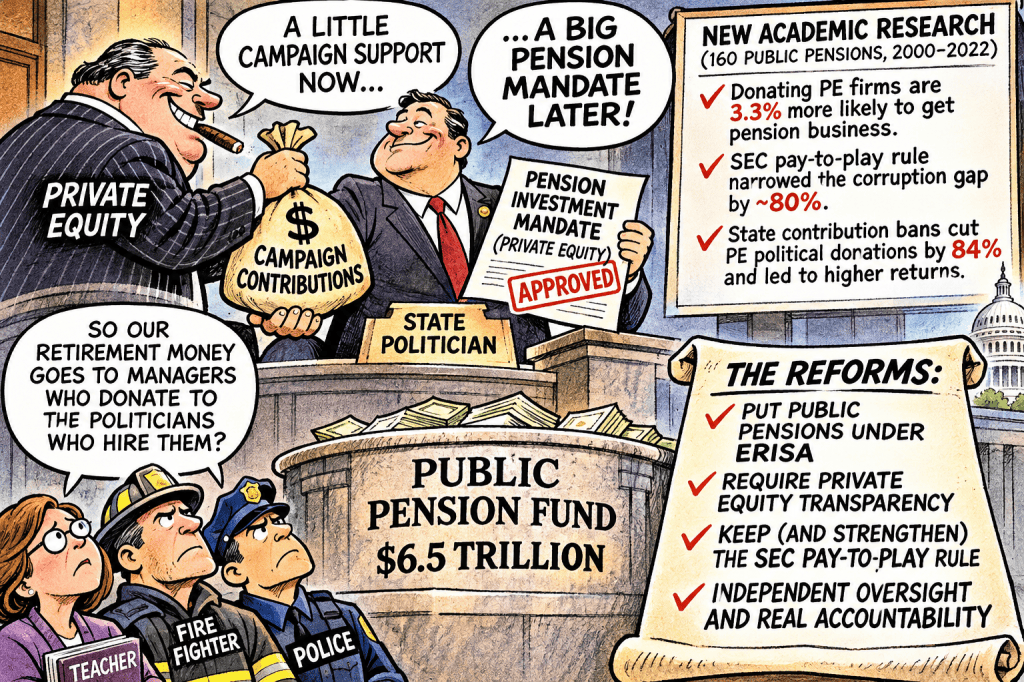
Study of 160 public pension plans strengthens the case for federal fiduciary protections, private equity transparency and independent pension oversight
By Chris Tobe, CFA, CAIA
For decades, public pension reform advocates have warned that political contributions, Wall Street influence, opaque private equity investments and weak fiduciary enforcement have created an environment ripe for abuse at the expense of public employees, retirees and taxpayers.
An outstanding new academic working paper provides some of the strongest empirical evidence supporting these concerns — and comes at precisely the right time.
Do Pay-to-Play Rules Protect Public Pension Funds? Evidence from Private Equity, by Jun Tu, Ziqi Wang and Jingshu Wen, examines whether political contributions distort the allocation of public pension assets to private equity managers and whether regulatory restrictions help prevent those distortions.
The authors are affiliated with Shanghai Jiao Tong University, Singapore Management University, the University of Maryland and the University of Oxford.
Their findings should be required reading for every public pension trustee, state attorney general, member of Congress and SEC commissioner.
They also provide important academic support for two federal legislative initiatives I have proposed:
- Bringing state and local public pension plans under federal ERISA fiduciary protections.
- Establishing comprehensive federal private equity transparency requirements for public pension plans.
2.25 Million Observations: This Is Not Just Anecdotal Evidence
The researchers examined:
- 160 public pension plans across 47 states.
- 2,698 private equity management firms in their matched sample.
- Approximately 2.25 million firm-state-year observations.
- Investment relationships and political contributions from 2000 through 2022.
- The effects of federal, state and local pay-to-play restrictions.
- The relationship between political contributions, manager selection and pension investment performance.
For those of us who have spent decades investigating public pension corruption, the importance of this research cannot be overstated.
We now have systematic academic evidence that extends well beyond individual scandals in California, Kentucky, New York and other states.
1. Political Contributions Are Associated With Private Equity Firms Getting Pension Business
The researchers found that private equity managers contributing to politicians in a state were 3.3 percentage points more likely to manage public pension assets in that state the following year.
That is an enormous association relative to the unconditional probability of just 0.6% in the matched sample.
When contributions over the preceding three years were examined jointly, the estimated coefficients totaled approximately 6.8 percentage points.
Even more revealing was who received the political contributions.
Contributions to candidates for offices with potential influence over pension investments were associated with subsequent pension business, including:
- Governors and lieutenant governors.
- State treasurers and comptrollers.
- Attorneys general.
- Secretaries of state.
- Other state and local officials, including pension board members.
Contributions to federal candidates in the same state, by contrast, had no statistically detectable association with subsequent pension business.
This distinction is particularly important. It suggests that the relationship is not simply a reflection of the political ideology of private equity executives. It is consistent with political giving being directed toward officials who can influence the allocation of pension assets.
In my opinion this study only captures the tip of the iceberg as I believe that since Citizens United, the vast majority of Private Equity donations to state officials are via Dark Money vehicles that these researchers do not have access to.
2. The SEC Pay-to-Play Rule Appears to Work — So Why Eliminate It?
In September 2026, I submitted a comment opposing the SEC’s proposed repeal of its investment adviser pay-to-play rule.
My SEC Comment Opposing Repeal of the Pay-to-Play Rule for Public Pensions
SEC Rule 206(4)-5, adopted in 2010, generally prohibits covered investment advisers from receiving compensation for advisory services to a government client for two years following certain political contributions.
The new academic research provides powerful evidence that this rule has served an important purpose.
Before implementation of the rule, the difference in the contribution-business relationship between states classified as having higher and lower levels of corruption was approximately 8.4 percentage points.
After implementation, that difference declined to approximately 1.4 percentage points.
The estimated gap narrowed by approximately 80%.
The researchers also found that state and local laws restricting political contributions by government contractors were followed by:
- An estimated 84% reduction in reported private equity political contributions under contribution-ban laws.
- An estimated 77% reduction under a broader definition that included disclosure-based regimes.
- Higher pension investment returns.
- No statistically detectable change in the proportion of pension assets delegated to private equity managers.
The last finding is especially significant. Stronger anti-corruption protections need not prevent pension plans from investing in private equity. They may instead help ensure that investment managers are selected on merit rather than political influence.
The SEC should be strengthening these protections, not dismantling them. These rules but a damper on blatant pay to play even though I believe it first shifted to placement agents but then Citizens United created dark money avenues.
3. The SEC’s $416 Million Cost-Savings Argument Is Particularly Weak
One of the most compelling calculations in the paper concerns the SEC’s projected annual savings from eliminating the pay-to-play rule.
The SEC estimates approximately $416 million in annual savings, primarily from reduced compliance costs.
The authors compare that figure with approximately $6.51 trillion in funded state and local defined-benefit pension assets.
An improvement in annual pension investment returns of just 0.64 basis points across those assets would equal the SEC’s entire projected annual savings.
Consider the following illustrative calculations:
| Annual improvement in pension returns | Value across $6.51 trillion |
| 0.64 basis points | $417 million |
| 1 basis point | $651 million |
| 5 basis points | $3.26 billion |
| 10 basis points | $6.51 billion |
| 25 basis points | $16.28 billion |
| 100 basis points | $65.10 billion |
These are illustrative calculations, not estimates of actual losses caused by pay-to-play.
Nevertheless, they demonstrate how little improvement in investment performance would be necessary to justify the regulatory costs.
Moreover, compliance savings enjoyed by Wall Street investment advisers are not necessarily passed through to pension beneficiaries.
The SEC needs to consider who receives the benefits of deregulation and who bears the potential costs.
4. Private Equity Managers Benefit — Pension Beneficiaries May Not
The paper also examines the economic incentives behind political contributions.
Obtaining a major public pension mandate provides a private equity firm with much more than management fees on a single investment.
A large public pension investor can provide credibility, attract other institutional investors, facilitate future fundraising and help the manager expand its assets under management.
The researchers found that greater public pension exposure was associated with subsequent growth in private equity firms’ assets under management and their number of active funds.
However, the investment benefits of delegating pension assets to private equity managers weakened as political contributions increased.
The paper finds similar adverse relationships in reported private equity investment returns.
This is the fundamental fiduciary problem: what is good for a private equity manager’s business may not be good for pension beneficiaries.
Interestingly, the researchers did not find a statistically significant relationship between larger political donations and higher reported fee ratios among existing pension managers.
That does not eliminate concerns about excessive private equity fees. Rather, it suggests that the economic rewards of political influence may come primarily through access to pension capital, rather than through charging higher reported fees on individual mandates.
It also raises the question of whether the fees disclosed in public pension financial reports adequately capture the total economic compensation received by private equity firms.
5. Political Pay-to-Play and the Pension Staff Bonus Machine
The academic research should also be considered alongside another serious governance problem: the extraordinary growth in public pension investment staff compensation.
As I recently documented:
Pension Staff Are Entering Football Coach Pay Territory While Helping Set Their Own Scoreboard
Public pension investment staff can have powerful incentives to expand private equity allocations and defend existing private equity relationships. Private Equity contracts are negotiated by staff in secret no-bid contracts.
Private equity investments can involve subjective valuations, delayed reporting, disputed benchmarks and considerable discretion in calculating investment performance.
When staff compensation is tied to those performance measurements, additional conflicts can emerge.
Consider the potential alignment of incentives:
- Politicians benefit from campaign contributions.
- Private equity managers benefit from investment mandates and management fees.
- Consultants benefit from maintaining lucrative advisory relationships.
- Pension investment staff may benefit from favorable performance measurements and bonuses.
- Pension beneficiaries and taxpayers bear the ultimate financial consequences of poor investment decisions.
The new paper does not directly investigate staff compensation or benchmark manipulation. But its findings concerning political influence and investment performance reinforce the need to investigate these additional conflicts.
My previous research on Ohio STRS illustrates why these issues deserve greater scrutiny:
New Academic Paper: Ohio STRS Had Two Performance Numbers and Used the Better One to Pay Bonuses
Ohio STRS Responds to Charges It Gamed Its Own Bonuses With More Games
The public deserves independent verification of the scoreboard before pension executives are rewarded for supposedly beating it.
6. The Apollo and Epstein Controversy: Why Pension Governance Matters
The longstanding relationship between major public pension plans and Apollo Global Management illustrates why pension trustees must examine the conduct, governance and conflicts of their external investment managers.
I have previously called for public pension plans to reconsider their Apollo investments in light of the documented financial relationship between Apollo co-founder Leon Black and Jeffrey Epstein.
The new academic paper is not an investigation of Apollo or Epstein and does not establish wrongdoing by any particular contemporary private equity manager.
What it does establish is a broader empirical basis for questioning whether public pension manager selection is sufficiently insulated from political and financial influence.
Public pension trustees should be able to demonstrate that decisions to hire, retain or terminate private equity managers are based on independently verified investment merits, costs, risks and fiduciary considerations.
7. Congress Should Bring Public Pensions Under ERISA
The new research provides substantial support for my proposal to extend federal ERISA fiduciary protections to state and local public pension plans.
Governmental pension plans are generally exempt from Title I of ERISA. Consequently, public employees depend primarily on a patchwork of state fiduciary laws, constitutional protections and enforcement mechanisms.
The new study demonstrates why that patchwork deserves reconsideration.
Political contributions were more strongly associated with pension business in states classified as having higher corruption levels.
Public employees should not receive weaker fiduciary protections simply because they happen to live in a state with weaker governance or enforcement.
Federal legislation should establish:
- A uniform fiduciary duty of loyalty and prudence.
- Federal prohibited-transaction protections against conflicted arrangements.
- Meaningful disclosure of direct and indirect compensation.
- Fiduciary accountability for investment consultants and other service providers exercising fiduciary authority.
- Participant and beneficiary rights to pursue appropriate legal remedies.
- Federal investigative and enforcement authority.
- Whistleblower protections.
The legislation could extend these fiduciary and enforcement protections without automatically transferring public pension liabilities to the federal government or placing all governmental plans under the PBGC insurance system.
Teachers, firefighters, police officers and other public employees deserve meaningful fiduciary protections comparable to those afforded private-sector workers.
8. The Case for a Federal Public Pension Private Equity Transparency Act
My second legislative proposal would establish comprehensive transparency requirements for private equity and other alternative investments held by state and local public pension plans.
The authors of the new paper had to manually collect investment manager identities, assets managed and reported fees from pension financial reports and match those records against commercial investment databases and campaign finance records.
That should not be necessary.
Congress should require standardized, publicly accessible reporting that allows pension beneficiaries, regulators, journalists and academic researchers to evaluate these relationships.
The legislation should require disclosure of:
Political and financial conflicts
- Political contributions by investment managers, covered executives, affiliates and relevant intermediaries.
- Political action committee contributions and legally reportable independent political expenditures.
- Placement-agent arrangements and compensation.
- Relationships between investment managers, consultants, trustees and elected officials.
- Material lobbying expenditures and other relevant political financial relationships.
Private equity fees and expenses
- Management fees and carried interest.
- Portfolio company fees and expenses.
- Fund-of-funds and intermediary compensation.
- Fee offsets and related-party transactions.
- Total investment costs in dollars and as a percentage of assets.
Investment valuations and performance
- Fund-level performance and cash flows.
- Valuation methodologies and independent valuation reviews.
- Public market equivalent performance comparisons.
- Appropriate vintage-year and strategy benchmarks.
- Liquidity restrictions and estimated secondary-market exit values.
- Reconciliation of investment performance used to calculate staff bonuses with independently verified performance.
As I previously discussed in:
Compliance with reporting standards is not a substitute for independent verification of the economic value and actual performance of pension investments.
Political influence is considerably more difficult to identify when investment costs, valuations and performance are themselves difficult to verify.
9. Independent Oversight — Not Just More Investment Staff Power
Another important finding of the new study is that the relationship between political contributions and pension mandates was substantially weaker among plans with separate investment boards.
In one specification, the estimated relationship was approximately zero for those plans.
This supports governance arrangements that reduce direct political discretion over investment decisions.
However, simply transferring power from elected officials to highly compensated investment executives is not necessarily the answer.
An investment board can itself become captured by Wall Street, consultants or senior investment staff.
Independent governance must be accompanied by independent oversight.
That is why I have also proposed independent inspector general oversight for CalPERS and stronger investigative mechanisms for public pensions generally.
An effective oversight structure should have access to investment contracts, fee arrangements, valuation records, political conflict disclosures and staff compensation calculations.
It must also have the independence and authority to investigate the people who control the pension system’s investment decisions.
10. A Growing Body of Academic Research
The new paper builds on several important studies examining political influence over public pension investments.
Among the most relevant are:
- Andonov, Hochberg and Rauh (2018), Political Representation and Governance: Evidence from the Investment Decisions of Public Pension Funds, which examines political representation on pension boards and private equity investment performance.
- Hochberg and Rauh (2013), Local Overweighting and Underperformance: Evidence from Limited Partner Private Equity Investments.
- Beggs and Harvison (2021), examining political contributions and government investment advisory business.
The authors also identify more recent research linking political connections to private equity commitments and examining how the SEC’s pay-to-play rule affected access to pension capital and investment performance.
This growing academic literature makes it increasingly difficult to dismiss concerns about public pension political conflicts as isolated scandals or the complaints of a handful of pension activists.
The evidence deserves a serious legislative response.
Conclusion: Follow the Money — And Protect the Pensions
The new study by Tu, Wang and Wen should be submitted to the SEC in opposition to the proposed repeal of its pay-to-play rule.
It should also be distributed to congressional committees responsible for pension policy, securities regulation and public corruption.
The authors appropriately acknowledge limitations in their research. Their estimates do not directly establish the precise investment return benefit of the federal SEC rule, and state-level regulatory changes may coincide with other governance reforms.
Nevertheless, the cumulative evidence is compelling.
Political contributions are associated with private equity firms’ access to public pension capital. The relationship is particularly pronounced where corruption is higher and political discretion is greater. Contribution restrictions appear to mitigate these problems, and political influence can weaken the investment benefits of external management.
For decades, public pension reform advocates have been demanding greater transparency, accountability and fiduciary enforcement.
Pension Fight Club Is Now Streaming — Meet the People Wall Street Wishes Would Stop Asking Questions
The academic research is increasingly validating those concerns.
Congress should extend federal fiduciary protections to public pensions, enact comprehensive private equity transparency legislation and strengthen protections against political conflicts.
The SEC should not be dismantling one of the few federal protections against public pension pay-to-play at the very moment academic researchers are demonstrating why those protections matter.
Public pension assets belong to public employees and retirees. They should never become a source of political patronage or a vehicle for enriching politically connected Wall Street firms.
Primary academic reference: Jun Tu, Ziqi Wang and Jingshu Wen, Do Pay-to-Play Rules Protect Public Pension Funds? Evidence from Private Equity (2026), SSRN working paper

